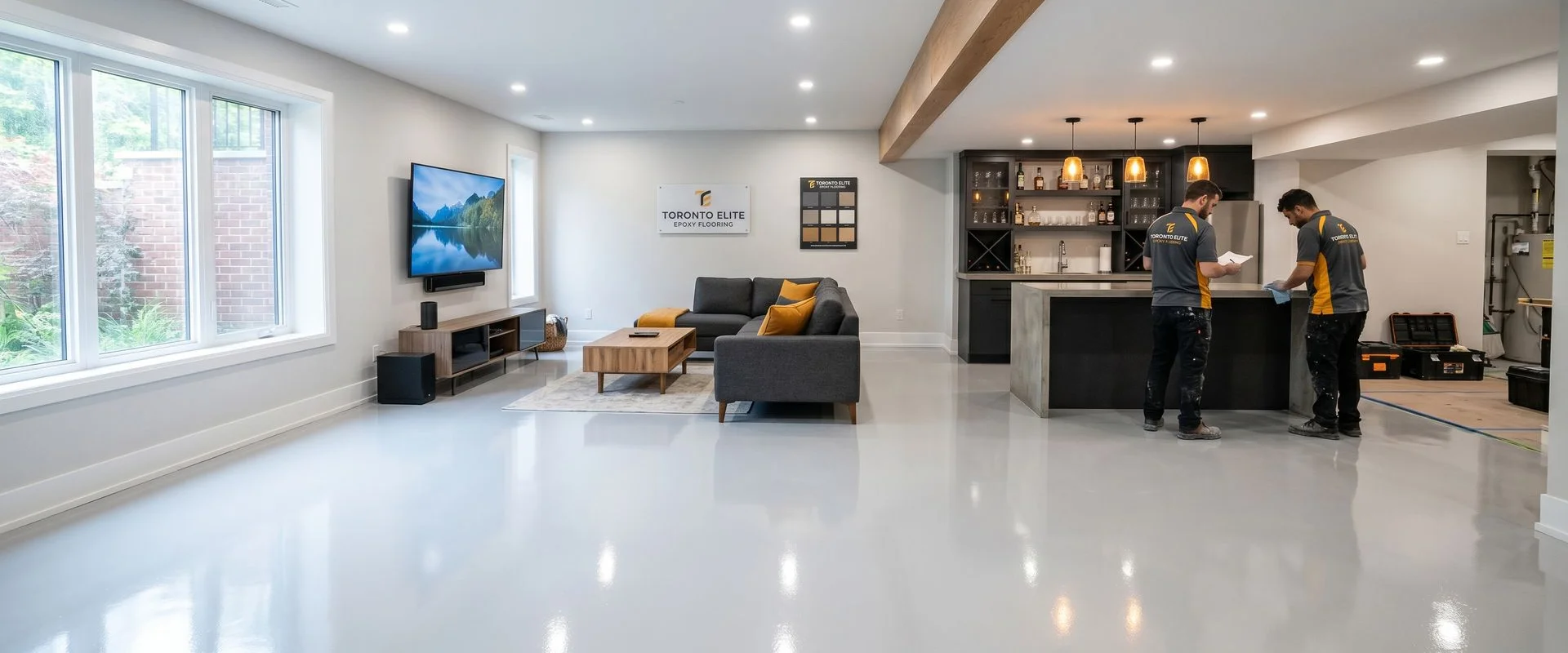
Basement Epoxy Flooring in Mississauga, ON - Moisture-Tested Floors That Stay Dry
Toronto Elite Epoxy Flooring - Mississauga installs moisture-tested epoxy systems for basements, home gyms, rec rooms, laundry rooms, and below-grade commercial spaces. Every basement starts with ASTM F2170 in-slab moisture testing, then a moisture-tolerant primer or full vapour barrier where readings call for it, then a decorative or solid-colour finish built for below-grade humidity.
Basements in Mississauga deal with moisture that above-grade floors never see. Much of the city sits on clay-rich till that holds water through spring, and many sub-grade townhomes in Erin Mills and Churchill Meadows sit under hydrostatic pressure from the surrounding soil. Older foundations in Port Credit and Cooksville were often poured without a polyethylene barrier. In-slab readings of 80-95% relative humidity are common, which is well above the roughly 75% limit where standard epoxy starts to lose its bond.
A 600-900 sq ft basement typically takes 1-2 days of active work, plus the 72-hour moisture test beforehand. Pricing runs $4.50 to $10 per sq ft depending on moisture mitigation, finish, and any cove base. Every price is confirmed in a fixed-price contract after testing.
Why Basement Floors in Mississauga Are Tricky
Most basement floor problems start with moisture you can’t see. Water vapour moves up through the concrete all the time. If a coating goes down without testing for it, that pressure pushes the floor up from below, and you end up with bubbles and peeling that look worse than bare concrete within a few years.
Tile, laminate, and vinyl plank have the same weakness. Grout lines soak up moisture and grow mould, and floating floors swell and buckle when the humidity climbs. A basement epoxy system with ASTM F2170 testing and a vapour barrier deals with the moisture where it starts. As a full-service epoxy flooring contractor, we test every basement slab before the first coat. Many homeowners then finish with a decorative metallic finish for a high-end rec room.
What is Basement Epoxy Flooring?
Basement epoxy is a seamless coating system made for below-grade concrete, where vapour drive is the main reason cheap floors fail. Vapour drive is moisture pushing up through the slab. Our system begins with ASTM F2170 relative humidity testing. Based on those readings, we install either a moisture mitigation primer or a full vapour barrier.
Once the slab is sealed, a 100% solids, zero-VOC epoxy base goes down in your chosen colour, running continuously to the walls and around plumbing and posts. A clear topcoat then protects against everyday wear, pet claws, and rec room traffic.
You end up with one continuous surface: no grout lines to hold mould and no carpet to stay damp. It’s pet-friendly, easy to clean, and built to last in a basement that would otherwise fight moisture every spring.
What Every Basement Epoxy Install Includes
Every basement project includes:
- On-site assessment within one business week, with sample boards
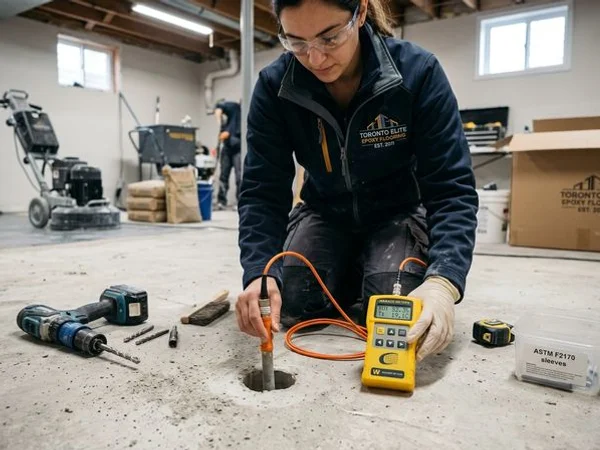
- 72-hour ASTM F2170 moisture vapour testing
- Diamond grinding and crack repair as needed
- Moisture mitigation primer or vapour barrier when readings require it
- 100% solids, zero-VOC epoxy base coat in your chosen colour
- Optional flake broadcast or 3D metallic layering
- Clear protective topcoat for cleaning and traffic
- Careful work around plumbing, columns, and stair edges
- A written warranty
Is Epoxy Good for Damp Basements? Moisture and Vapour
Below-grade conditions in Mississauga and the rest of Peel Region are tougher than most homeowners expect. Much of the area sits on dense glacial clay till, with shale bedrock closer to the Credit River valley. That clay holds water from the spring thaw, roughly March through May, and moisture moves sideways and upward into the slab. Homes built before the 1980s often have slabs poured straight onto the ground with no plastic vapour barrier. Vapour emissions on those slabs can top 15 lbs per 1,000 sq ft per 24 hours on a bad day, far above the 3 lb level where most standard epoxies start to fail.
Newer homes have their own problem. Many townhouse developments in Erin Mills and Churchill Meadows have deep sub-grade basements that sit below the surrounding water table for part of the year, and hydrostatic pressure keeps the slab damp even with a vapour barrier underneath.
A properly specified system handles vapour at two levels. First, a moisture mitigation primer, usually a two-component polyurea or moisture-tolerant epoxy, bonds chemically to damp concrete and forms a low-permeance layer. Second, a 100% solids epoxy base coat at a minimum 8 mils dry film thickness adds a physical vapour retarder on top. Together, they cut vapour transmission below the level that causes blistering or peeling.
Slabs in older Mississauga homes often read between 80% and 95% RH on an F2170 probe in spring. Above 75% RH, standard epoxy without mitigation typically fails within two to three years. Above 90% RH, a standard primer may not be enough, and a full reactive polyurea vapour barrier is needed first. That’s why the 72-hour probe test isn’t optional. It tells us what the slab actually needs.
Why Moisture Vapour Testing (ASTM F2170) Matters Before Install
ASTM F2170 is the current standard for measuring relative humidity inside a concrete slab. The older calcium chloride test (ASTM F1869) only measures what comes off the surface. F2170 probes go into holes drilled 40% of the way through the slab and stay sealed for at least 72 hours. That captures the moisture condition inside the concrete, which is the number that predicts how much vapour will push against a sealed coating.
That difference matters a lot here. A slab that passes a surface test in January can read 88% RH on an F2170 probe in April, after snowmelt has soaked the surrounding soil. Contractors who skip the wait or rely on the surface test often approve slabs that are too wet to coat. The failure tends to show up 12-24 months later, after the first summer pushes vapour pressure to its peak. Many homeowners who call us to redo a failed floor tell us the previous installer never drilled a single test hole.
The written test record also matters for the warranty. A documented reading before installation gives you and us a baseline if a question ever comes up later. Your results go into the project file and stay available if you sell the house or refinish the floor.
Is Basement Epoxy Pet-Friendly and Safe to Walk On?
Yes, once it’s cured. How soon depends on the system. A 100% solids epoxy base is safe for foot traffic and pets within 12-18 hours at 20°C. The aliphatic polyurea topcoat we use on basements reaches full hardness in 4-6 hours at room temperature. In practice, a basement coated Tuesday morning is usually walkable Tuesday evening.
Zero-VOC matters more below grade. Basements get less fresh air than the rest of the house, and solvent-based epoxies release VOCs while they cure. A 100% solids system has no solvent to release, which is why it’s appropriate for occupied homes with kids and pets. Once cured, the surface is inert and non-porous, so pet dander, bacteria, and allergens have nothing to cling to.
For homes with big dogs, the topcoat matters. Aliphatic polyurea rates above 80 on the Shore D scale, much harder than a clear epoxy topcoat. That makes a real difference in a busy family rec room with dogs, toys, and rolling chairs. We use it as the standard topcoat on every basement rather than charging extra for it.
Best Basement Floor Finishes Compared: Epoxy vs Vinyl vs Tile
Luxury vinyl plank is the most common alternative homeowners consider. It floats on the slab rather than bonding to it, which leaves an air gap where vapour keeps acting on the underside of the planks. In a basement with surface RH above 60%, the joints tend to swell over time, especially along exterior walls that sit against wet soil. Many vinyl manufacturers also void their warranty above a certain moisture emission rate, and older basements here often exceed it.
Ceramic or porcelain tile set in polymer-modified thin-set is more rigid than vinyl, but the grout is still the weak spot. Grout is porous, so in a consistently damp space it absorbs vapour and grows mould. Epoxy grout helps but adds cost and complexity, bringing installed tile to $12-$18 per sq ft. A full basement epoxy system runs $4.50-$10.
Polished concrete is worth mentioning too. A Class B grind and polish gives a low-maintenance surface, but polishing doesn’t add any vapour barrier. Over a high-RH slab it will eventually show efflorescence, white mineral deposits carried up by moisture. Epoxy with moisture mitigation is the only common basement floor that deals with vapour drive head-on.
Basement Epoxy Flooring Cost per Sq Ft
Pricing depends mostly on system complexity and slab condition. A standard system, with a moisture mitigation primer, solid-colour 100% solids epoxy base, and clear polyaspartic topcoat, runs $4.50-$6.00 per sq ft installed. That covers slabs reading under 75% RH, which only need the primer.
Slabs above 75% RH need a reactive polyurea vapour barrier underneath the decorative system. That adds $0.75-$1.25 per sq ft, depending on the product and the measured emission rate. For many older or sub-grade basements tested in spring, the working total ends up between $5.25 and $7.25 per sq ft.
Decorative finishes move pricing into the $7-$10 range. Full-flake broadcast, where colour chips cover the whole floor before the topcoat, adds texture and depth and is the most popular choice for home gyms. Metallic systems using a pigmented aliphatic polyurea, in colours like Gunmetal, Copper, or Pearl White, run $8.50-$10 per sq ft. Substrate repairs such as routing and filling cracks or grinding down high spots are priced at the assessment and usually add $0.50-$2.00 per sq ft on slabs in poor shape.
Epoxy vs Waterproofing: What a Wet Basement Actually Needs
Basement epoxy and basement waterproofing solve different problems, and mixing them up is one of the most common renovation mistakes. Epoxy handles vapour drive, which is moisture vapour moving up through a structurally sound slab. Interior waterproofing, like a weeping tile and sump pump, handles hydrostatic pressure, meaning groundwater pushing against the foundation walls or under the slab.
If water is actually coming in through wall cracks, window wells, or the floor-wall joint, that has to be fixed before any coating goes down. Epoxy over active leaks will peel within months. A good contractor spots active leaks at the assessment and recommends the right fix, usually an interior drainage system or exterior membrane repair, before talking about floors.
For basements with no active water but high vapour readings, which describes most older homes we see, epoxy over a reactive polyurea vapour barrier is the right fix. The polyurea bonds to the concrete and forms a low-permeance membrane that holds vapour back without needing to drain anything. That’s a different job from a sump pump, and it’s what most basements actually need. Diagnosing which problem you have comes before recommending any product.
Related Questions Homeowners Ask
How much does basement epoxy cost for a 1,000 sq ft basement?
A 1,000 sq ft basement with a moisture primer and solid-colour epoxy runs about $4,500-$6,000 installed. If the slab tests above 75% RH, add $750-$1,250 for the vapour barrier. Flake or metallic finishes bring the same basement to $7,000-$10,000.
How long does basement epoxy take from start to finish?
Usually 5-7 days in total. Most of that is the 72-hour moisture test. Prep and coating take one to two days for a typical basement. The floor is walkable 12-18 hours after the final coat and ready for furniture and normal use in 48-72 hours.
Will basement epoxy crack if the slab moves?
All slabs settle a little and move with temperature through the year. A 100% solids epoxy isn’t very flexible, so a crack that opens after installation will show through. On slabs with moving cracks, we route them and fill them with semi-rigid polyurea before coating, which absorbs small future movement. Cracks wider than 3 mm, or with one side higher than the other, point to a structural issue that needs to be looked at before flooring goes in.
Can basement epoxy be installed in winter?
Yes, as long as the space is warm enough. Both the concrete and the epoxy need at least 10°C to bond and cure properly, and an unheated basement in January can be colder than that. We ask that the space be heated to at least 15°C for 48 hours before prep and kept there through the cure. Most lived-in homes already are. Vacant or unfinished basements may need temporary heaters, which changes the logistics but not the system.
What is the lifespan of a basement epoxy floor?
A basement system installed over a tested slab with the right vapour mitigation should last 15-20 years or more in normal home use. High-traffic areas of the topcoat may wear first. A fresh topcoat, usually $1.50-$2.50 per sq ft, renews the surface without replacing the whole system. The shortest-lived floors we see are the ones installed without moisture testing, which often peel within three years. How long a basement floor lasts depends far more on prep than on the brand of coating.
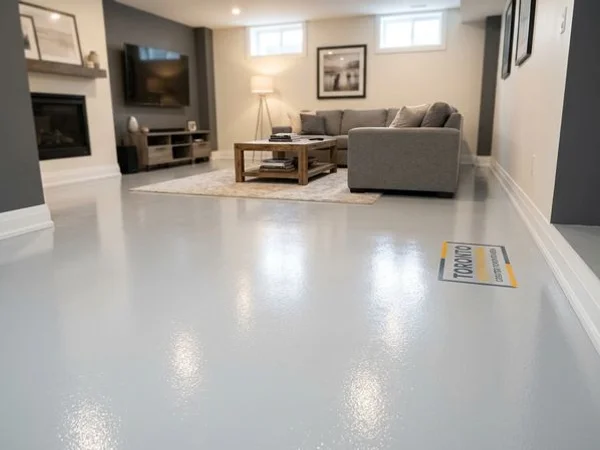
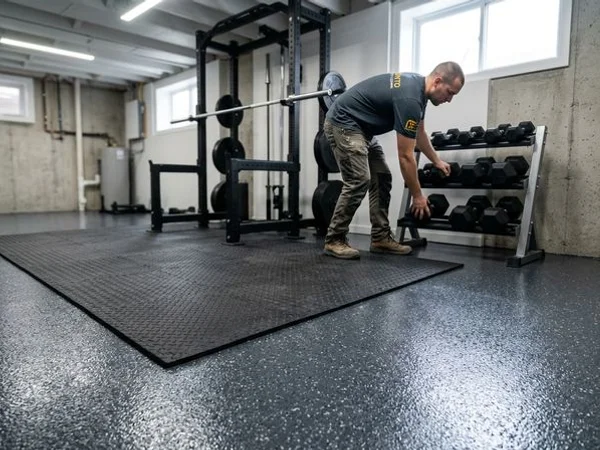
Our Basement Epoxy Results in Toronto
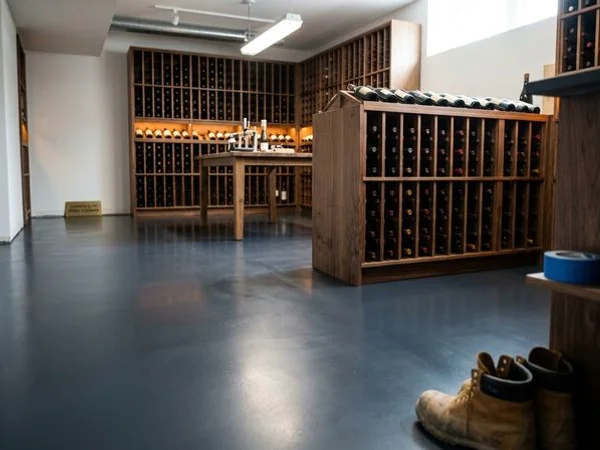
Basement Epoxy Pricing
Includes ASTM F2170 moisture testing, vapour barrier where needed, and continuous finish.
Why GTA Customers Choose Toronto Elite Epoxy Flooring - Mississauga for Basement Epoxy
Moisture-Tested First
Vapour coming up through the slab is the top cause of failed basement floors. We test before we coat, every time.
Zero-VOC, Pet-Safe
Living-space safe materials with no harsh fumes. Safe for kids and pets once cured.
Continuous Finish
No tile joints to harbour mould or hold water. Easier to clean and visually open.
Warranty
Backed in writing because our own crew controls the prep and the material.
How Basement Epoxy Works
Moisture Vapour Testing
ASTM F2170 relative-humidity probes go in your slab for 72 hours so we know exactly what mitigation is required.
Prep & Vapour Barrier
Diamond grind, crack repair, and a moisture mitigation primer or vapour barrier where the test results call for it.
Continuous Base Coat
100% solid zero-VOC epoxy base in your chosen colour, applied continuously to the slab edges and around obstructions.
Clear Protective Topcoat
Clear topcoat sealed for easy cleaning, pet claws, and rec-room traffic. Ready for furniture in 24-48 hours.
Ready for a Free On-Site Assessment?
Same-day quotes across the GTA. WSIB-certified, $2M liability on every project.
What Customers Say About Our Basement Epoxy
"Our Erin Mills townhouse basement tested at 89% RH. They put down a polyurea vapour barrier first, then a light grey epoxy. Two spring thaws later it's completely dry."
"Home gym floor in our Meadowvale basement. Dark flake, easy to wipe down, and it handles dropped weights and rubber mats without a scratch."
"Older Port Credit house with a basement that always smelled musty. They tested, sealed, and coated it, and the whole lower level feels different now."
Basement Epoxy FAQs
What does basement epoxy flooring cost in Mississauga?
A standard system with a moisture primer and solid-colour epoxy runs $4.50-$6 per sq ft. Slabs that test above 75% RH need a full vapour barrier, which adds $0.75-$1.25 per sq ft. Flake or metallic finishes bring the total to $7-$10 per sq ft. For a typical 700 sq ft basement, that works out to roughly $3,150-$7,000, confirmed as a fixed price after testing.
Our Churchill Meadows townhouse basement feels damp. Can it still get epoxy?
In most cases, yes. Sub-grade townhome basements often have moisture moving up through the slab even when there's no visible water. That's exactly what the 72-hour F2170 test measures. If the readings are high, we install a reactive polyurea vapour barrier before the epoxy. If you have water actually coming in through cracks or the floor-wall joint, that needs a waterproofing fix first, and we'll tell you.
Is basement epoxy safe for kids and pets?
Yes. We use 100% solids, zero-VOC materials that are safe in living spaces once cured. The seamless surface has no grout lines to trap bacteria, and the hard topcoat stands up well to dog claws.
How long will the whole project take?
Plan on about a week from start to finish. Most of that is the 72-hour moisture test, during which nothing happens in the space. Active grinding and coating takes one to two days, and you can walk on the floor that evening.
Is epoxy better than vinyl plank for a basement?
In a damp basement, usually yes. Vinyl plank floats on top of the slab, so moisture can still collect underneath and cause swelling and buckling at the joints. Epoxy bonds to the concrete and seals vapour at the slab itself.
Epoxy flooring, metallic coatings & polyaspartic
across the Greater Toronto Area
Same crew, same materials, same written warranty on every job. Browse by service and city — or call us direct.
Don't see your city? View our full service area →
Related Services
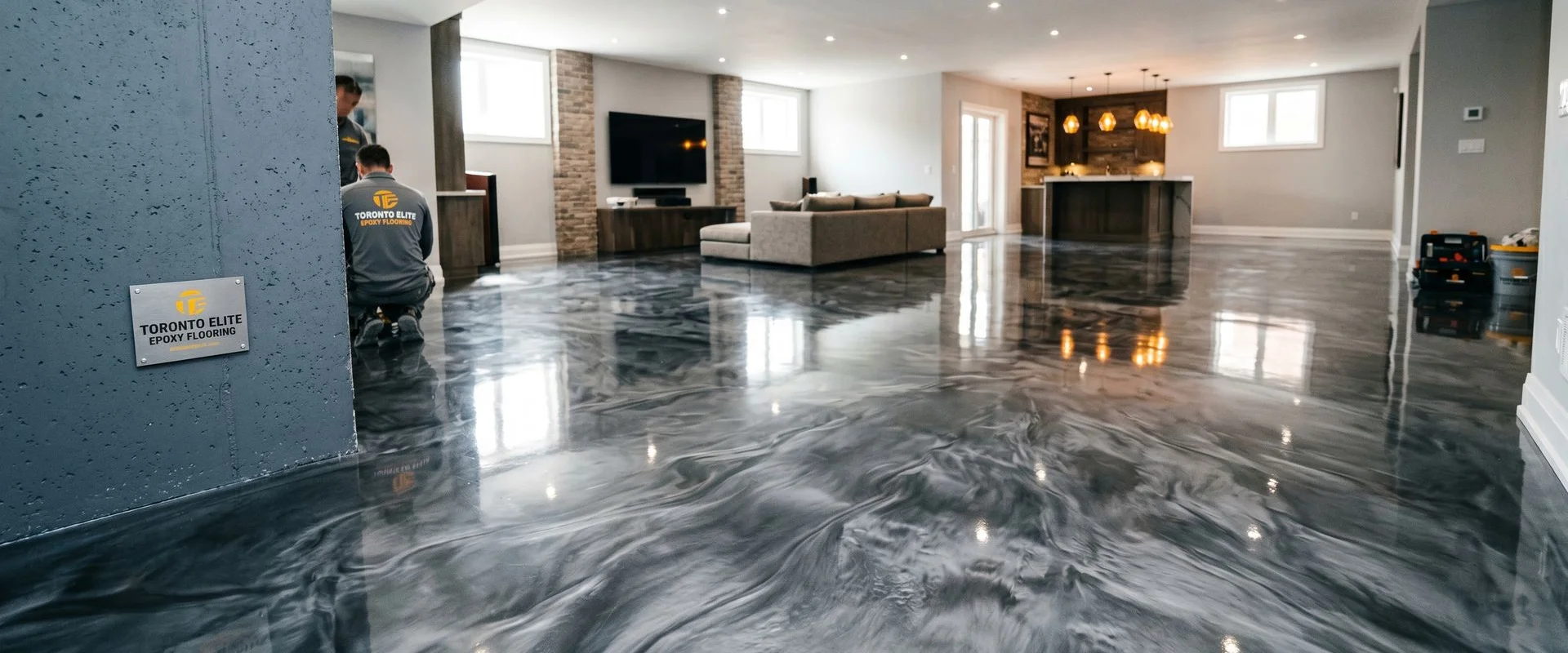
Decorative Metallic Epoxy Flooring in Mississauga, ON
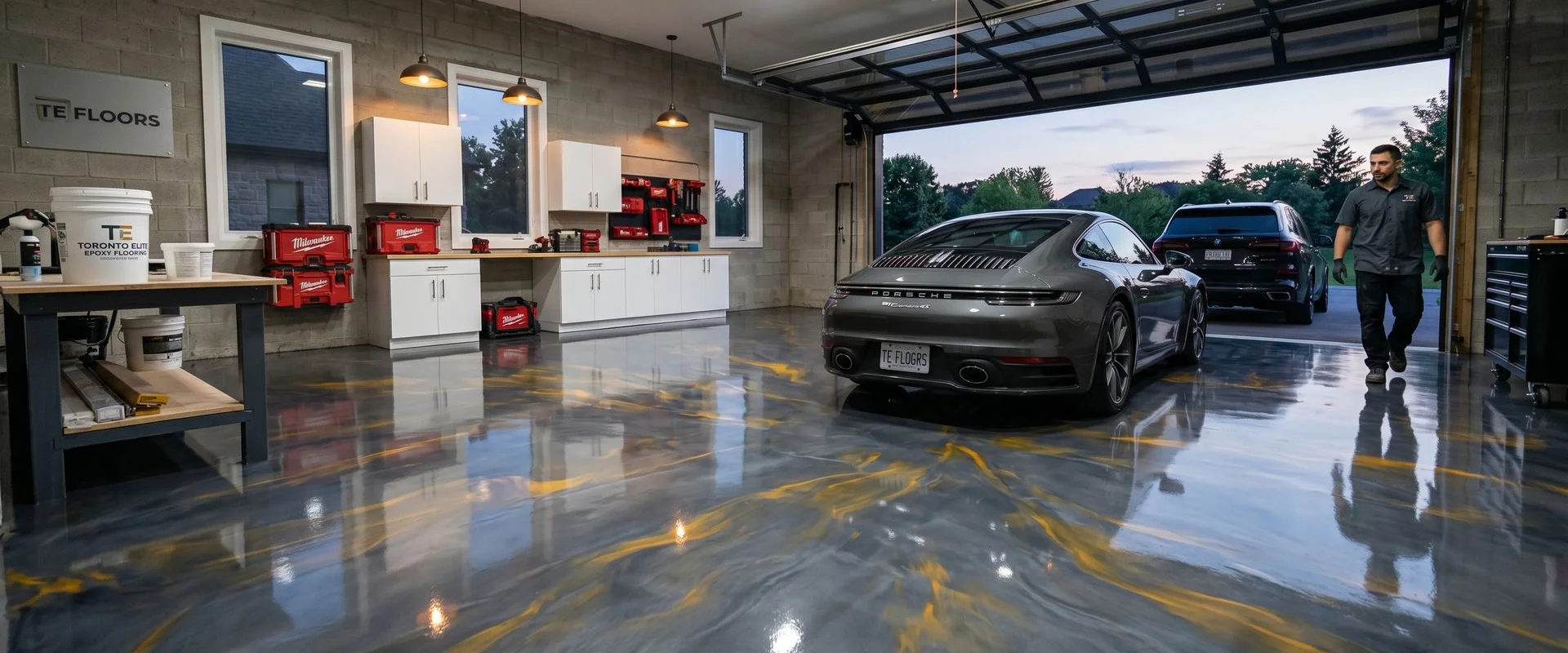
Decorative metallic epoxy in Mississauga, with hand-manipulated pigments that give each floor its own 3D liquid-art look. A UV-stable polyaspartic topcoat keeps the colour true under sun and LED lighting. $9-$16 per sq ft installed, with most 500 sq ft basements or showrooms done in 2-3 days.
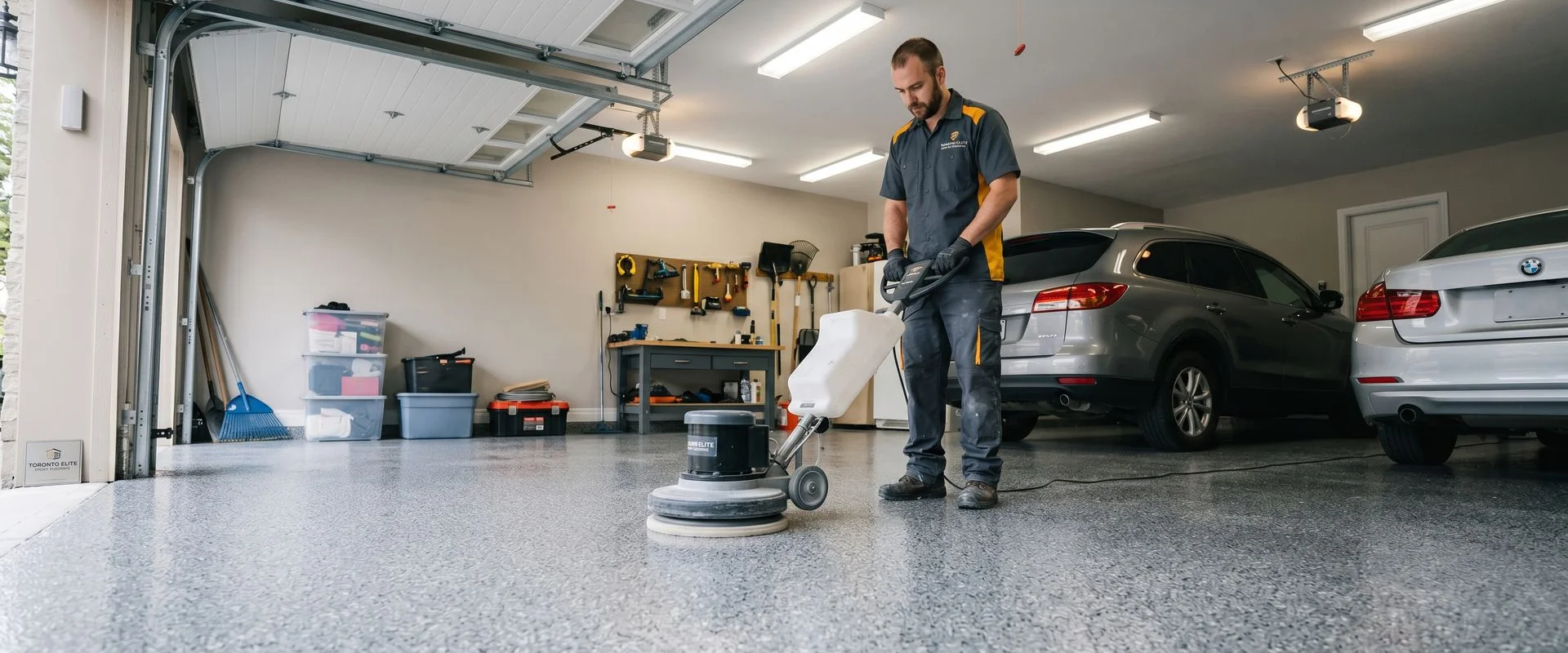
Garage Floor Epoxy in Mississauga, ON
Garage floor epoxy in Mississauga, built for highway brine and freeze-thaw. Diamond-ground to CSP 3, moisture-tested, then a 100% solids epoxy base, quartz or flake broadcast, and a UV-stable polyaspartic topcoat that resists road salt and hot tire pickup. A typical two-car garage runs $2,900-$4,500 installed in 1-2 days.
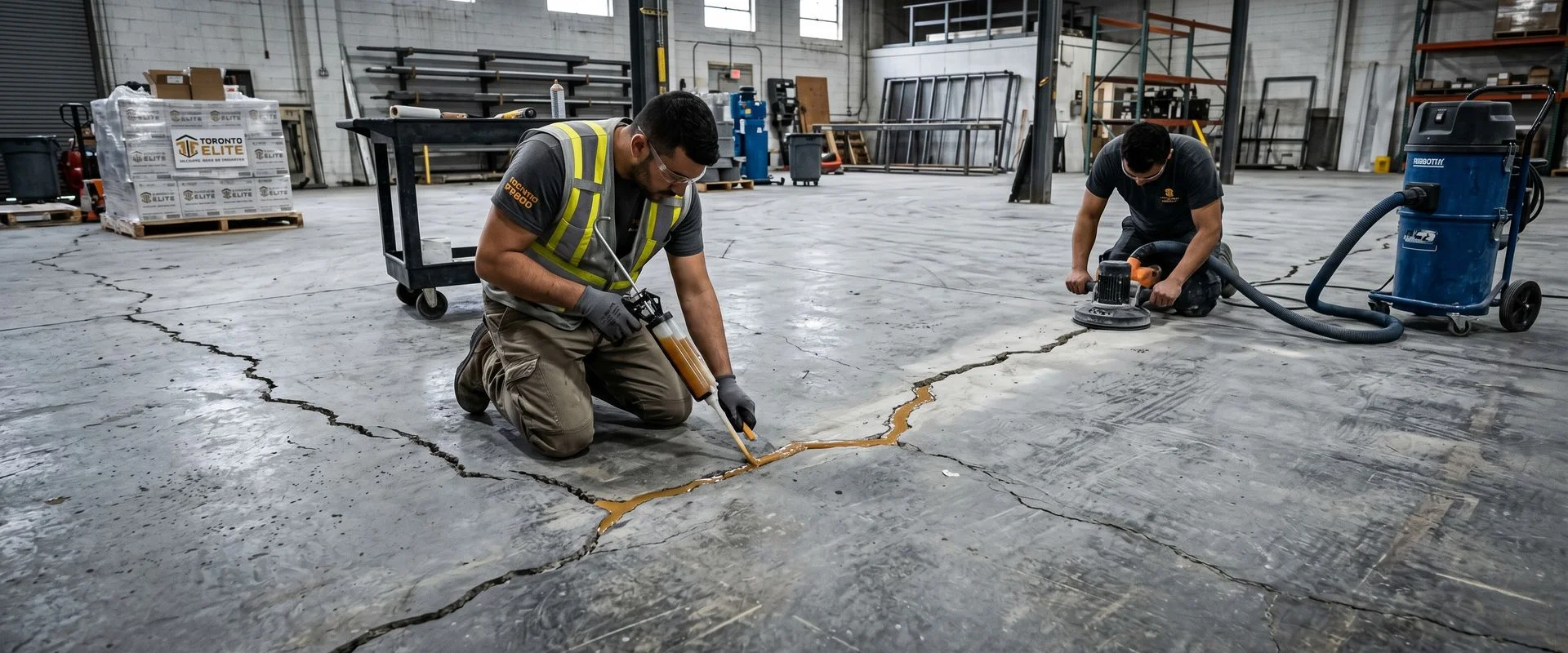
Concrete Repair & Restoration in Mississauga, ON
Concrete repair in Mississauga using carbon fibre crack stitching, polyurea injection, spall patching, and self-levelling underlayment to bring a slab back to a sound CSP 3 surface ready for coating. Crack repair starts at $8-$18 per linear foot and slab resurfacing from $3 per sq ft. Surface profile is confirmed before any coating goes down.
Ready to Book Basement Epoxy?
Same-day free on-site assessment. WSIB-certified, $2M liability on every project.