Concrete Repair & Restoration in Mississauga, ON - Crack Stitching, Spall Repair, and Slab Levelling
Toronto Elite Epoxy Flooring - Mississauga stitches cracks with carbon fibre staples, fills them with rapid-set polyurea, patches spalls with epoxy mortar, and pours self-levelling underlayment for homes and commercial buildings. Every assessment includes high-spot grinding, joint evaluation, and ASTM F2170 moisture testing so the slab is flat, sound, and dry enough for a lasting coating bond.
Repairs fail when the contractor patches the surface without checking the slab underneath. Vapour emissions above 3 lbs per 1,000 sq ft per 24 hours (ASTM F1869), or RH above 75% (ASTM F2170), break down cementitious patches within 12-18 months. Hairline cracks left alone grow through freeze-thaw. A 0.3 mm crack takes on water in fall, opens to 0.4 mm in January, and can pass 1 mm after five winters of movement and traffic. In slabs that carry cars or forklifts, cracks need carbon fibre stitching, not just filler.
Demand for slab repair is high in Mississauga because industrial vacancy is tight, around 2.6%, and owners are renovating older buildings rather than moving. Jobs range from 50 sq ft patches to full re-levelling of 5,000+ sq ft commercial floors, plus trench and joint repair. Pricing runs $3 to $12 per sq ft depending on crack density, spall depth, and moisture mitigation. Most residential repairs take one day, and larger commercial jobs run 2-3 days in phases.
What is Concrete Repair & Restoration?
A coating is only as good as the slab underneath it. Moving cracks, unpatched spalls, and uneven slabs are the most common reasons epoxy floors fail, and many contractors skip the repair work to keep their quote low.
We don’t. Every coating quote we write in Mississauga includes the substrate repair the slab actually needs, so the floor lasts the full warranty. That’s a big part of how we work as a full-service epoxy flooring contractor. Prep is never an afterthought. Concrete repair is also a stand-alone service for owners who want a slab restored without a coating, and it’s the first step in most epoxy floor repair and recoat jobs.
What’s Included
- Visual and hands-on damage assessment
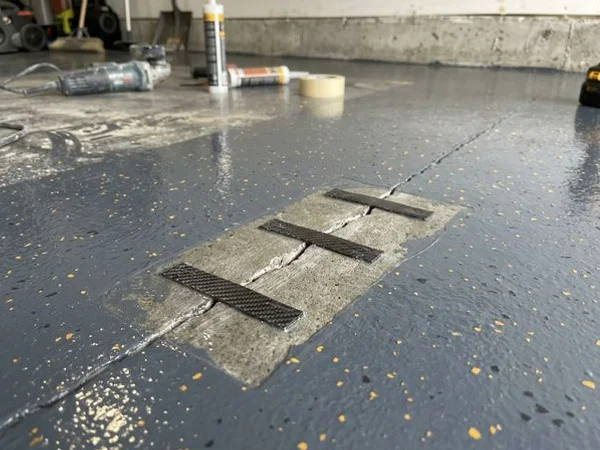
- Crack stitching with carbon fibre staples
- Rapid-set polyurea crack filling
- Epoxy mortar patches for spalls and broken corners
- Self-levelling underlayment for uneven slabs
- High-spot grinding and expansion joint detailing
- Final surface profile prep for coating
- Documented before and after records for the warranty
Fixing Cracked and Spalled Concrete Before Coating
Cracked and spalled concrete isn’t just a cosmetic issue. It directly threatens how well a coating bonds and how long it lasts. ASTM D4259 and the ICRI CSP scale define how rough a surface must be for a coating to grip. A spall or active crack breaks up that profile and creates a stress point where coatings lift within months. That’s especially true in unheated garages, where January slab temperatures can drop below -15°C and the coating shrinks at a different rate than the concrete.
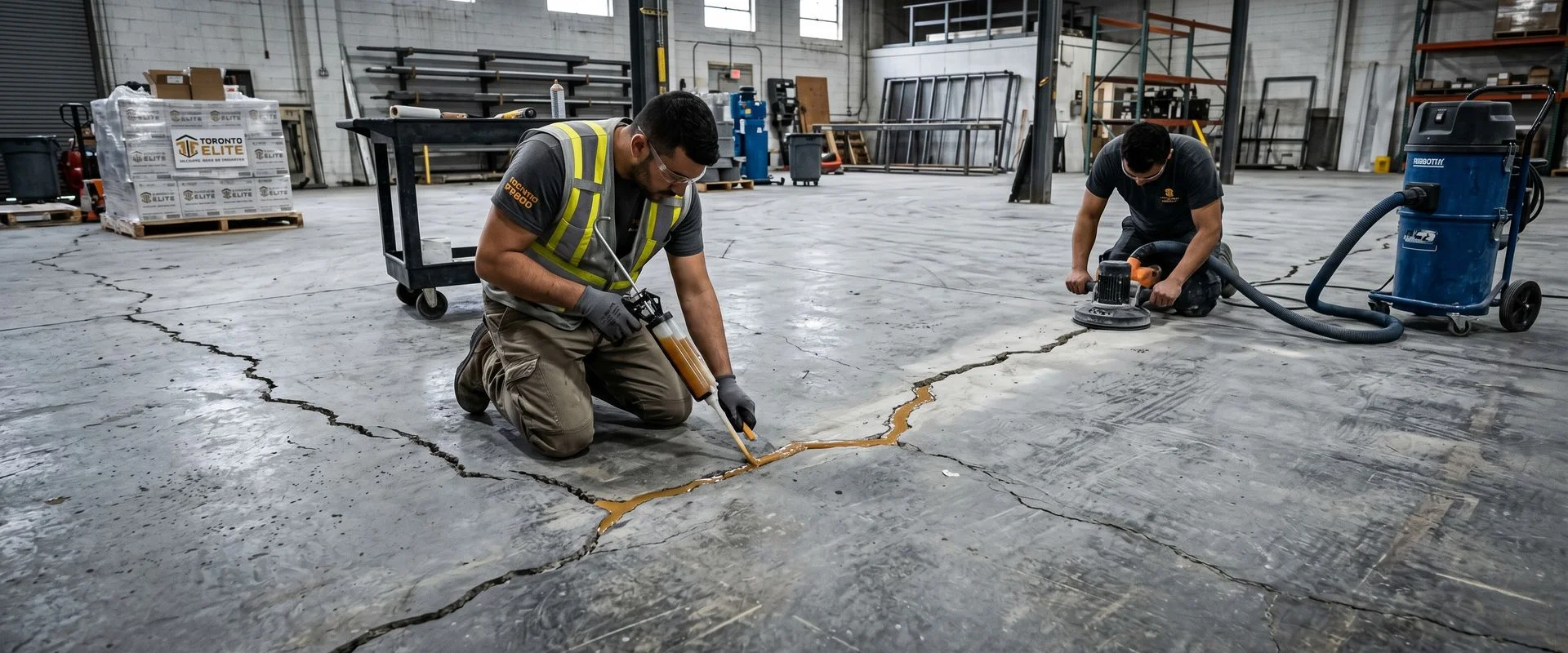
Repair starts by classifying each crack. Dormant hairline cracks under 1 mm are opened slightly with a crack-chaser blade and filled with rapid-set semi-rigid polyurea. Active cracks that move with the seasons need mechanical stitching, with carbon fibre staples set 6-10 inches apart across the crack, followed by flexible polyurea. The staple pattern follows ICRI Technical Guideline 310.3. Skip the staples and the crack reopens with the next thermal cycle. We’ve redone polyurea-only repairs by other installers after just one winter.
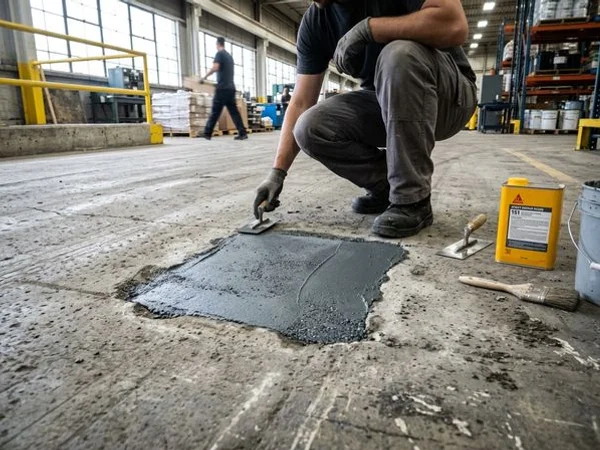
Spalls follow a different process. Hollow or delaminated areas are removed with a chisel or small rotary hammer, all the way back to sound concrete. Shallow spalls up to 25 mm are rebuilt with a two-part, near-100% solids epoxy mortar that bonds directly without a separate bonding agent. That’s the usual fix for the deep salt pitting we see in older garages in Clarkson and Applewood. Deeper structural spalls, common in older industrial buildings in Malton and the Dixie Road corridor, may need a polymer-modified cementitious mortar placed in lifts to avoid shrinkage cracks. Either way, the patch has to reach CSP 3-5 before primer or base coat goes on.
Spall repair on a 600 sq ft commercial floor typically runs $800-$2,200 depending on depth and total area. That’s small compared with stripping and recoating a failed floor two years later, which costs $4-$7 per sq ft on top of the original coating. Doing the substrate work right the first time is the only sensible option.
Self-Levelling and Substrate Repair: When Your Slab Needs It
Not every slab problem is a crack. Plenty of residential and light commercial floors in Mississauga, especially basement and shop slabs from the 1950s through the 1980s, are out of plane from settlement, heave, or uneven original finishing. The historic commercial buildings in Streetsville village often have slabs that are both irregular and aged. If a floor varies by 10 mm or more across a 3-metre straightedge, it isn’t ready for most flake or metallic systems, which show every surface irregularity.
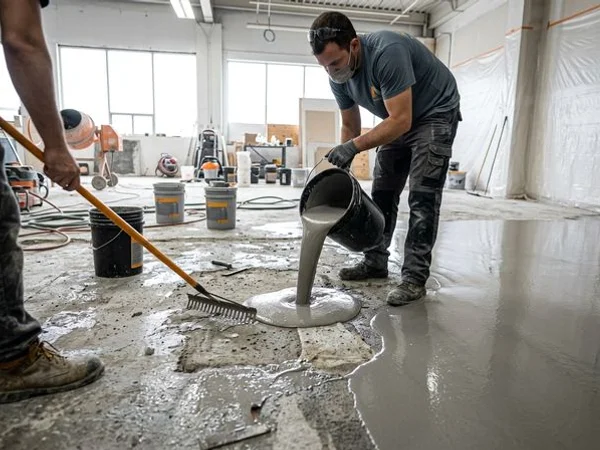
The standard fix is a cementitious self-levelling underlayment (SLU) poured to fill low spots and bring the slab into tolerance. A good SLU feathers to 1-2 mm and can build up to 50 mm in one pour, depending on the product. Polymer-modified SLUs typically reach 25-35 MPa compressive strength after 24 hours, in line with CSA A23.1 for normal-density concrete, which is strong enough for a full epoxy or polyaspartic system. The slab must be primed with a penetrating epoxy primer first. That secures the bond and stops the slab from pulling water out of the underlayment too fast, a common failure when crews skip the primer to save time.
High spots are the opposite problem. Exposed aggregate, trowel ridges, or areas heaved by tree roots need grinding with diamond cup wheels on a single-disc or planetary machine. Root heave is common on older walkways and garages in mature neighbourhoods like Mineola and Lorne Park. High spots over 5 mm usually take several passes, and very large humps may need scarifying. Grinding also opens the concrete from a closed CSP 1 to the CSP 2-3 profile a 100% solids primer needs.
Expansion joints need their own treatment. Filling them with rigid epoxy makes the coating crack right along the joint as the slab moves through the seasons. It’s one of the most common complaints we hear about previous coatings. The right approach is to honour the joint: clean it out, add backer rod if it’s deep, and fill it with flexible polyurea that stays pliable. The coating goes over the cured flexible fill instead of bridging a rigid gap, which prevents the dark crack line that reappears through otherwise intact floors. On a two-car garage, joint repair usually adds $150-$350, a small cost that heads off a big cosmetic problem.
Concrete Repair on Commercial and Industrial Floors
Commercial repair carries higher stakes in two ways. The floor is usually in use and can’t close for a week, and it carries far heavier loads than a home garage. Loading bays at distribution centres near Pearson see forklifts at 8,000-12,000 kg gross weight on hard polyurethane wheels that concentrate the load into a contact patch smaller than a boot heel. Any patch or crack fill that isn’t fully bonded will shatter within weeks.
For commercial slabs, we use a two-part epoxy mortar that cures to over 70 MPa compressive strength, well above the 25-35 MPa of standard ready-mix concrete, so the patch is never the weak point. Epoxy mortar also bonds without a cementitious slurry, which removes one possible failure layer. In food plants and commercial kitchens where hot water and steam cleaning happen daily, we use a novolac epoxy mortar rated for continuous chemical exposure, since standard bisphenol-A epoxy can soften under hot water and caustic cleaners. Trench drains and failed joints in older food and logistics buildings are rebuilt the same way.
Scheduling is a real constraint. Most logistics operators along Highway 401 can’t take a floor offline for days. We work in sections, isolating 20-30% of the floor at a time, repairing and priming it overnight, and returning it before closing the next zone. Rapid-set polyurea crack fill reaches full vehicle load in 30-60 minutes, so forklifts can be back on a repaired section before the crew moves on. Epoxy mortar patches need longer, typically 4-6 hours to foot traffic and 12-24 hours to forklift load, so we sequence sections around your shifts. You get a written sequencing plan before work starts, so your operations team knows exactly when each zone will be ready.
Related Questions Property Owners Ask
How do I know if my garage floor cracks need stitching or just filling?
Cracks wider than 3 mm, cracks where one side has shifted up or sideways, and cracks that have grown over one or more winters should be stitched before they’re filled. Hairline cracks under 1 mm in a stable slab can be filled with semi-rigid polyurea alone. If a contractor quotes fill-only without assessing the cracks, treat it as a red flag.
What does concrete spall repair cost?
Residential spall repair with two-part epoxy mortar runs about $12-$22 per sq ft of affected area, depending on depth and access. A two-car garage with moderate spalling across 15-20% of the slab might cost $600-$1,400 for the repair alone, before any coating. Commercial floors with widespread spalling are priced per project after an assessment.
Can self-levelling underlayment fix a sloped garage floor?
Self-levelling underlayment corrects low spots, waves, and minor settlement, but it isn’t designed to add or change slope. If you want to change how a garage floor drains, the options are a polymer-modified topping screeded and trowelled to the new slope, or in severe cases, a structural fill. SLU levels itself, which is great for a sunken middle but not for redirecting water.
How long does a full concrete repair and recoat take for a two-car garage?
A 400-500 sq ft two-car garage with moderate cracks and patching, plus a full epoxy system, usually takes two days plus cure time. Day one covers crack prep and stitching, epoxy mortar patching, and grinding. Day two covers primer, base coat with broadcast, and topcoat. You can walk on it 12-24 hours after the final coat and drive on it at 72 hours. Self-levelling underlayment adds a day for the pour and cure.
Does concrete repair before coating affect the warranty on the epoxy floor?
Yes, it protects it. Manufacturers and professional installers void warranties on systems put over poorly prepared slabs. When Toronto Elite Epoxy Flooring - Mississauga does the repair as part of a coating job, it’s documented in the project file and the coating warranty covers the whole system. Skipping $300 of repair on a $2,000 floor is how homeowners end up with a failed floor and no warranty claim.
Our Concrete Repair Results in Toronto
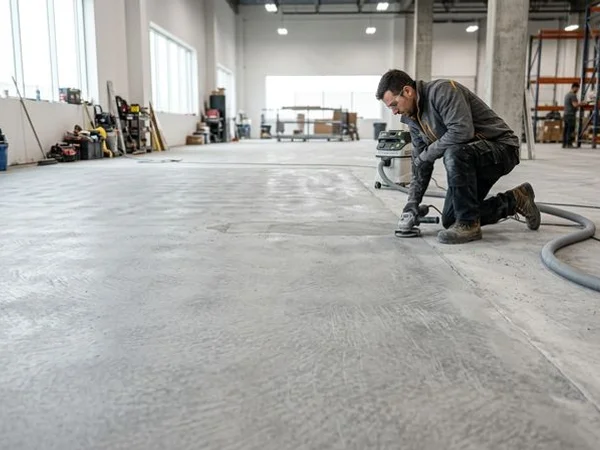
Concrete Repair Pricing
Why GTA Customers Choose Toronto Elite Epoxy Flooring - Mississauga for Concrete Repair
Prep Saves Floors
Substrate damage is the top reason coatings fail. Our crew never skips this step.
Carbon Fiber Stitching
Stops crack growth. A polyurea fill alone often just hides the problem.
Full Range of Repairs
Cracks, spalls, joints, trenches, high spots, and re-levelling, all in-house.
Protects Your Warranty
A coating on a bad slab voids warranties. Repair first, coat second.
How Concrete Repair Works
Damage Assessment
We document cracks, spalls, high spots, and any moisture issues.
Crack Stitching
Carbon fiber staples and rapid-set polyurea crack filler stop crack propagation.
Patching + Levelling
Epoxy mortar for spalls, self-levelling underlayment for uneven slabs.
Profile for Coating
Diamond grind to proper concrete surface profile, ready for the new floor.
Ready for a Free On-Site Assessment?
Same-day quotes across the GTA. WSIB-certified, $2M liability on every project.
What Customers Say About Our Concrete Repair
"Our loading bay in Malton had deep spalls and a crack running across the dock. They stitched it, rebuilt the spalls with epoxy mortar, and it's held up through a full winter of forklift traffic."
"Our Streetsville shop had an uneven old slab that made the new flooring impossible. They ground the high spots, poured self-leveller, and it's flat as glass now."
"Honest, no-shortcuts crew. They explained every step on our Clarkson garage and the warranty is in writing."
Concrete Repair FAQs
How much does concrete crack repair cost in Mississauga?
A typical garage crack repair with polyurea fill and carbon fibre stitching runs $300-$700 depending on crack length and number. Spall repair with epoxy mortar runs about $12-$22 per sq ft of affected area. Commercial floors with widespread spalling, trench damage, or self-levelling underlayment are priced per project, usually from $1,500 to $8,000 or more, with every line item shown in the fixed-price contract.
Our Clarkson garage slab is pitted all over from salt. Can it be saved?
Usually, yes. Salt pitting is surface damage. We grind off the weak top layer, fill the pits with epoxy mortar, and regrind the patches flat. The slab is then ready for a coating that stops the salt from doing it again.
We're retrofitting an older warehouse in Meadowvale. Can you repair the slab while we fit out?
Yes. Repairing cracks, spalls, and failed joints is often the first step in an industrial retrofit. We can work in phases around racking installers and other trades and finish with a coating or polish once the slab is sound.
Is a permit required for concrete slab repair in Mississauga?
Cosmetic repair such as crack filling, patching, and surface prep doesn't need a permit from the City of Mississauga Building Division. Structural foundation repairs, extensive slab replacement, or floor drain changes may need a permit and an engineer's sign-off. We'll flag that during the assessment.
How soon can I coat the floor after repairs?
Polyurea crack fill can be overcoated in 30-60 minutes. Epoxy mortar patches take 4-6 hours to walk on and 12-24 hours before coating. Self-levelling underlayment needs a full 24 hours. We schedule the coating around these windows.
Epoxy flooring, metallic coatings & polyaspartic
across the Greater Toronto Area
Same crew, same materials, same written warranty on every job. Browse by service and city — or call us direct.
Don't see your city? View our full service area →
Related Services
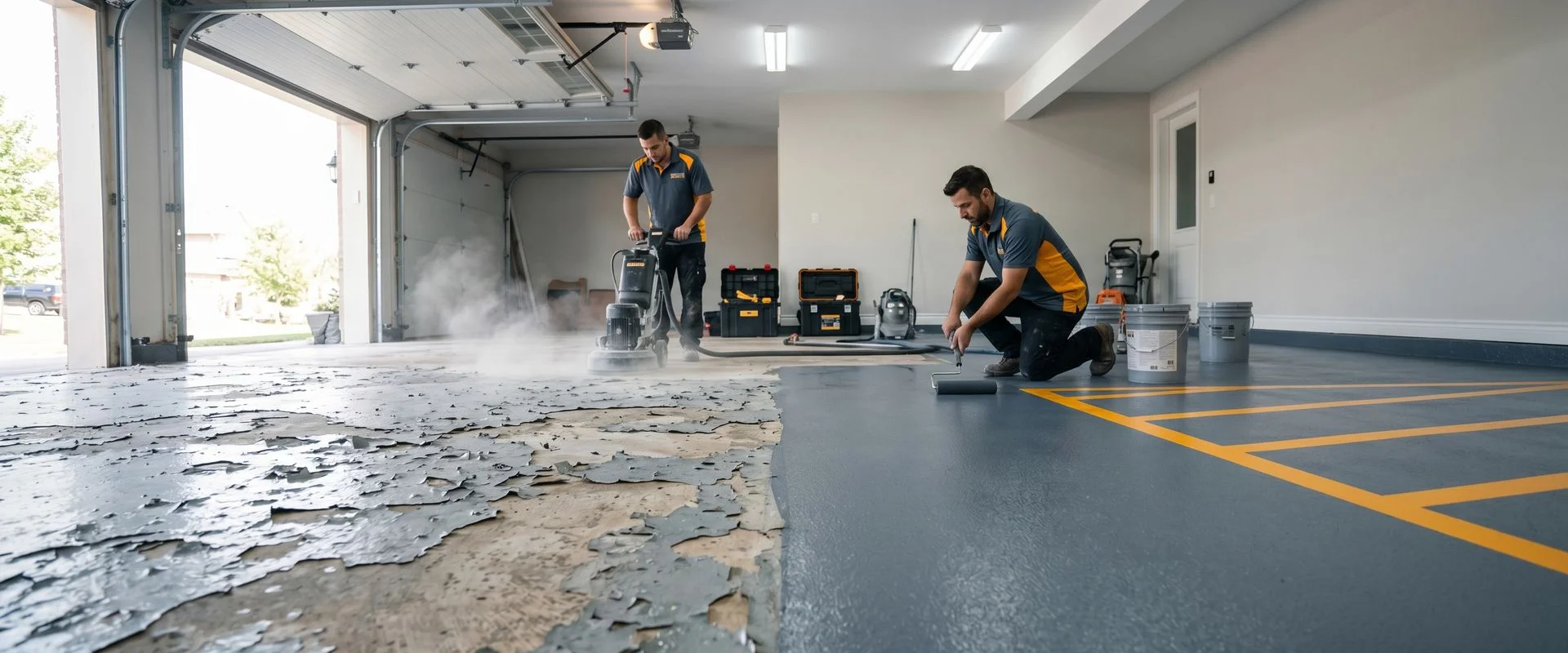
Epoxy Floor Repair & Recoat in Mississauga, ON
Epoxy floor repair in Mississauga that removes failed or peeling coatings back to bare concrete, re-tests moisture with ASTM F2170, and installs a fresh 100% solids system rated for 10-15+ years. Full recoats run $3-$7 per sq ft installed, and most garage repairs finish in 2 days. We find the root cause first so the new floor doesn't fail the same way.
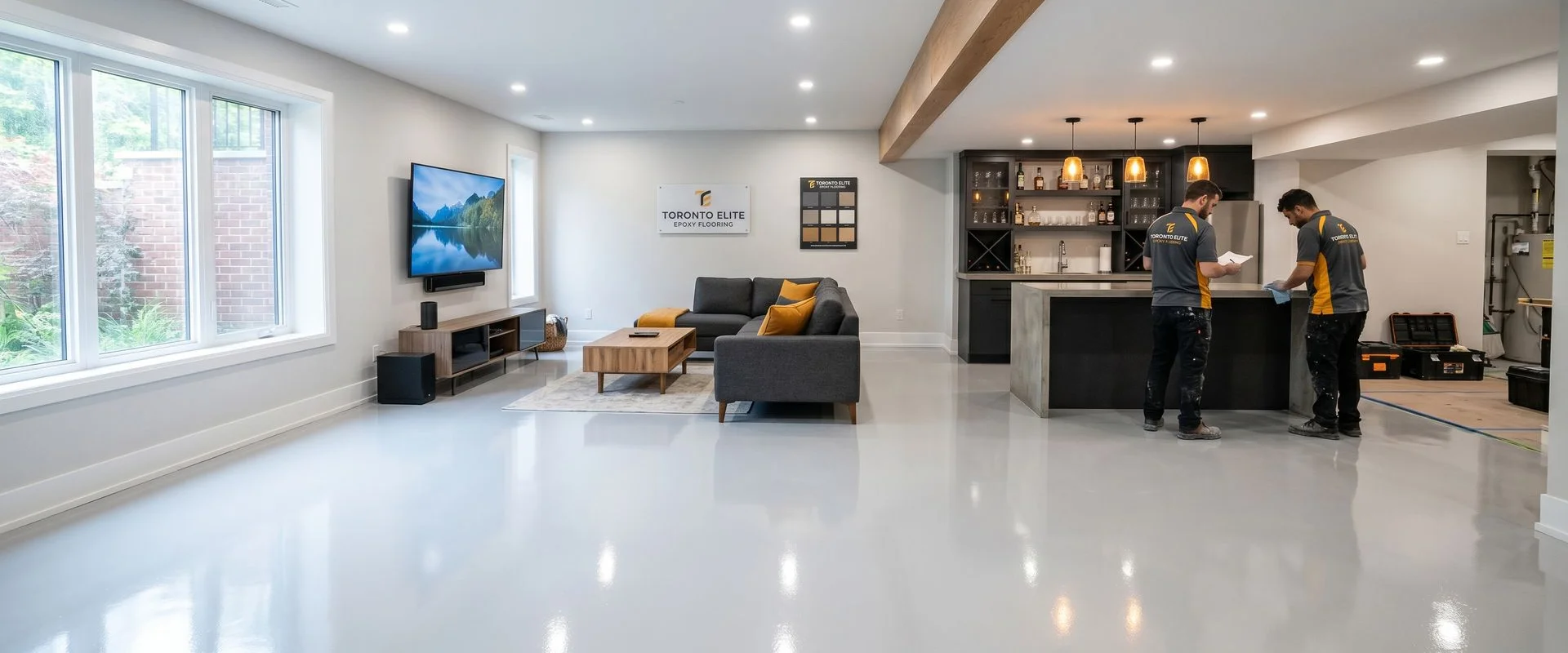
Basement Epoxy Flooring in Mississauga, ON
Basement epoxy flooring in Mississauga that starts with ASTM F2170 moisture testing and a vapour barrier primer for below-grade slabs. Seamless, pet-friendly, and zero-VOC for living spaces. $4.50-$10 per sq ft installed, and most 600-900 sq ft basements finish in 2 days of active work.
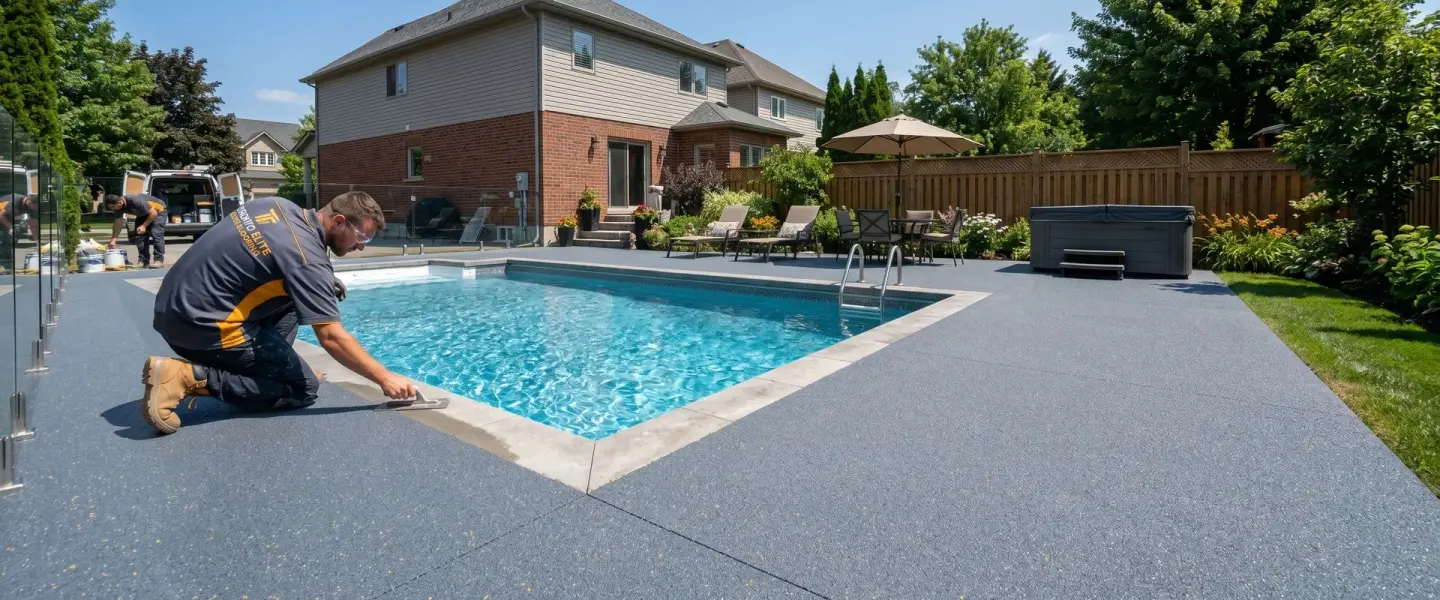
Outdoor Patio Epoxy Coating in Mississauga, ON
Outdoor patio epoxy in Mississauga built on a textured non-slip base with a UV-stable aliphatic polyaspartic topcoat. It handles freeze-thaw, de-icing salt, and pool water without yellowing or peeling. A 400 sq ft pool deck or patio typically runs $3,200-$4,800 installed over 2 days, with sealed joints and non-slip aggregate included.
Ready to Book Concrete Repair?
Same-day free on-site assessment. WSIB-certified, $2M liability on every project.