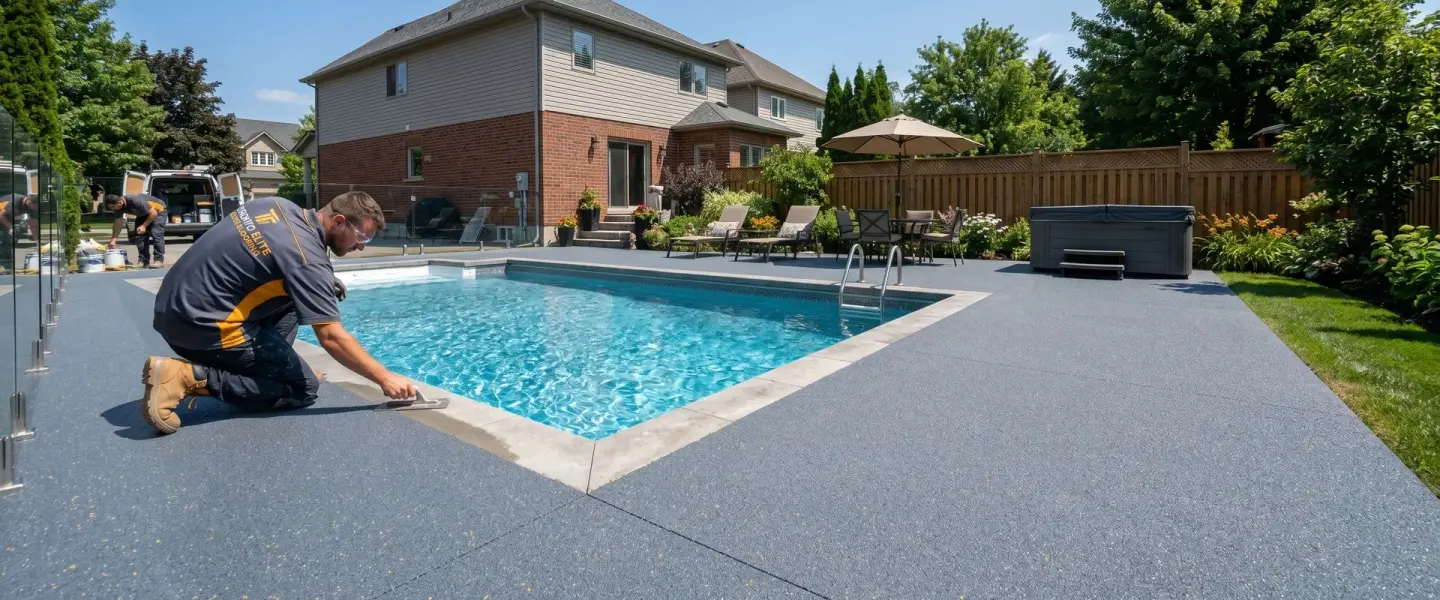
Outdoor Patio Epoxy Coating in Mississauga, ON - Non-Slip, UV-Stable Surfaces That Survive Winter
Toronto Elite Epoxy Flooring - Mississauga installs textured quartz broadcast and non-slip polyaspartic systems for backyard patios, pool surrounds, walkways, driveway aprons, and commercial patios. Every outdoor coating uses a freeze-thaw rated polyaspartic topcoat, sealed expansion joints to handle slab movement, and a primer that blocks moisture coming up from below.
Outdoor concrete here takes far more punishment than any indoor floor. Patios and pool decks go through dozens of freeze-thaw cycles each winter, with temperatures ranging from about -15°C in a cold snap to over 32°C on humid July afternoons. Standard epoxy turns brittle in the cold, cracks, lets water in, and then pops off when that water freezes. Only aliphatic polyaspartic chemistry stays flexible and bonded across that full range, and expansion joints at no more than 10-foot spacing manage the movement.
Most residential patios and pool decks of 200-600 sq ft are finished in 1-2 days. Simple sealed walkways start around $4-$9 per sq ft, and full pool deck systems with heavy grit and repairs run $8-$14. Chlorine- and saltwater-resistant options are available for pool surrounds, and lakeside homes in Port Credit and Lorne Park often choose light, cool-surface colours.
What is Outdoor & Patio Epoxy?
Outdoor concrete takes more abuse than any other surface on your property: UV all summer, salt all winter, and freeze-thaw cycles that open cracks and lift coatings. A standard indoor epoxy will yellow, chalk, and peel within a single winter outside.
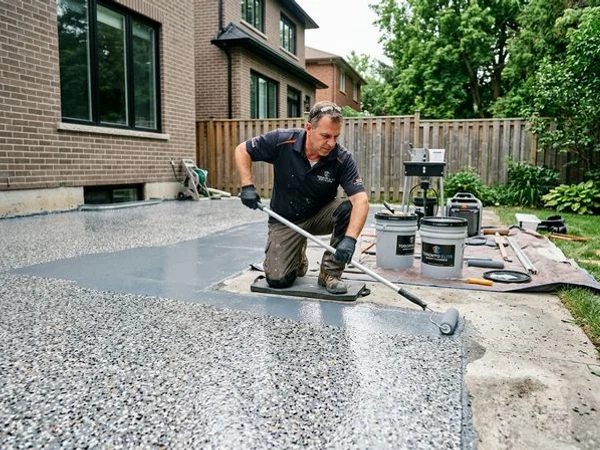
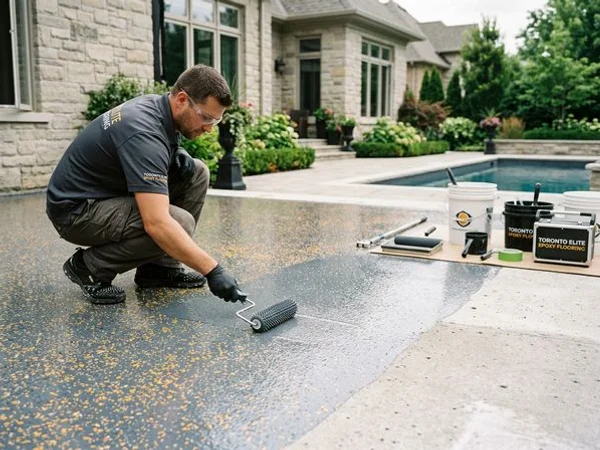
Our outdoor systems use UV-stable polyaspartic floor coatings over a textured, non-slip base. The grit keeps the surface safe in rain and around pool water, and the sealed topcoat protects against salt and freeze-thaw. It’s the same UV-stable chemistry we rely on across all our work as a full-service epoxy flooring contractor.
Pool decks, patios, and walkways, sealed properly so they look the same in spring as they did in fall.
What’s Included
- Diamond-grind surface prep and crack repair
- UV-stable base coat in your chosen colour
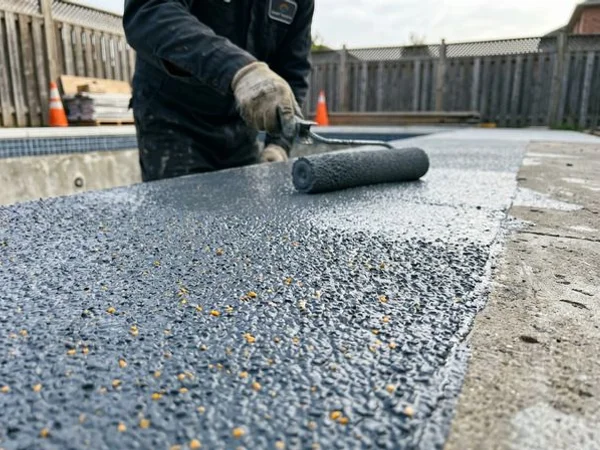
- Non-slip grit broadcast for wet-area safety
- Polyaspartic or urethane weatherproof topcoat
- Cool-surface colour options for pool decks
- Sealed perimeter and expansion joint detailing
- A written warranty
Will Outdoor Epoxy Survive GTA Freeze-Thaw Winters?
Yes, but only if the system is chosen for Canadian outdoor exposure. Outdoor slabs here go through roughly 60-80 freeze-thaw cycles a year, with temperatures running from around -20°C in January to +35°C in July. Standard aromatic epoxy, the kind in most big-box DIY kits, can’t handle that. It chalks in the sun and loses its grip as the concrete shrinks and swells underneath. That’s why so many coated patios and driveways are peeling and bubbling by their second spring.
The coatings that actually survive are aliphatic polyurea and polyaspartic. Because they’re aliphatic rather than aromatic, UV doesn’t break down their molecular backbone. Polyaspartic was developed as a cold-weather coating and stays pliable instead of brittle when temperatures drop, which is what keeps it bonded through freeze-thaw. Every outdoor system we install uses it as the topcoat.
Prep is what separates a 10-year coating from a two-season one. Every outdoor slab is diamond-ground to CSP 3 on the ICRI scale before any coating goes down. That gives the polyaspartic something to grip rather than just sitting on top. Cracks and spalls are filled with semi-rigid polyurea instead of rigid cement patch. Rigid patches fail at their edges in freeze-thaw because they expand and contract at a different rate than the slab, while semi-rigid polyurea moves with the concrete. We also seal every perimeter and expansion joint with an exterior-rated flexible sealant to stop water from sneaking under the coating at the edges.
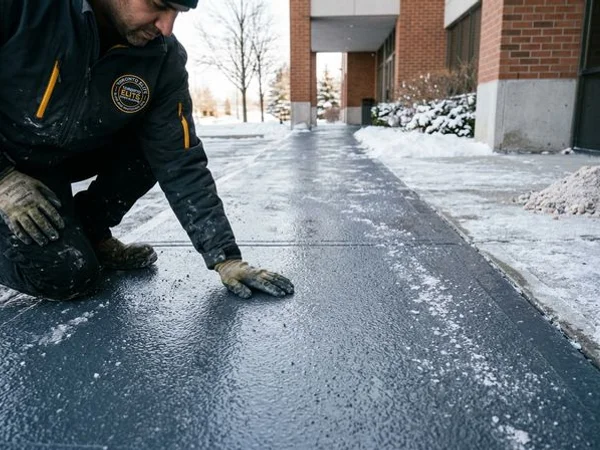
Road salt is the other big threat. Sodium and calcium chloride on driveways and sidewalks are very hard on bare concrete, drawing moisture in and out of the slab and speeding up surface scaling. Homes along busy, heavily salted streets in Mississauga see it on their walkways and aprons every spring. Once cured, our polyaspartic topcoat is impermeable to salt and forms a physical barrier between the concrete and the brine that forms when de-icer meets snow.
Pool Deck and Patio Coatings: Slip-Resistant Options
On a pool deck, slip resistance is a safety requirement and a liability issue. ASTM D2047 sets a minimum static coefficient of friction of 0.5 for a surface to count as slip-resistant. A smooth, unbroadcast epoxy on a wet deck typically measures 0.3-0.4, well below that. On our pool decks, silica or aluminium oxide grit is broadcast into the wet topcoat, which raises the reading to 0.6-0.8 depending on grit size and density. For homes with small children or older adults, a coarser grit pushes it higher still.
There’s no single right texture. For most residential pool decks we use a medium broadcast of 60-grit aluminium oxide. It grips a wet foot but isn’t rough on bare skin. For commercial pool surrounds at condos or clubs, we move to a heavier broadcast or quartz aggregate that meets NFPA 101 criteria for wet walking surfaces. Either way, the grit is set into the polyaspartic topcoat rather than added as a separate layer, so it’s chemically bonded and won’t scrape off like a stick-on traction strip.
Colour also affects heat, and most contractors don’t mention it. A dark pool deck in full summer sun can hit 55-65°C, hot enough to hurt bare feet and to speed up UV wear on the coating. Our cool-surface colours use infrared-reflective pigments in lighter and mid-tone mixes, keeping the surface 10-15°C cooler than a dark deck in the same sun. They read as warm grey or sandstone rather than stark white. That makes them a popular choice for exposed decks in Lorne Park and other neighbourhoods near the lake.
A standard two-coat polyaspartic pool deck or patio with grit runs $8-$14 per sq ft installed. A 400 sq ft pool deck usually lands between $3,200 and $4,800, depending on slab condition, the number of repairs, and the colour system. Slabs with heavy spalling or an old failed coating sit at the top of that range because prep takes much longer. We price after seeing the slab in person, then confirm it in a fixed-price contract, because outdoor concrete varies too much to quote reliably over the phone.
Driveway Aprons, Walkways, and Entryways: Expanding Beyond the Patio
Pool decks and backyard patios are the most common outdoor requests, but the same system works just as well on driveway aprons, front walkways, and covered entries, where foot traffic and weather hit a small area hard. The driveway apron, the strip between the garage door and the sidewalk, is one of the hardest-working surfaces on any property. On streets that get heavy winter salting, unprotected aprons commonly scale and spall within 10-15 years. A sealed polyaspartic surface stops chloride from getting into the concrete and ends the moisture cycling that causes scaling.
Front walkways at older homes have their own issues. In established neighbourhoods like Applewood, Mineola, and Clarkson, walkways are often narrow post-war slabs that mature tree roots have heaved by 10-30 mm. We check grinding tolerances and joint condition before quoting. Sections heaved more than about 20 mm usually need self-levelling underlayment or saw-cutting before we can lay down a flat, continuous coating. A level, non-slip walkway also lowers your slip-and-fall risk from November to March, when wet leaves and overnight ice make bare concrete dangerous.
Covered entries and porches get less UV than open patios, but they deal with condensation. The temperature difference between a heated house and a cold porch can soak an uncoated slab each season. A polyaspartic system over a penetrating epoxy primer seals the slab against that moisture and gives a clean, easy-care surface that ties in with the flooring inside the door.
Related Questions Homeowners Ask
How long does outdoor patio epoxy last?
A properly installed polyaspartic system on a prepared slab should last 10-15 years under normal residential use before the topcoat shows real wear. The limit is UV. Even aliphatic polyaspartic loses a bit of gloss after 8-10 years of direct southern exposure. When that happens, a single fresh topcoat at roughly $2-$3 per sq ft restores the finish without stripping anything.
What is the difference between polyaspartic and polyurea for outdoor use in Ontario?
Both are aliphatic and both resist UV and freeze-thaw. Polyurea cures very fast, often within 30-60 seconds of mixing, which makes it great for cold-weather work and for moisture-tolerant primers on damp slabs. Polyaspartic gives you 20-45 minutes of working time, which allows a more controlled colour coat and grit broadcast on larger areas. In practice, we often use a polyurea primer under a polyaspartic colour coat and topcoat, using each where it works best.
Can outdoor epoxy be applied to a pool deck that slopes for drainage?
Yes, and a proper slope is actually needed for a coating to last. Water that sits at a low spot will eventually work its way under any coating. ICRI guidance calls for at least a 1.5% slope, about 3/16 inch per foot, on outdoor slabs. We check the slope at the site visit and flag poor drainage before coating. Sometimes we can build slope into the repair layer with a fast-set cementitious underlayment before grinding and coating.
When is the right time of year to coat an outdoor patio?
May through September is ideal, when temperatures stay above 10°C. Some polyaspartic formulations can go down at temperatures as low as -20°C, so we can extend into early spring and late fall when a project can’t wait. What we can’t work around is rain or dew on the slab, which causes adhesion failure at any temperature. We watch the forecast and book accordingly.
Does outdoor epoxy require a building permit in Mississauga?
No. Coating an existing slab doesn’t change its structure or footprint, so the City of Mississauga Building Division doesn’t require a permit for it. Permits come into play when a slab is being poured, replaced, or extended, or when drains are being modified. If you’re adding a new pool deck slab as part of a landscaping project, that contractor handles the permit, and we coat the slab once it’s cured and passed inspection.
Our Outdoor Epoxy Results in Toronto
Why GTA Customers Choose Toronto Elite Epoxy Flooring - Mississauga for Outdoor Epoxy
Made for Ontario Winters
Salt-, freeze-thaw-, and UV-resistant. Your patio looks the same in spring as it did in fall.
Non-Slip for Wet Areas
Broadcast grit keeps pool decks and patios safe in rain and around water.
Cool-Surface Options
Light, infrared-reflective colours keep pool deck temperatures down in summer heat.
Warranty
Backed in writing, even on outdoor systems.
How Outdoor Epoxy Works
Site Assessment
We check slab condition, exposure, and the sheen and colour you want.
Diamond-Grind Prep
Full prep plus crack and spall repair before the coating system goes down.
Base + Texture Coat
UV-stable base coat with broadcast grit for non-slip surface.
Weatherproof Sealer
Sealed against freeze-thaw, road salt, and UV. Cool-surface options available.
Ready for a Free On-Site Assessment?
Same-day quotes across the GTA. WSIB-certified, $2M liability on every project.
What Customers Say About Our Outdoor Epoxy
"Pool deck at our Lorne Park home. They ground it, filled every crack, and used a light sandstone colour with grit. Three summers in, it's cool underfoot and not slippery at all."
"Our front walkway and driveway apron in Applewood were scaling badly from salt. They repaired the spalls and sealed it all with polyaspartic. Last winter, not a single new flake came off."
"Covered patio for our cafe in Streetsville. Done in two days, non-slip, and it cleans up easily after a busy weekend."
Outdoor Epoxy FAQs
How much does outdoor patio epoxy cost in Mississauga?
Simple sealed walkways and covered porches start around $4-$9 per sq ft. Full pool deck systems with a colour coat, heavy grit broadcast, and polyaspartic topcoat run $8-$14 per sq ft. A 400 sq ft pool deck usually lands between $3,200 and $4,800. Slabs with heavy salt scaling or an old failed coating cost more because of the extra prep.
Our Port Credit pool deck gets lake wind and full sun. Will the coating hold up?
Yes, with the right chemistry. We use an aliphatic polyaspartic topcoat that doesn't yellow under UV and resists chlorine and salt. For full-sun decks, we recommend lighter cool-surface colours that stay 10-15°C cooler underfoot than dark finishes.
Can you coat over interlock or pavers?
No. Each paver moves independently, so a coating that bridges the joints will crack in the first winter. If you want a continuous coated surface, the pavers need to be replaced with a concrete slab first.
When is the best time to coat a patio here?
May through September, when temperatures stay above 10°C. With polyaspartic, we can stretch into early spring and late fall. What we can't work around is rain or dew on the slab, so we book around the forecast.
Is the surface slippery when wet?
No. We broadcast grit into the topcoat while it's wet, which raises slip resistance well above the ASTM D2047 threshold of 0.5. Families with young kids or older users can choose a coarser grit for even more grip.
Epoxy flooring, metallic coatings & polyaspartic
across the Greater Toronto Area
Same crew, same materials, same written warranty on every job. Browse by service and city — or call us direct.
Don't see your city? View our full service area →
Ready to Book Outdoor Epoxy?
Same-day free on-site assessment. WSIB-certified, $2M liability on every project.