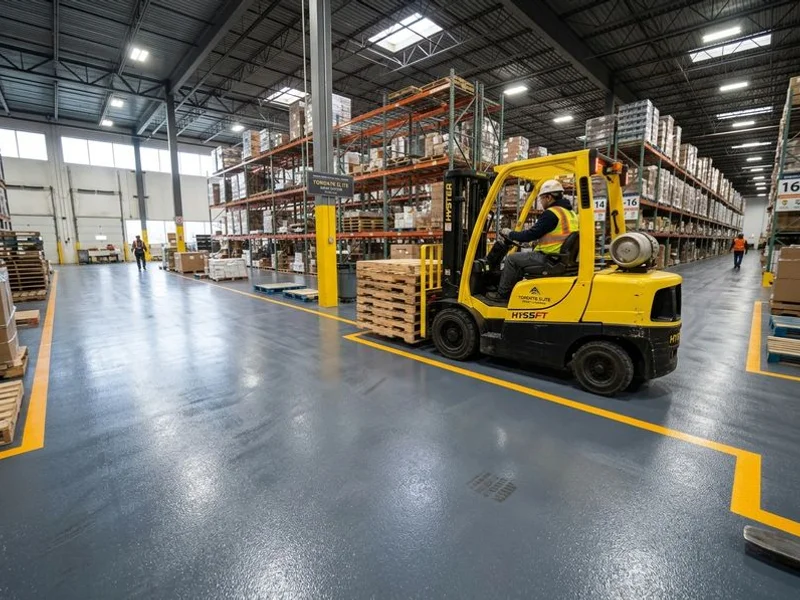
Industrial Epoxy Flooring in Mississauga - Forklift-Rated Floors for Plants and Distribution Centres
Toronto Elite Epoxy Flooring - Mississauga installs high-build broadcast epoxy, urethane cement, novolac chemical-resistant systems, polyurea coatings, secondary containment, and ESD floors for manufacturing plants, distribution centres, food processors, automotive operations, and chemical storage. Each project is specified for the facility's real loads, chemicals, and compliance rules, whether that's Class 1-3 forklift traffic, CFIA continuous surfaces, TSSA containment, or ANSI/ESD S20.20 static control.
Industrial floors face loads and chemicals that commercial and residential systems aren't built for. Class 3 forklifts at 6,000-10,000 kg put more than 300 PSI on the drive-wheel contact patch. A 40-60% solids epoxy that shrinks 30-50% as it cures can't hold under that shear on a CSP 2 surface. When industrial floors fail, it's almost always the prep, not the coating. The coating peels clean because the weak laitance layer was never removed. CSP 3 diamond grinding or 1-3 mm shot blasting is the minimum for forklift floors, and an 80-100 mil build of 4-6 layers is what bridges hairline cracks and survives wheel shear.
Mississauga is one of Canada's biggest logistics and manufacturing hubs, with industrial vacancy around 2.6% and owners renovating older buildings in Meadowvale, Malton, Southdown, and around Pearson rather than moving. Open warehouse systems start at $3 per sq ft, heavy-duty manufacturing floors run $5-$10, urethane cement and wash bay systems $7-$12, and containment and chemical storage coatings $10-$18.
Heavy-Duty Floor Coating Services
Toronto Elite Epoxy Flooring - Mississauga installs high-build broadcast systems, urethane cement, novolac chemical-resistant floors, and secondary containment for manufacturing plants, distribution centres, food processors, and chemical storage across the city, from the logistics corridor around Pearson to the heavy industry in Southdown. Every industrial project starts with CSP 3 surface preparation, the one step that decides whether a floor lasts 15 years under forklifts or fails in 12 months.
Industrial Epoxy Services We Install
- Commercial & Industrial Epoxy - 80-100 mil high-build broadcast, Class 1-3 forklift rated
- Warehouse Epoxy Flooring - distribution centres, logistics hubs, pallet racking areas
- Secondary Containment Coatings - TSSA, Ontario liquid fuels rules, CCME guidance
- ESD Conductive Epoxy - ANSI/ESD S20.20 electronics manufacturing
- Wash Bay & Washdown Epoxy - urethane cement, 82°C hot pressure wash rated
- Automotive Service Bay Epoxy - oil-decontaminated, hoist-pad reinforced
- Cold Storage & Freezer Epoxy - polyurea for -40°C service
- Commercial Kitchen Epoxy - CFIA food plant continuous surface
- Parking Garage & Hangar Epoxy - ASTM C672, polyurea traffic membrane
How Much Does Industrial Epoxy Cost?
Industrial epoxy ranges from $3 per sq ft for open warehouse systems to $18 for novolac chemical-resistant systems with full compliance documentation (2026 pricing). Heavy-duty manufacturing floors run $5-$10 per sq ft. Projects range from 1,000 sq ft equipment pads to distribution centre floors over 200,000 sq ft.
Benefits That Protect Your Bottom Line
Industrial epoxy strengthens and protects concrete and extends its life while keeping the workplace clean and safe. Our systems meet Ontario industrial standards and support heavy machinery, chemical exposure, and nonstop traffic.
Durability and Longevity
Our epoxy floor coating systems are engineered for long-term strength under extreme use. Every installation uses forklift-rated 100% solids epoxy with compressive strength of 3,000-6,000 psi, supporting material handling equipment, racking, and constant movement without chipping or delaminating.
Prep includes CSP 3-5 shot blasting for a deep mechanical bond, and ASTM F2170 moisture testing confirms the slab is ready before coating, reducing the risk of trapped moisture lifting the floor from below.
That durability matters most in the distribution centres and plants along Highway 401 and the 410 and 427 corridors. Properly prepared and installed, these floors typically last more than 15 years under Class 2-3 forklift traffic, cutting replacement cycles and maintenance budgets.
Chemical and Abrasion Resistance
Many plants handle oils, hydraulic fluids, and strong cleaners. Our epoxy coatings and optional urethane topcoats form a continuous barrier against corrosive substances and stains, rated under ASTM D1308 for chemical immersion resistance.
Pairing epoxy with polyurethane topcoats adds scratch and abrasion resistance. In automotive, electronics, and food processing plants, this hybrid holds up after long exposure to the specific chemicals in each facility. Where concentrated acids or solvents are present, as in parts of the Southdown Industrial Area, novolac epoxy provides the cross-link density standard bisphenol-A epoxy can’t maintain under long-term exposure.
Easy Maintenance and Hygiene
Seamless floors make daily cleaning simpler and improve hygiene. The non-porous epoxy surface won’t absorb liquids, which reduces bacterial growth and contamination. Floors can be scrubbed or pressure-washed without damage.
We design section-by-section installations so operations continue while new areas cure. Compared with tile or bare concrete, epoxy eliminates grout lines and concrete dusting. That makes it ideal for distribution centres, logistics parks, and flex industrial units, like those in Meadowvale Business Park, where uptime and cleanliness are key. Regular sweeping and an occasional neutral cleaner keep the floor looking and working its best.
Improved Appearance and Safety
Industrial epoxy improves both safety and appearance. We add safety lines, colour-coded zones, and slip-resistant textures to separate vehicles and pedestrians. The reflective finish spreads light further and improves visibility, reducing accidents during shifts in large buildings.
For sensitive areas and MHE traffic zones, we add anti-static and chemical-resistant formulations to reduce hazards from static near production equipment and from spilled lubricants in vehicle aisles. Safety line colours are chosen to meet Ontario workplace visibility standards for industrial floor markings.
How We Compare
| Feature | Typical Provider | Toronto Elite Epoxy Flooring - Mississauga |
|---|---|---|
| System Build Thickness | 25-30 mil (2-3 layers) | 80-100 mil (4-6 layers) |
| Surface Preparation | CSP 1-2 acid etch or light grind | CSP 3-5 shot blasting confirmed by gauge |
| Moisture Testing | Visual inspection only | ASTM F2170 in-situ RH testing on every slab |
| Warranty | 1-5 years limited | Lifetime warranty, written |
| Insurance & Compliance | Basic liability | WSIB-certified, $2M liability, full documentation |
| Off-Hours Scheduling | Limited availability | 24-hour overnight and weekend shifts available |
Advanced Flooring Solutions for Industrial Operations
Our industrial floors are built to perform under heavy machinery, high traffic, and strict safety rules, in line with Ontario Building Code standards for industrial occupancy. Every installation follows professional testing and prep procedures for long life and efficiency.
Specialised Systems for Heavy-Duty Environments
We apply forklift-rated, 100% solids epoxy with compressive strength of 3,000-6,000 psi for the continuous MHE traffic found in warehouses and plants. Before coating, we run ASTM F2170 moisture testing and CSP 3-5 shot blasting to manage contamination and adhesion.
Every project gets tailored scheduling, including off-hours and section-by-section installation to minimize downtime. Our chemical-resistant resins tolerate oils, hydraulic fluids, and industrial cleaners, which suits the aerospace, automotive, and electronics manufacturers clustered around Malton and the Airport Corporate Centre.
Standard warehouse industrial floor coating runs $3-$7 per sq ft installed, and novolac chemical-resistant systems with compliance documentation run up to $18. Every job is WSIB-cleared with $2M liability coverage.
Polished Concrete for Industrial Facilities
We also offer mechanical polished concrete, which improves appearance and strength without adding a coating. The process refines the surface through several stages of concrete polishing and densification with lithium silicate hardener for a dense, abrasion-resistant finish.
Clients often choose polishing for low maintenance and reflectivity in areas with little chemical exposure. Polished floors resist tire marks and light staining, and the shine improves light across large buildings. In mixed facilities, polished concrete suits offices and corridors, while broadcast epoxy handles forklift aisles and loading zones in the same project.
Slip Resistance and Safety Features
Traction and workplace safety are core requirements on every industrial epoxy job. We embed silica aggregate or textured topcoats matched to each area, improving grip in wet or oily zones. Texture can run from light for pedestrian areas to coarse for vehicle aisles, rated to ASTM D2047 for coefficient of friction.
We also install safety lines, zone markings, and high-visibility borders under the final topcoat, protecting them from forklift wear and chemical cleaning that would strip surface paint within months.
Warehouse, Factory, and Plant Flooring Applications
Our industrial systems handle heavy traffic while meeting strict safety and performance standards. Each installation is built around the operational needs of the facility for long wear life and simple maintenance.
Warehouses and Manufacturing Facilities
We install industrial-grade epoxy floor coatings for distribution centres, production lines, and automotive facilities across Mississauga, including Gateway, Meadowvale, Malton, and the Dixie Road industrial zone. In warehouses, our forklift-rated 100% solids epoxy reaches up to 6,000 psi compressive strength and meets Ontario Building Code industrial occupancy requirements. Every floor is prepared by CSP 3-5 shot blasting, including areas heavily contaminated with oil or solvents.
In manufacturing plants, chemical-resistant epoxy stands up to oils, hydraulic fluids, and strong maintenance cleaners. Facilities running material handling equipment (MHE) get seamless, non-slip surfaces that reduce tire wear and vibration under load. For electronics, aerospace, and automotive work, we offer anti-static epoxy rated to ANSI/ESD S20.20 and run ASTM F2170 moisture testing for long-term adhesion and safety.
Our crews schedule off-hours or section-by-section installation so operations keep running. Standard systems typically run $3-$7 per sq ft installed, and specialized chemical-resistant, compliance-documented installs run up to $18. Every project carries full WSIB coverage and $2 million liability insurance.
Customisation: Colours, Finishes, and Safety Markings
Every industrial epoxy project is tailored to your operations and safety standards. Choose from solid colour, metallic, or decorative flake systems that improve light reflectivity and stay easy to clean. A high-gloss epoxy floor coating brightens picking aisles, while a satin or matte finish suits production areas where less glare helps operators see.
We build in custom colour zones, line markings, and wayfinding borders for traffic management and safety. Loading zones, pedestrian lanes, and work cells are colour-coded under the final topcoat so the markings survive forklift traffic and chemical cleaning.
Our high-performance flooring systems use UV-stable topcoats and slip-resistant aggregate matched to your specs. Every floor combines function, appearance, and compliance in a lasting investment for food plants, cold storage, life sciences, and manufacturing operations throughout Peel Region.
Our Installation Process and Quality Standards
Every industrial project follows a standards-based workflow to meet expectations for longevity, appearance, and safety. Careful prep, precise application, and efficient scheduling keep quality consistent while limiting disruption.
What Surface Preparation Does Industrial Epoxy Require?
Proper surface preparation is the foundation of a durable floor. Every project starts with a detailed concrete assessment, followed by diamond grinding or CSP 3-5 shot blasting to remove contaminants and ensure strong adhesion. On heavily contaminated slabs, like oil-soaked machine shops, fuel storage, and automotive facilities, we apply a petroleum decontamination treatment before blasting to reach clean concrete.
Moisture testing is critical. We follow ASTM F2170 to measure relative humidity inside the slab and prevent delamination and blistering. When readings are too high, we apply moisture mitigation primers before any coating. Concrete compressive strength must also be at least 3,500 psi. We check this during the site visit and flag any areas that need repair first.
Epoxy Floor Installation Best Practices
With prep complete, we install high-performance systems engineered for durability and safety. Each layer goes on at a controlled thickness while temperature and humidity are monitored for proper cure. We choose from epoxy resins, urethane topcoats, and anti-static formulations based on the facility’s needs and Ontario Building Code industrial occupancy standards.
Controlled conditions keep bond strength high, and consistent technique reduces variation across large floors. We document every stage for quality assurance, including thickness per layer, slab moisture readings, cure times, and topcoat coefficient of friction results.
Can You Install Epoxy Without Shutting Down Operations?
Uptime matters for manufacturers and distributors. We schedule section-by-section or off-hours work around your production schedule, segmenting zones to stay clear of active machinery and foot traffic. Each finished section reopens as the next one begins.
For large facilities of 50,000-200,000 sq ft, we produce a written schedule before work starts that shows each section, its install date, cure time, and traffic access date. You get it at kickoff so production planning can account for every zone.
Questions About Industrial Epoxy Flooring in Mississauga
Why does industrial epoxy fail in some warehouses and not others?
The most common cause is prep, specifically coating over a CSP 1-2 profile that can’t hold under forklift loads. A CSP 2 surface from light grinding or acid etching is fine for foot traffic but not for the 300+ PSI at a Class 3 forklift’s drive wheel. The second most common cause is moisture. F2170 readings above 75% RH mean vapour pressure will push standard epoxy off. The third is oil contamination left below the grinding depth, which leaves a contaminated layer between the concrete and primer. All three are prep failures, not product failures.
What is the difference between shot blasting and diamond grinding for industrial floor preparation, and when is each required?
Diamond grinding is the standard for clean concrete, including new construction, light commercial floors, and slabs without petroleum contamination. It reaches CSP 2-4 depending on tooling and suits most warehouse and manufacturing projects. Shot blasting is needed when oil, chemicals, or mechanical contamination is bonded into the pores, as in automotive shops, machine shops, fuel storage, and heavily contaminated food plants. It removes contaminated concrete mechanically without water or chemicals. On slabs with confirmed oil contamination, we apply a decontamination pre-treatment first to draw the oil out of the pores before blasting.
Can a 200,000 sq ft distribution centre near Pearson get an epoxy floor without halting operations?
Yes, that’s exactly what section-by-section scheduling is for. We map your forklift routes, picking paths, and dock door usage, then divide the floor into sections that can be isolated overnight and on weekends. A 200,000 sq ft facility usually goes in as 5,000-10,000 sq ft sections over 20-40 overnight shifts, with each section ready for forklifts 48-72 hours later. You get the written schedule at kickoff, and no shutdown is needed.
What ASTM standards govern the performance of industrial epoxy flooring in Ontario facilities?
The key standards are ASTM F2170 (in-situ concrete RH testing), ASTM D1308 (chemical resistance by immersion), ASTM D4060 (Taber abrasion resistance), ASTM D2047 (slip resistance), and ASTM D4259 (concrete surface preparation). ESD floors follow ANSI/ESD S20.20 for specification and testing. Food plants follow CFIA requirements for continuous surfaces and coving. We reference all applicable standards in the compliance package at handover.
How do anti-static and ESD conductive epoxy floors differ, and which does an electronics or aerospace plant need?
ESD dissipative epoxy (10^6-10^9 ohm surface resistance) bleeds static slowly to ground without a sudden discharge. It’s the right spec for electronics manufacturing, PCB assembly, and server rooms where parts are static-sensitive but there’s no explosion risk. ESD conductive epoxy (under 10^6 ohm) discharges faster and is required where static could ignite flammable vapours or explosive materials. For the electronics, aerospace, and automotive manufacturers around Malton and the airport, dissipative systems meeting ANSI/ESD S20.20 are the standard. We test every ESD floor with a calibrated surface resistance meter and provide ANSI/ESD S20.20 documentation at handover.
Industrial Epoxy Pricing
Loading specification, chemical resistance rating, and compliance documentation affect final price.
Why GTA Customers Choose Toronto Elite Epoxy Flooring - Mississauga for Industrial Epoxy
80-100 Mil Build - Not 25-30 Mil
Thin 25-30 mil systems can't withstand forklift wheel shear. We install 80-100 mil builds of 4-6 layers that bridge hairline cracks and handle Class 1-3 forklift contact pressures over 300 PSI.
CSP 3-5 Confirmed Before Any Coat
Most industrial failures are prep failures. Our crew confirms CSP 3 or higher with a profile gauge before any primer goes down. No exceptions.
Shot Blasting for Oil-Contaminated Slabs
Grinding alone can't pull petroleum out of concrete pores. Oil-soaked plants, like many older buildings in Malton, get decontamination pre-treatment and 1-3 mm shot blasting to reach clean concrete.
Section-by-Section Off-Hours Scheduling
Distribution centres near Pearson can't close for a week. We map production zones and forklift routes, then install 5,000-10,000 sq ft sections overnight and on weekends while operations continue.
How Industrial Epoxy Works
Loading & Chemical Exposure Assessment
Forklift class and axle weight, chemical exposure profile, ASTM F2170 moisture testing, slab condition and compressive strength, and section-by-section scheduling plan mapped to your production timetable.
CSP 3-5 Shot Blasting & Contamination Removal
1-3 mm shot blasting for oil-contaminated substrates, petroleum decontamination pre-treatment where required, HEPA dust collection, surface profile confirmation with CSP gauge before any primer application.
High-Build System Application
Moisture-tolerant primer, 100% solid epoxy base coat, broadcast aggregate or flake, 80-100 mil total build for forklift-rated applications, urethane or polyaspartic topcoat matched to chemical exposure profile.
Safety Marking & Compliance Documentation
Safety line and zone marking installation, adhesion and thickness testing, compliance documentation package (CFIA, TSSA, ANSI/ESD S20.20 as applicable), forklift access timeline confirmed at handover.
Ready for a Free On-Site Assessment?
Same-day quotes across the GTA. WSIB-certified, $2M liability on every project.
What Customers Say About Our Industrial Epoxy
"80,000 sq ft distribution centre in the Airport Corporate Centre with forklifts running 24 hours a day. They mapped our traffic patterns first, then installed section by section over three weeks of overnight shifts. Every zone was handed back on time with cure documentation, and two years of Class 3 forklift traffic later there isn't a single crack or lifted edge."
"Our Meadowvale plant had two previous coatings fail within 18 months from hydraulic fluid and cleaner exposure. They removed the old coating, ran moisture tests, and specified a urethane topcoat over a 100% solids base. They even documented the ASTM D1308 chemical resistance rating for our insurer. No chemical damage through a full production cycle."
"Our Malton parts facility had 30 years of oil in the slab, and two earlier contractors' floors failed within a year. They did a petroleum decontamination treatment, shot-blasted to CSP 4, and used a moisture-tolerant primer. Three winters later, no delamination anywhere in the drive lanes."
Industrial Epoxy FAQs
What industrial epoxy systems do you install in Mississauga?
High-build broadcast epoxy (80-100 mil for Class 1-3 forklifts), urethane cement for hot washdown, novolac chemical-resistant systems, polyurea coatings, TSSA-compliant secondary containment, ANSI/ESD S20.20 conductive floors, and cold storage systems. We work in plants and warehouses across the city, from Meadowvale and Malton to Southdown and the airport corridor.
How much does industrial epoxy flooring cost in Mississauga?
From $3 per sq ft for open warehouse systems to $18 for novolac chemical-resistant systems with compliance documentation (2026 pricing). Heavy-duty manufacturing floors run $5-$10 per sq ft, and urethane cement and washdown systems $7-$12. The price depends on loads, chemicals, prep, and documentation, and is fixed in writing after an assessment.
How thick does industrial epoxy need to be for forklift traffic?
80-100 mils total, built in 4-6 layers. The 25-30 mil systems used in retail and offices can't take forklift wheel shear. Prep matters just as much: CSP 3 grinding or shot blasting removes the weak laitance and creates the profile the coating needs to grip.
Can you install without shutting down our facility?
Yes. We split the floor into 5,000-10,000 sq ft sections and work overnight and on weekends, usually one section per shift. Before starting, we map your forklift routes and dock usage and give you a written schedule showing when each zone will be available again.
When can forklifts go back on the floor?
Foot traffic in 12-18 hours after the final topcoat, and forklifts and heavy equipment after 48-72 hours, depending on temperature and product. In unheated warehouses during winter, we use heated enclosures to keep the slab at 10°C or more through the cure.
Epoxy flooring, metallic coatings & polyaspartic
across the Greater Toronto Area
Same crew, same materials, same written warranty on every job. Browse by service and city — or call us direct.
Don't see your city? View our full service area →
Related Services
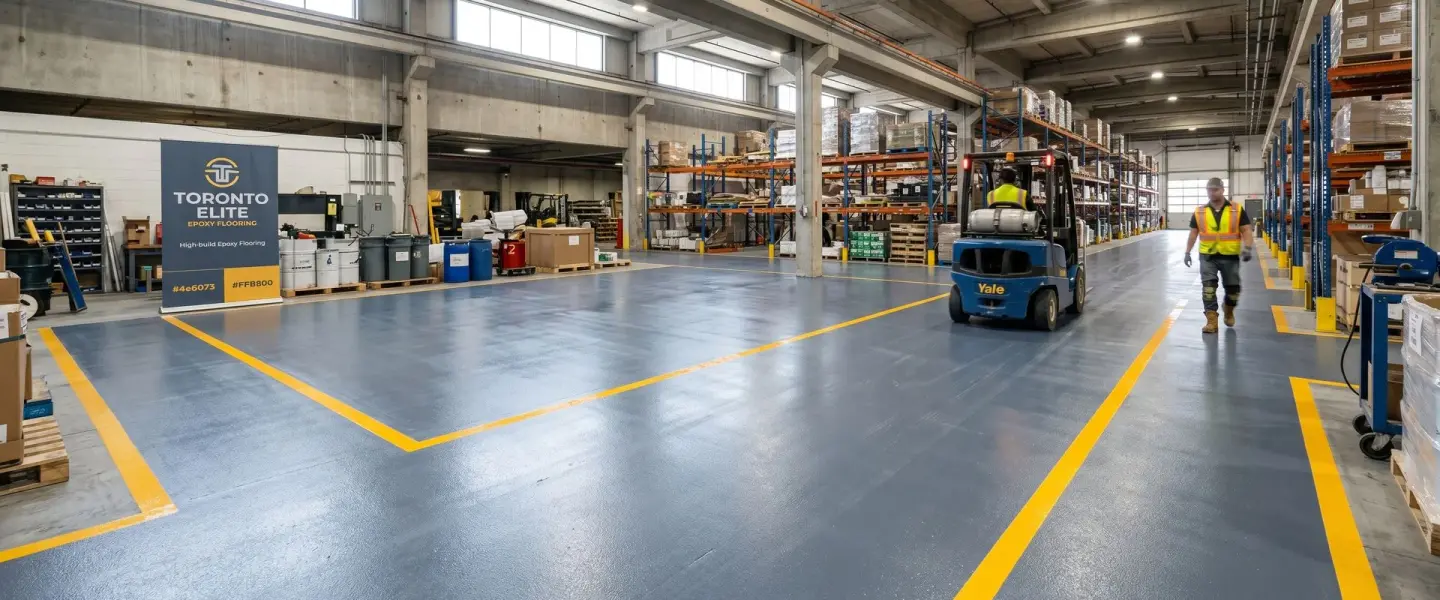
Warehouse Epoxy Flooring in Mississauga, ON
Warehouse epoxy flooring in Mississauga: forklift-rated 100% solids systems with shot-blast prep, chemical-resistant topcoat, and embedded line marking for distribution centres and logistics hubs. $3-$7 per sq ft installed, with large floors done in off-hours weekend windows. WSIB-cleared crews, $2M liability, full compliance documentation.
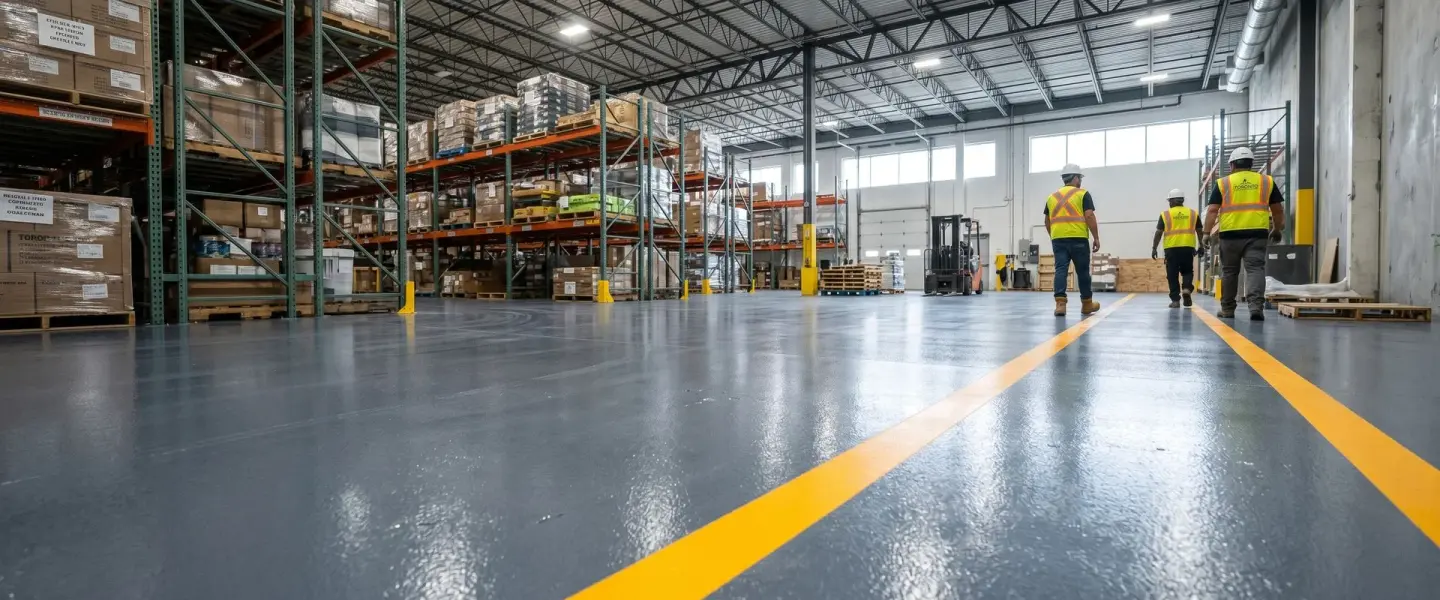
Commercial & Industrial Epoxy Flooring in Mississauga, ON
Commercial and industrial epoxy in Mississauga using 100% solids systems over shot-blasted CSP 3-4 concrete, for facilities running forklifts, food production, or 24-hour operations. $3.50-$8 per sq ft installed for standard systems, with off-hours scheduling that returns the floor before the next shift. WSIB cleared, $2M liability, full compliance documentation.
Automotive Service Bay Epoxy Flooring in Mississauga, Ontario
Automotive service bay epoxy in Mississauga for dealership service departments, oil change bays, repair shops, and fleet maintenance garages. Resists oil, fuel, and brake fluid, with anti-slip texture and hoist pad reinforcement. $6-$12 per sq ft installed, and most bays finish in 1-2 days. WSIB cleared, $2M liability.
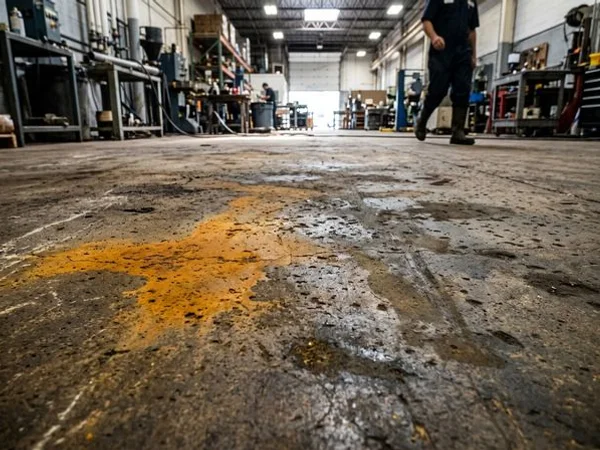
Secondary Containment Coatings in Mississauga, Ontario
Secondary containment coatings in Mississauga for fuel tank berms, chemical storage, transformer pads, and spill containment floors. Novolac and vinyl ester systems rated for full chemical and petroleum immersion, built to TSSA requirements. $10-$18 per sq ft installed. WSIB cleared, $2M liability, full compliance documentation.
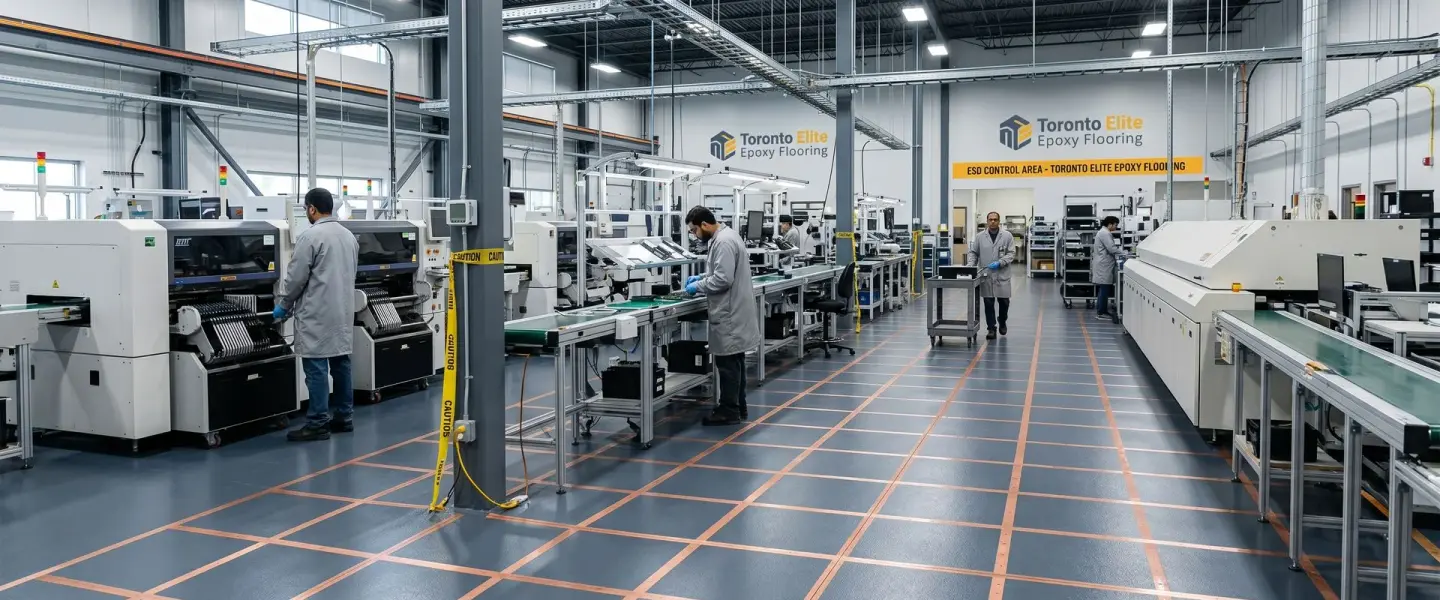
ESD Conductive Epoxy Flooring in Mississauga, ON
ESD conductive epoxy in Mississauga, built to ANSI/ESD S20.20 with a copper grounding grid and verified by megohmmeter to NFPA 99 and ESD Association STM7.1. $7-$14 per sq ft installed for standard systems, with resistance testing and a full compliance report included. Built for electronics, aerospace, data centres, and cleanrooms.
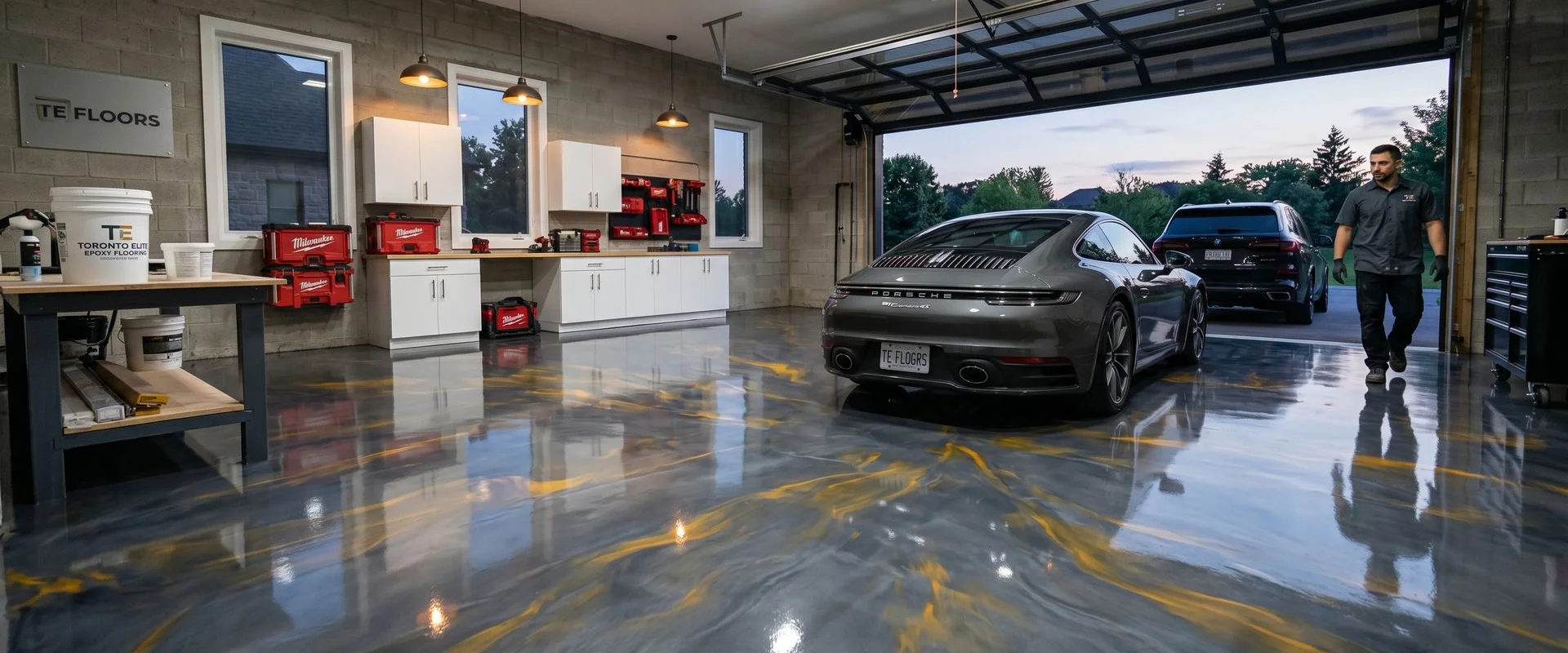
Ready to Book Industrial Epoxy?
Same-day free on-site assessment. WSIB-certified, $2M liability on every project.