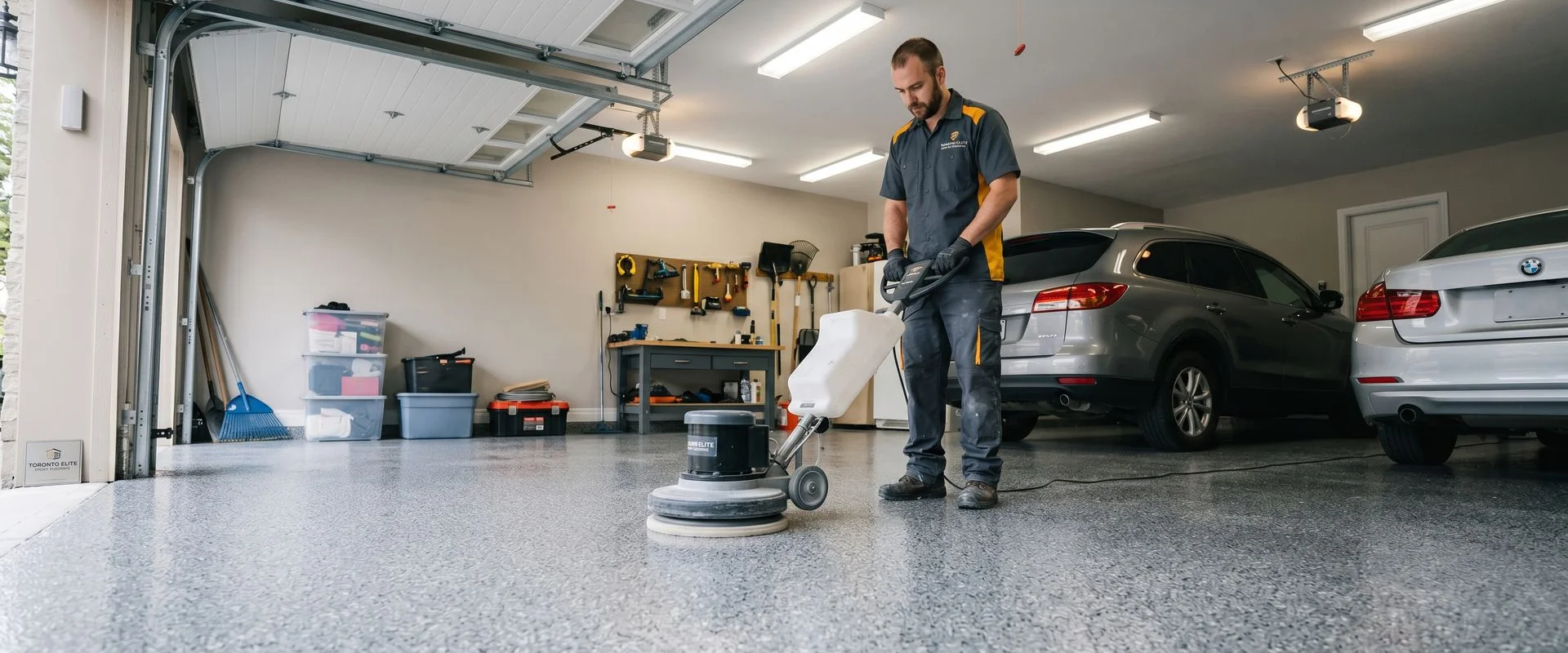
Garage Floor Epoxy in Mississauga, ON - Salt-Proof Systems Built for Ontario Winters
Toronto Elite Epoxy Flooring - Mississauga installs quartz broadcast, vinyl flake, solid-colour, and metallic garage floor systems in single, double, and triple-car garages. Every floor starts with diamond grinding to CSP 3 and ASTM F2170 moisture testing, followed by a 100% solids epoxy base and an aliphatic polyaspartic topcoat that stands up to salt, oil, and hot tires.
Mississauga garages see some of the harshest conditions in the GTA. The city averages about 108 cm of snow a year, winter lows reach -15°C, and almost every commute runs along the 401, 403, 410, or QEW, where brine is laid down all winter. That salt rides into the garage on the tires and soaks into bare concrete, causing pitting and spalling within a few seasons. In summer, highs above 32°C with heavy humidity cause hot tire pickup, peeling cheap floor paint straight off the slab. A 100% solids system bonded to a mechanically profiled slab handles both.
A single-car garage (around 250-300 sq ft) usually finishes in one day, and most two-car garages take two. Pricing runs $6.50 to $10 per sq ft installed, depending on finish, slab condition, and the number of coats. We work on 1950s slabs in Port Credit and Clarkson, newer builds in Churchill Meadows, and everything in between, and quote a fixed price after seeing the floor.
Why Garage Floors in Mississauga Fail
Almost every peeling garage floor we’re called to comes down to two things: poor prep and low-grade product. Acid etching leaves a smooth, weak surface layer in place, so the coating never really grips the concrete. Hardware store epoxy kits are thin and usually water- or solvent-based. They tend to last two or three years before hot tires, salt, and freeze-thaw start lifting them.
Redoing a failed floor costs more than the second coating. You lose the garage again, deal with the dust and grinding, and pay to remove what was put down the first time. A 100% solids garage floor epoxy system on a diamond-ground slab, finished with a polyaspartic topcoat, lasts 10-15+ years in Ontario conditions. We bring the same standard to every job as a full-service epoxy flooring contractor.
What is Garage Floor Epoxy?
Garage floor epoxy is a multi-layer coating system bonded to bare concrete. When it’s installed properly, it bonds mechanically into the slab and gives you a hard surface that resists oil, salt, freeze-thaw, and hot tire pickup. That’s the failure that ruins most one-day kits.
Winter is what really tests a garage in Mississauga. From November through March, cars come home caked in slush and brine from the 401, 403, and QEW. Our system starts with a 100% solids epoxy base coat, then quartz or vinyl flake for texture and depth, then a clear aliphatic polyaspartic topcoat that won’t yellow or soften under sun or hot tires.
Every slab is diamond-ground, usually to CSP 3, and gets a moisture primer when testing calls for it. We stitch cracks and fill them with rapid-set polyurea, and anti-slip grit goes into the topcoat so the floor still has grip when it’s wet with slush.
Installed this way, the floor lasts 10-15+ years in a working Ontario garage, and the warranty is in writing.
What Every Garage Epoxy Install Includes
Each garage project includes:
- On-site assessment within one business week, with a fixed-price contract
- Diamond grinding to a proper concrete surface profile
- Crack stitching with polyurea filler and minor substrate repair
- 100% solids epoxy base coat (never solvent-based products)
- Quartz or metallic flake broadcast to refusal
- Clear polyaspartic topcoat with anti-slip grit
- Careful detailing around drains, walls, and expansion joints
- Full clean-up and a final walk-through with you
- A written warranty on the system
Will Epoxy Survive Ontario Winters and Road Salt?
Salt Resistance
Ontario uses hundreds of thousands of tonnes of road salt every winter, and the highways through Peel Region are among the most heavily salted in the province. By February, a lot of that salt is sitting on garage floors. Calcium chloride and sodium chloride both attack concrete and break down weak coating bonds wherever moisture gets in. A properly formulated aliphatic polyaspartic topcoat is chemically inert to both at the concentrations tracked in on tires. It acts as a sealed film, so salt has nothing to soak into.
The Freeze-Thaw Risk
Salt alone rarely causes the failure. Freeze-thaw cycling at a weak bond line does. If the base coat isn’t bonded properly because of acid etching, oil, or too smooth a profile, water gets under the film. When it freezes, it expands by about 9% and pries the coating off the slab. ASTM D4541 pull-off testing shows why prep matters so much:
- Diamond-ground CSP 3 surface: pull-off strength above 250 psi
- Acid-etched surface: 80-120 psi, which fails under freeze-thaw cycling
That difference is why kit floors peel after two winters while professionally prepared systems last a decade or more.
Moisture Variables in Older and Sub-Grade Garages
Attached garages in older neighbourhoods like Port Credit and Clarkson often sit on slabs with no vapour barrier underneath. In spring and fall, swings between the heated house and the cold outdoors cause condensation on the slab. Our moisture primer goes on right after grinding and seals the capillary pores before the base coat. In this climate it’s an important step, and it often decides whether a floor lasts two years or fifteen.
Garage Epoxy: Flake vs Solid Colour vs Metallic
There are three main finishes for residential garages: quartz flake, solid colour, and metallic. Each one performs and looks different, and picking the wrong one for how you use the garage is an expensive mistake.
Quartz or vinyl flake is the most practical choice for a garage that gets used every day. Chips are broadcast to refusal, meaning they’re thrown onto the wet base coat until no more will stick. That gives a fully covered surface that hides imperfections, resists scuffs, and adds texture under the topcoat. The flake layer also gives the topcoat a second mechanical key. Flake systems run $6.50-$9.00 per sq ft installed and are what most two- and three-car garages in the area end up with.
Solid colour is a single pigmented build coat under a clear topcoat. It suits tidy workshops but shows scuffs, roller marks, and slab variation more easily than flake. Because it has no broadcast texture, it needs anti-slip grit in the topcoat for safe footing. We always add it, though the grip isn’t as consistent as full flake. Solid colour runs $5.50-$7.50 per sq ft.
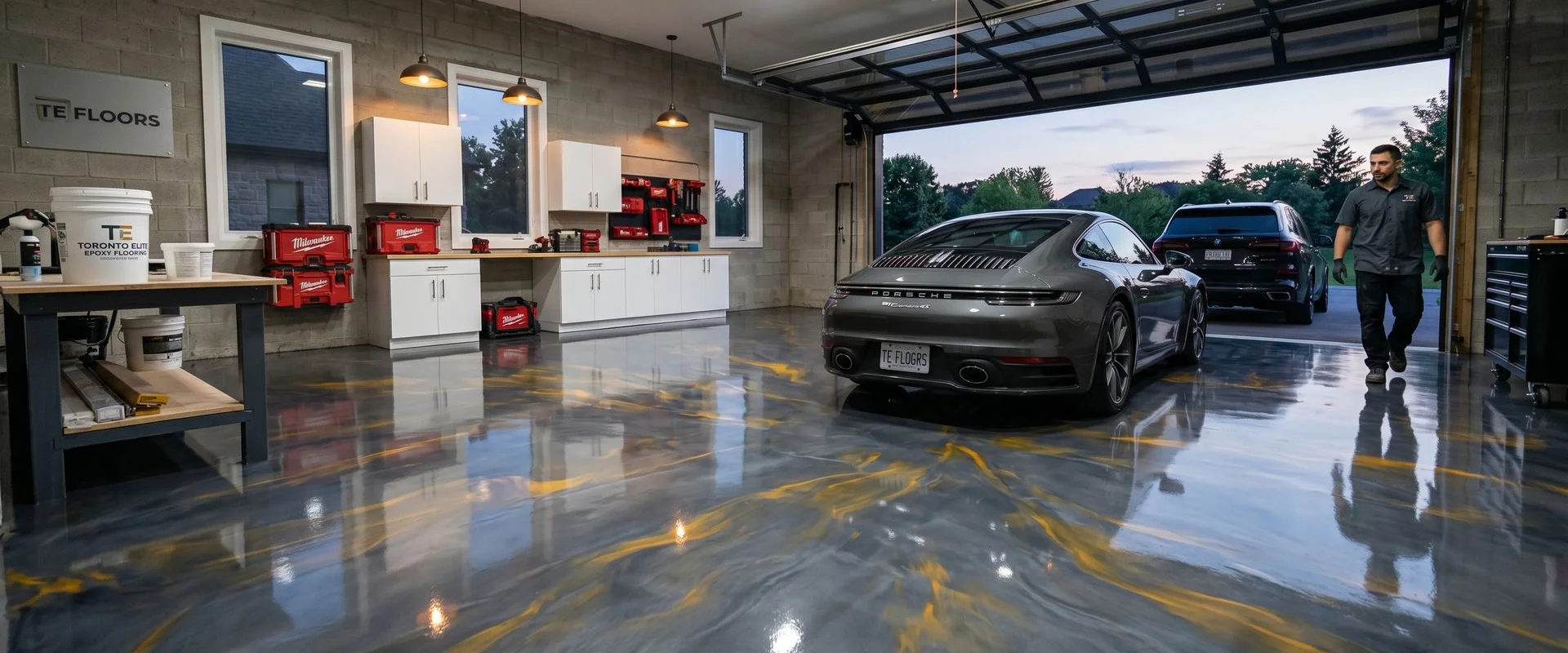
Metallic epoxy suspends aluminium or mica pigment in a high-build coat that we work with tools and air to create flowing, three-dimensional patterns. At $10-$14 per sq ft, it’s the most expensive finish. It needs a very smooth sub-base and suits showroom or collector garages where looks come first, which is common in larger homes around Lorne Park and Mineola. Metallic builds need at least a 3-mil build coat and an aliphatic polyaspartic topcoat. Aromatic urethanes turn amber over metallic pigment and shouldn’t be used.
How to Prep a Garage Floor for Epoxy (Grinding vs Etching)
Surface prep is the biggest single factor in how long a garage floor lasts. The International Concrete Repair Institute rates concrete profiles from CSP 1 (almost smooth) to CSP 9 (heavily scarified). A 100% solids system needs about CSP 3, which feels like coarse sandpaper. A weighted planetary diamond grinder is the only reliable way to reach that consistently on a residential slab.
Muriatic acid etching, still sold with DIY kits and used by some budget installers, reaches CSP 1-2 at best. Results vary with slab age, mix, and how evenly the acid is applied and neutralised. Older slabs from the 1950s and 60s often have a carbonated top layer more than 10 mm deep, and acid barely touches it. Grinding cuts through that layer to fresh aggregate whatever the slab’s age.
Oil contamination needs its own step. Motor oil, transmission fluid, and power steering fluid can soak 25 mm into uncoated concrete. We apply an alkaline degreaser, let it dwell, then grind through the contaminated layer. Epoxy over oil-soaked concrete can let go within weeks no matter how good the profile is, because the oil acts as a release agent.
Cracks are repaired after grinding and before the base coat. We use rapid-set aliphatic polyurea, which reaches over 3,000 psi tensile strength in under 30 minutes, flexes slightly with the slab, and takes the epoxy base without an extra primer. Rigid epoxy mortar is the wrong choice for moving cracks because it just cracks again with the seasons.
How Long Does Garage Epoxy Take to Cure?
“Cured” gets used loosely, and it confuses a lot of homeowners. A multi-layer garage floor goes through three stages: tack-free, light traffic, and full chemical cure.
Our aliphatic polyaspartic topcoat is tack-free in 2-4 hours at 20°C and 50% relative humidity, which is typical for a spring or fall garage. Foot traffic is fine after 12-16 hours. Cars, including a hot one fresh off the highway, need at least 24 hours after the final coat. Cold slows everything down. At 10°C, the same topcoat can need 36-48 hours before it’s ready for a vehicle. That’s normal polyurea chemistry, not a defect.
Full chemical cure, when the coating reaches its rated Shore D hardness and chemical resistance, takes 5-7 days. You can use the floor during that time, but avoid leaving spills like brake fluid or acetone on it and don’t drag heavy equipment across it. After a week, the topcoat is fully cross-linked and meets its rated ASTM D4060 abrasion resistance.
Timing matters with Mississauga’s weather. We don’t install when overnight garage temperatures will drop below 5°C unless we can add heat. Attached, heated garages in the city’s newer subdivisions are rarely an issue. Detached or unheated garages are best scheduled between late April and October. We go over all of this at the assessment so the schedule fits the weather.
Epoxy vs Polyaspartic for Garage Floors
People often ask whether epoxy or polyaspartic is better. In a well-designed system they aren’t competing, because they do different jobs. The confusion comes from installers who sell a single-coat “polyaspartic floor.” It’s faster and cheaper to put down, but it’s thinner and doesn’t last as long as a layered system.
Epoxy as the Base Coat
A 100% solids epoxy builds film quickly, typically 20-30 mils per coat, and provides the system’s structural depth. Its strengths:
- Excellent adhesion to properly prepared concrete
- High compressive strength and chemical resistance
- Builds 20-30 mils per coat for structural depth
Its weakness is UV. Aromatic epoxy yellows and chalks in sunlight, so it should never be the top layer in a garage with windows or an open door facing south. It also cures slowly, needing 12-24 hours between coats.
Polyaspartic as the Topcoat
Aliphatic polyaspartic covers all of epoxy’s surface weaknesses:
- Cures in 2-4 hours, compared with 24+ hours for standard epoxy
- Fully UV-stable, so it won’t yellow through Ontario summers
- Shore D hardness of 75-85, much harder than standard epoxy topcoats
- Rated from -30°C to +100°C, the full Ontario temperature range
On its own over bare concrete, a thin coat doesn’t build enough film for long-term impact resistance. Over an epoxy base, the two work together: epoxy gives depth and adhesion, polyaspartic gives hardness and UV resistance.
One-Day Systems vs Full Layered Systems
Single-coat “one-day” polyaspartic floors usually go down at 10-15 mils total. A full epoxy and polyaspartic system is 40-60 mils. Thinner films wear through faster under tires and show scratch patterns within 3-5 years. For a garage that handles two cars and a winter of slush, the layered system is the right spec.
Garage Floor Epoxy Cost: What to Budget
Garage epoxy prices depend on the system, the slab, and the square footage. Here’s a realistic 2026 budget for a properly installed floor in Mississauga, not a DIY kit or one-coat spray job.
Cost by System Type
| System | Price per sq ft | Best For |
|---|---|---|
| Quartz flake + polyaspartic | $6.50-$9.00 | Working garages, double/triple-car |
| Solid colour + polyaspartic | $5.50-$7.50 | Clean workshop spaces |
| Metallic + polyaspartic | $10-$14 | Showroom and collector garages |
Typical Project Totals
- 400 sq ft single-car: $2,600-$3,600 installed
- 600-800 sq ft double-car: $3,900-$7,200 installed
- 600 sq ft double-car metallic: $6,000-$8,400 installed
All prices include diamond grinding, crack repair, materials, and the warranty, based on an average slab.
Slab Condition Add-Ons
- Severe crack networks (polyurea injection and bridging): +$300-$800
- Heavy oil contamination (degreasing and extra grinding): +$200-$500
- Deep salt pitting (epoxy mortar fill): +$250-$700
- Moisture barrier for high vapour readings: +$1.50-$2.50/sq ft
All of this is identified at the assessment and written into a fixed-price contract, so the invoice holds no surprises. Comparing these numbers to a $600 kit isn’t apples to apples. A kit on an acid-etched slab typically fails within 2-4 years, and it then has to be ground off before a professional system can go down. Removal plus recoat often costs more than doing it right the first time.
Related Questions Homeowners Ask
How much does it cost to epoxy a two-car garage?
A 450-600 sq ft two-car garage with quartz flake and a polyaspartic topcoat typically costs $2,900-$5,400 installed in 2026. Clean, newer slabs in subdivisions like Churchill Meadows or Lisgar land at the lower end. Older slabs that need pit repair and oil removal land higher. Metallic finishes for the same size garage run $6,000-$8,400.
Can garage epoxy be applied in cold weather in Ontario?
Yes, with limits. The polyaspartic topcoat needs at least 10°C in the air and the slab to cure properly. That’s rarely a problem in an attached, heated garage. For detached or unheated garages, late April through October is the practical window. Propane heaters and enclosures let us work in the shoulder seasons for a small added mobilisation cost.
How do I know if my garage slab needs crack repair before epoxy?
Any crack wider than a hairline, roughly 0.3 mm, gets filled with polyurea before the base coat. The usual spots are control joints, drain frames, and the edge along the foundation wall. If one side of a crack sits slightly higher than the other, the slab is moving with the seasons, and the crack needs flexible polyurea rather than rigid mortar. We check every crack at the assessment and include the repair in the price.
What is the difference between vinyl flake and quartz aggregate in garage epoxy?
Vinyl flake chips are thin acrylic wafers that give the floor its speckled, terrazzo-style look. They’re decorative and don’t change the system’s strength much. Quartz aggregate is a harder, denser material that adds abrasion resistance when broadcast into the base. Many systems use both: quartz in the base for durability and flake on top for appearance. Our standard garage system uses a quartz and flake blend for grip and looks.
How long does the epoxy smell last after a garage installation?
100% solids epoxy has very low VOCs, typically under 50 g/L compared with 250-400 g/L for solvent-based products. Expect a mild resin smell for 6-12 hours with the door closed, or 2-4 hours with the door open or a fan running. The polyaspartic topcoat is similarly low in VOCs. If a floor gives off a strong solvent smell while it’s going down, it’s a solvent-based product and not the commercial-grade system we install.
Our Garage Epoxy Results in Toronto
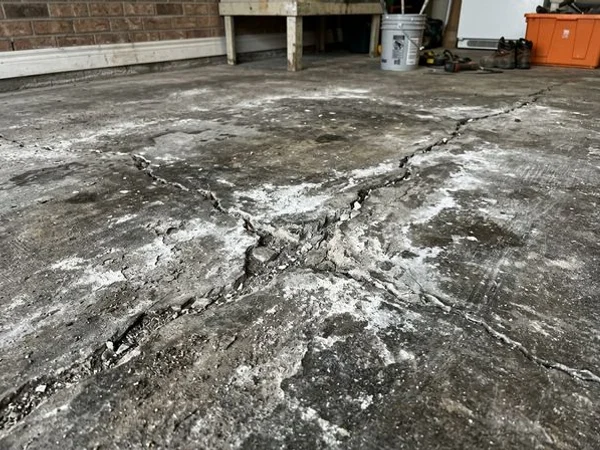
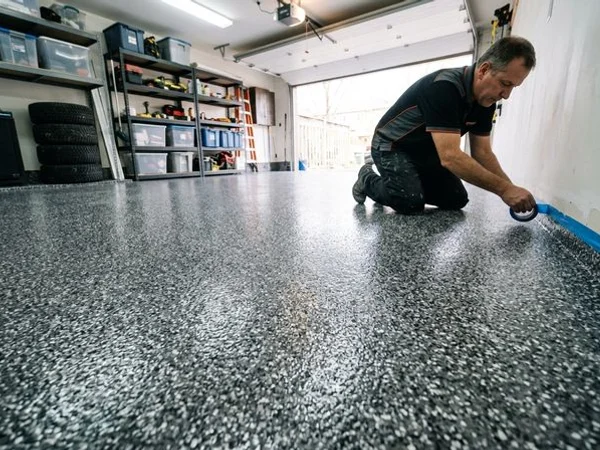
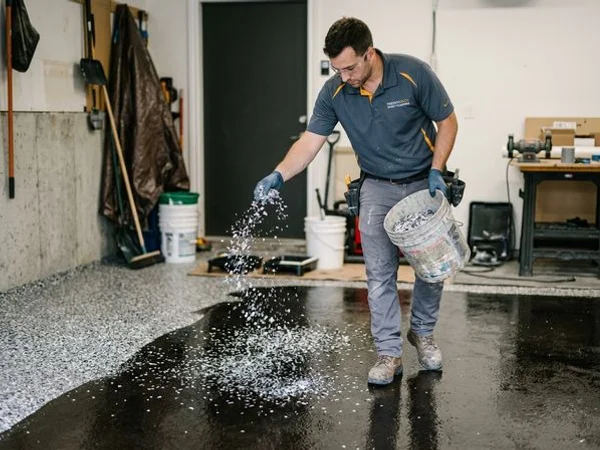
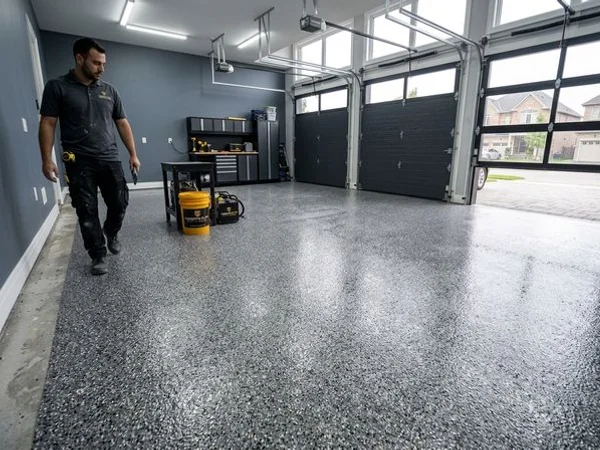
Garage Epoxy Pricing
Quartz flake + polyaspartic topcoat. Final price depends on slab condition.
Why GTA Customers Choose Toronto Elite Epoxy Flooring - Mississauga for Garage Epoxy
Built for Highway Salt and Freeze-Thaw
Polyaspartic topcoats resist brine off the 401 and QEW, -15°C cold snaps, and hot tires straight from the driveway.
100% Solid Materials
Commercial-grade zero-VOC epoxy on every job. We never use solvent-based budget products.
Warranty
Backed in writing. If the floor fails from a prep or product issue, we fix it.
Fixed-Price Quotes
On-site assessment within one business week and a fixed-price contract, with no obligation.
How Garage Epoxy Works
Free On-Site Assessment
We inspect your slab, measure square footage, and quote on the spot - same-day in most of the GTA.
Diamond Grinding Prep
We grind the concrete to a proper surface profile (CSP 3) and fill cracks. No acid etching shortcuts.
Base + Broadcast Flake
100% solid epoxy base coat, broadcast quartz or metallic flake to refusal for grip and depth.
Polyaspartic Topcoat
UV-stable polyaspartic topcoat with anti-slip grit. Ready for use in about 24 hours.
Ready for a Free On-Site Assessment?
Same-day quotes across the GTA. WSIB-certified, $2M liability on every project.
What Customers Say About Our Garage Epoxy
"Our 1960s Clarkson garage was pitted from years of salt. They filled every pit, ground the whole slab, and put down a grey flake system. Two winters later there is not a mark on it."
"Two-car garage in Churchill Meadows with a peeling DIY kit. They ground it all off and redid it properly. The fixed price was exactly what we paid."
"Metallic charcoal floor in our Lorne Park triple-car garage. Tidy crew, on schedule, and it looks like a dealership showroom."
Garage Epoxy FAQs
How much does garage floor epoxy cost in Mississauga?
Quartz-flake systems with a polyaspartic topcoat run $6.50-$10 per sq ft installed, including grinding, crack repair, materials, and the warranty. Most two-car garages in Mississauga subdivisions are 400-500 sq ft, which puts them in the $2,900-$4,500 range. Badly pitted or oil-soaked slabs cost a little more because they need extra repair before coating.
My garage is in an older Port Credit home and the slab feels damp. Can it still be coated?
Usually, yes. Older lakeside foundations often push moisture up through the slab, which is why we test with ASTM F2170 probes before quoting. If readings are high, we add a moisture-mitigating primer under the epoxy. Skipping that step is the main reason coatings bubble and lift in older homes.
Will the floor stand up to salt from my daily 401 commute?
Yes. The aliphatic polyaspartic topcoat is chemically resistant to the sodium and calcium chloride used on highways, and it forms a sealed film rather than an absorbent surface. The weak point on most failed floors is the bond to the concrete, not the topcoat, so we diamond-grind every slab to get a mechanical bond.
How long will my garage be out of service?
Most garages take 1-2 days to install. You can walk on the floor after about 12-16 hours and park on it after 24 hours. In cold weather we may ask you to wait up to 48 hours before parking a hot car on it.
Can you fix a DIY epoxy kit that is peeling?
Yes, this is one of the most common jobs we see. The failed coating has to be ground off completely to bare concrete, because new epoxy over old paint will peel the same way. After that, the floor gets the same full system as any other garage.
Epoxy flooring, metallic coatings & polyaspartic
across the Greater Toronto Area
Same crew, same materials, same written warranty on every job. Browse by service and city — or call us direct.
Don't see your city? View our full service area →
Related Services
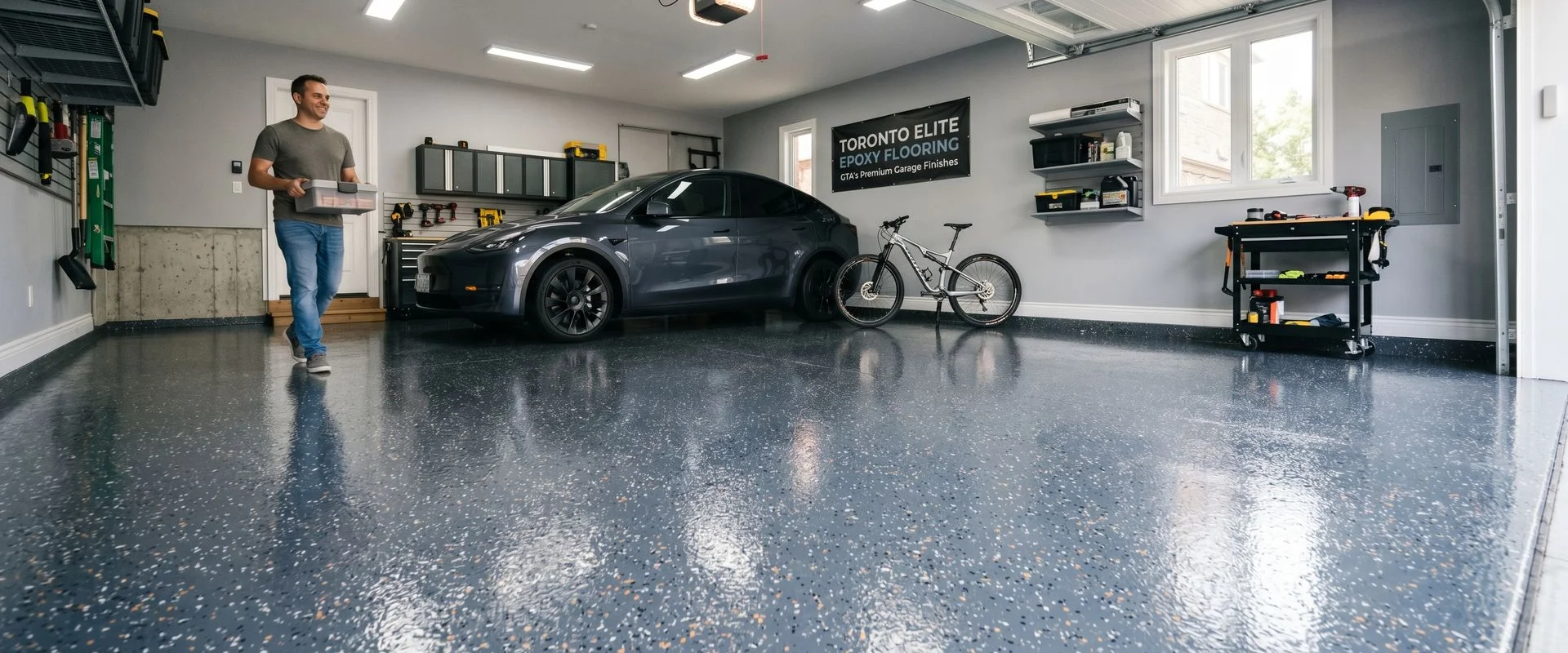
Polyaspartic Floor Coating in Mississauga, ON
Polyaspartic floor coating in Mississauga that cures fast enough to have most garages back in service within 24 hours. Aliphatic, UV-stable, and much harder than standard epoxy topcoats, with cold-weather application for winter installs. $3.50-$7 per sq ft installed, with a typical two-car garage done in one day.
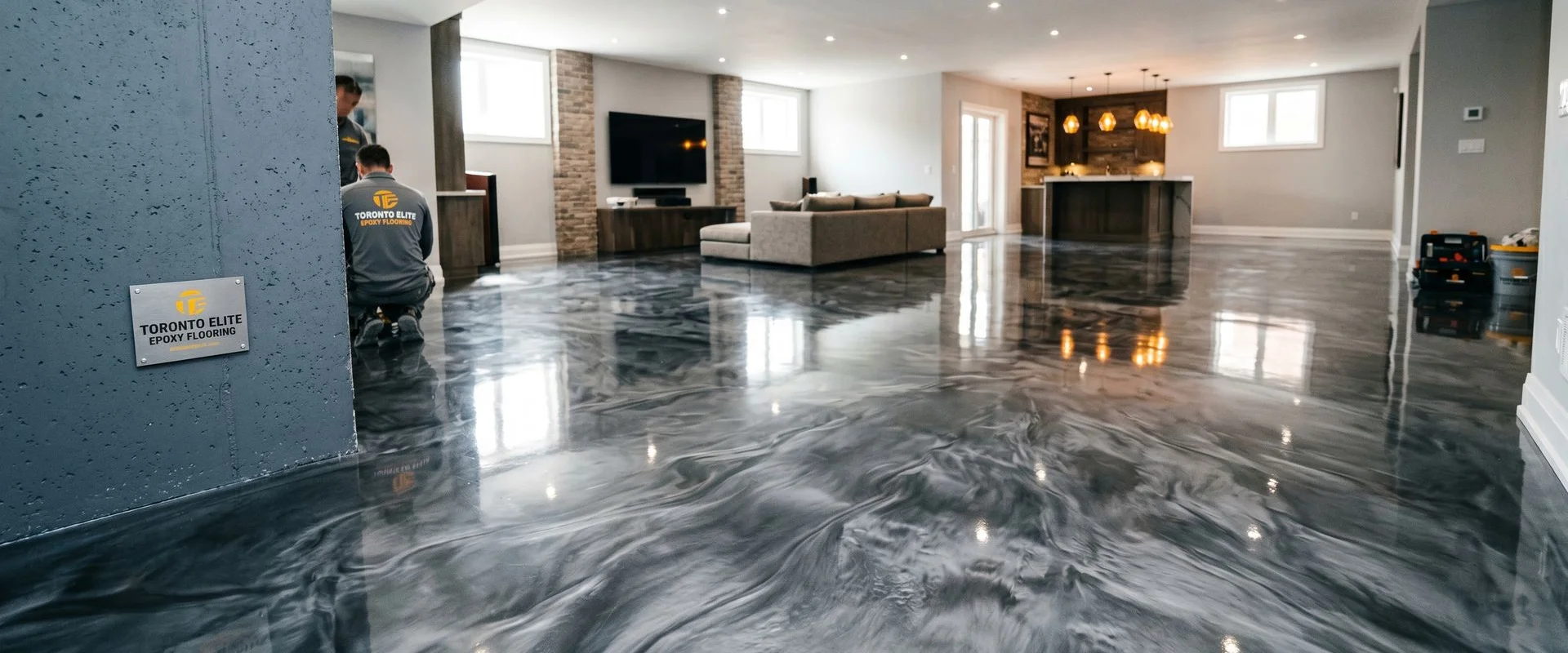
Decorative Metallic Epoxy Flooring in Mississauga, ON
Decorative metallic epoxy in Mississauga, with hand-manipulated pigments that give each floor its own 3D liquid-art look. A UV-stable polyaspartic topcoat keeps the colour true under sun and LED lighting. $9-$16 per sq ft installed, with most 500 sq ft basements or showrooms done in 2-3 days.
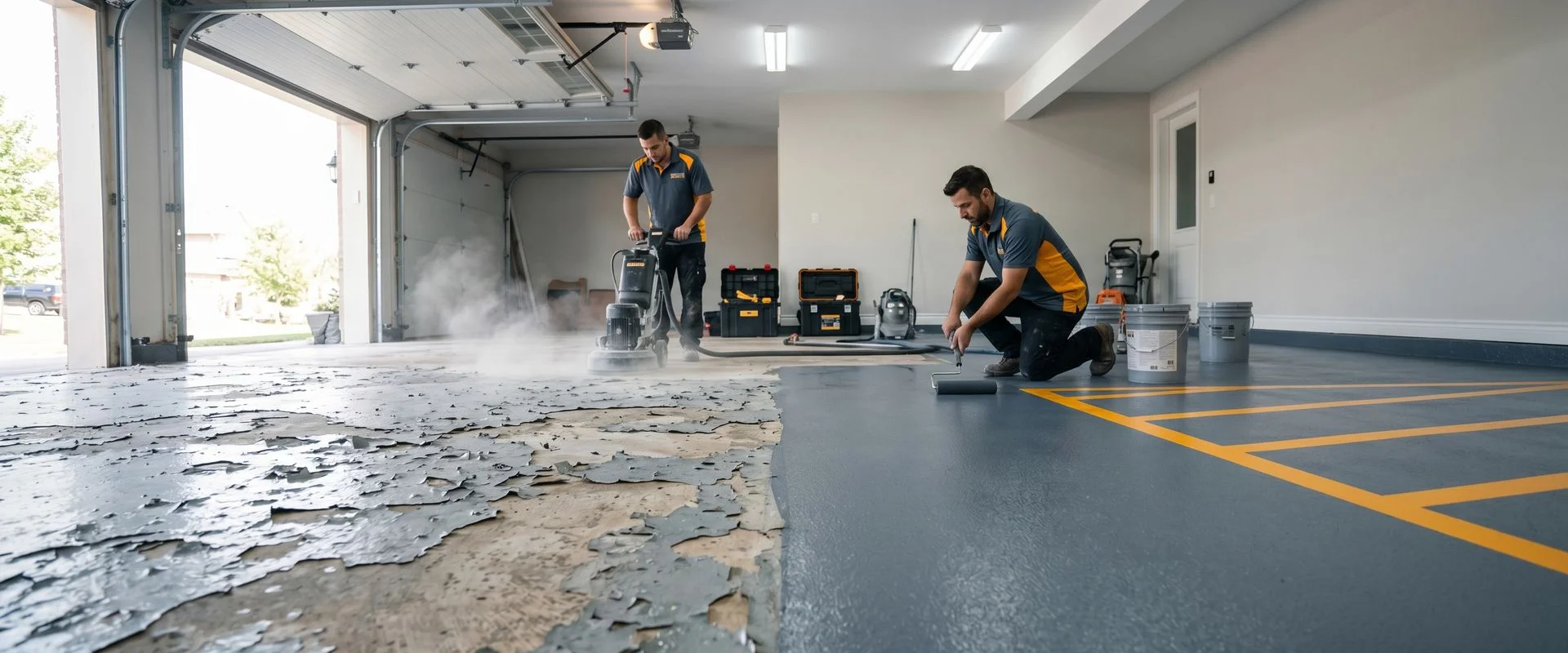
Epoxy Floor Repair & Recoat in Mississauga, ON
Epoxy floor repair in Mississauga that removes failed or peeling coatings back to bare concrete, re-tests moisture with ASTM F2170, and installs a fresh 100% solids system rated for 10-15+ years. Full recoats run $3-$7 per sq ft installed, and most garage repairs finish in 2 days. We find the root cause first so the new floor doesn't fail the same way.
Ready to Book Garage Epoxy?
Same-day free on-site assessment. WSIB-certified, $2M liability on every project.