Commercial Epoxy Flooring in Mississauga - Compliant Floors for Kitchens, Clinics, Retail, and Specialty Facilities
Toronto Elite Epoxy Flooring - Mississauga installs commercial floor systems for retail showrooms, restaurants and commercial kitchens, offices, schools, clinics and medical facilities, pharmaceutical and lab spaces, and every other type of commercial property in the city. Each project is built to the rules for that facility type: CFIA for food establishments, Ontario's Food Premises Regulation for restaurants, IPAC Canada coving for healthcare, and ISO 14644-1 for cleanrooms.
Commercial floors carry compliance and liability obligations that home floors don't. A restaurant floor cited by Peel Public Health for cracked or porous surfaces can mean a critical infraction, and a single day closed costs more than a properly installed seamless floor. Kitchens need continuous coving where the floor meets the wall, so bacteria have nowhere to hide. Clinics need 4-inch integral coving to satisfy infection control audits. What separates a compliant floor from a failed inspection usually isn't the epoxy itself. It's the detailing, the coving, and the paperwork, which most general contractors and residential installers can't provide.
Pricing runs from $3 per sq ft for open warehouse epoxy to $20 for ISO-classified pharmaceutical cleanrooms. Restaurant and kitchen floors run $8-$14, healthcare floors $9-$16, and retail showrooms $5-$9. With Mississauga's life sciences and food processing sectors growing fast, a large share of our commercial work here is regulated space, and every project includes the right compliance documentation.
Commercial Epoxy Flooring in Mississauga
Toronto Elite Epoxy Flooring - Mississauga installs CFIA-compliant kitchen systems, coved healthcare floors, ESD and pharmaceutical floors, and high-traffic retail epoxy for commercial properties across the city. Every commercial project includes the compliance documentation, off-hours scheduling, and code-level installation details that property owners and facility managers need.
Commercial Epoxy Services We Install
- Commercial & Industrial Epoxy - broadcast systems for high-traffic commercial facilities
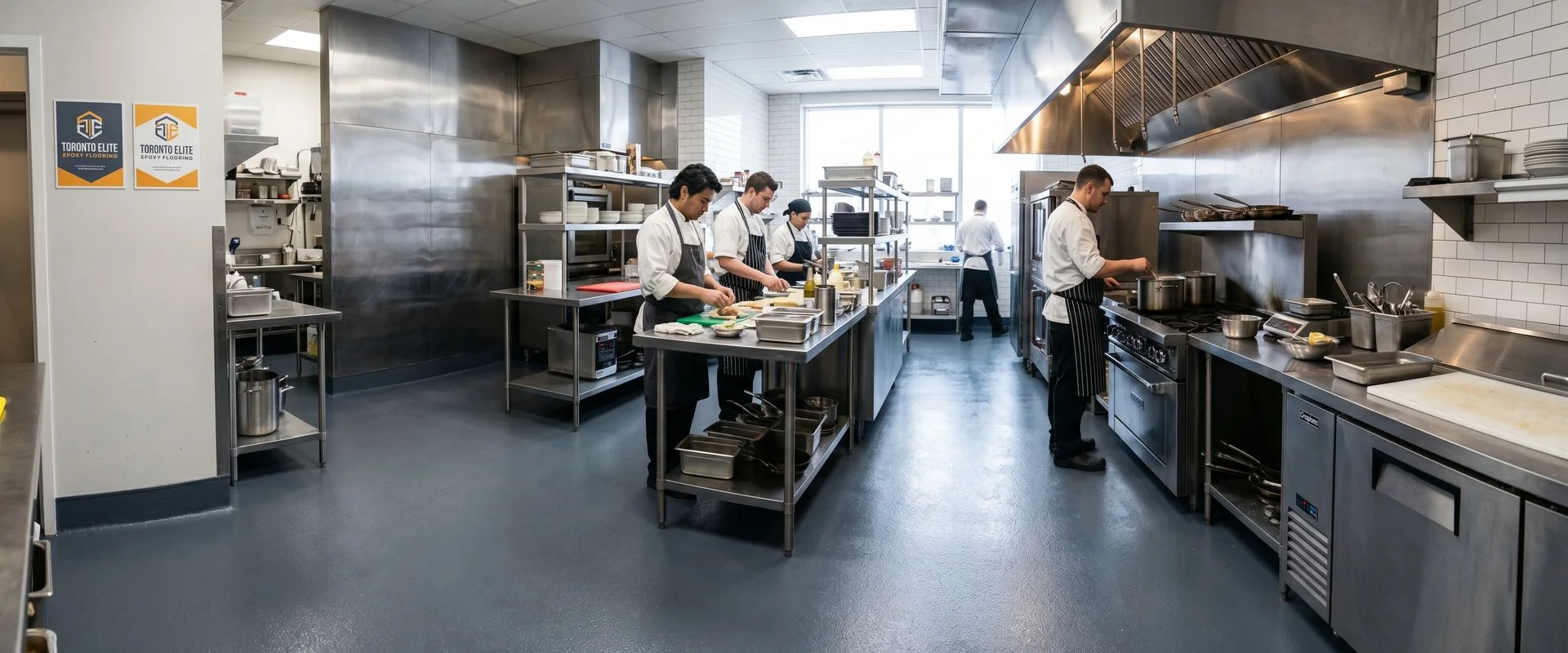
- Commercial Kitchen Epoxy - CFIA and Food Premises Regulation compliant
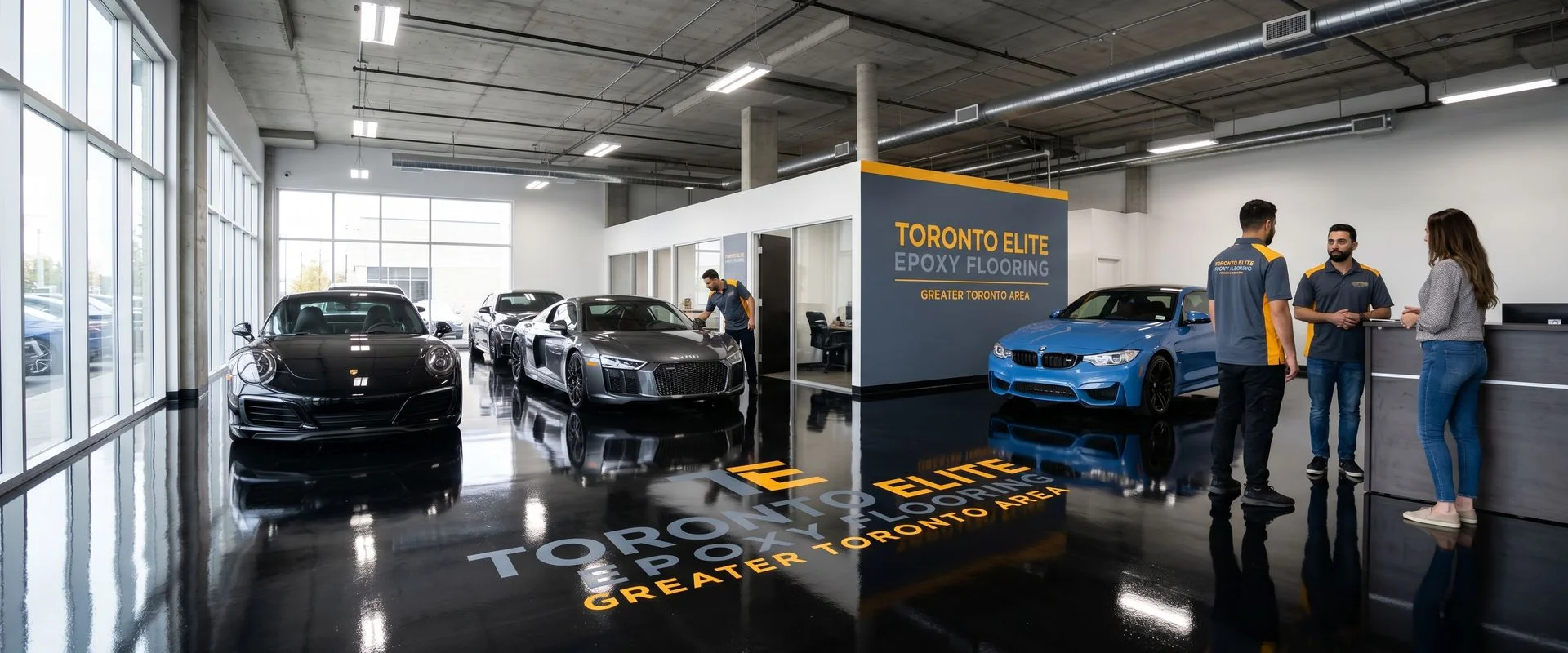
- Retail & Showroom Epoxy - rated for 1,000-5,000 daily crossings
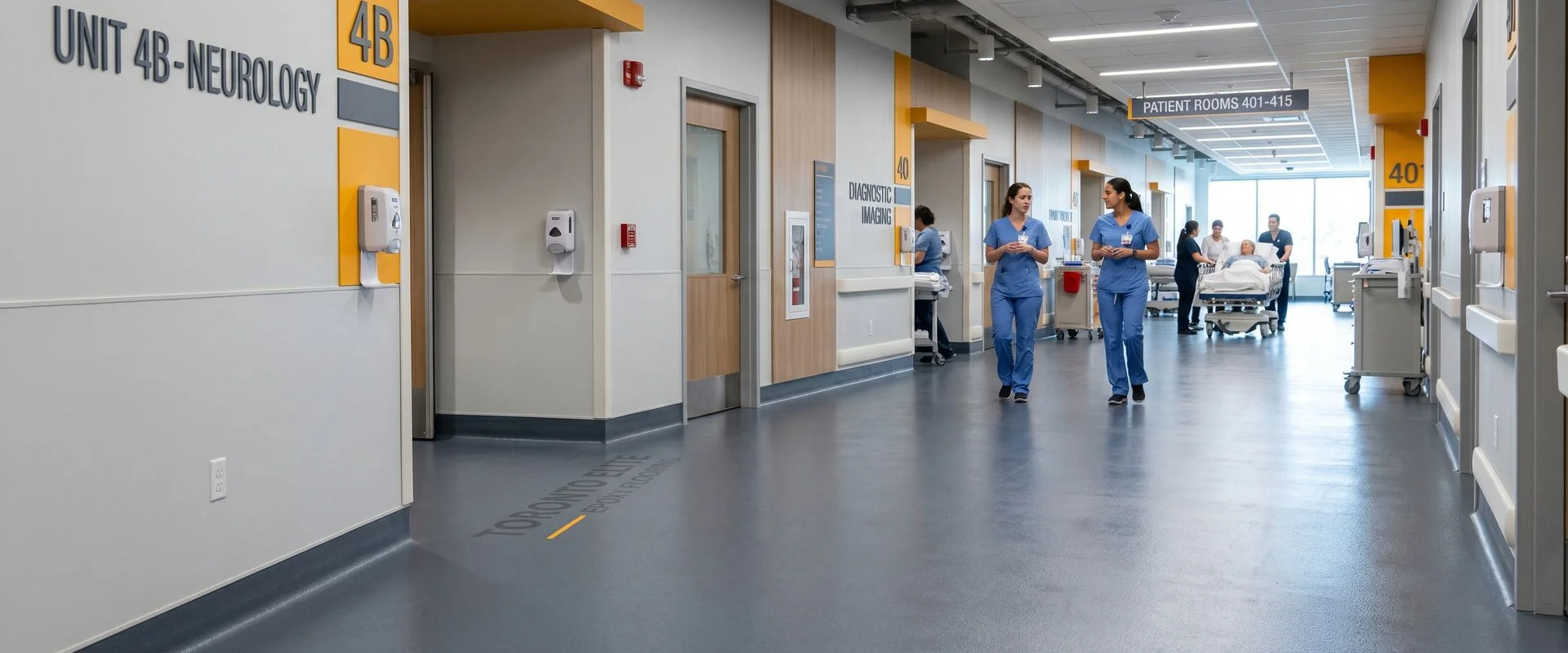
- Institutional & Medical Epoxy - IPAC Canada coving, QAC resistant
- ESD Conductive Epoxy - ANSI/ESD S20.20 compliant, 10^6-10^9 ohm
- Pharmaceutical Cleanroom Epoxy - ISO 14644-1, GMP documentation
- Laboratory Epoxy Flooring - novolac, anti-static, chemical resistant
- Secondary Containment Coatings - TSSA compliant, CCME guidance
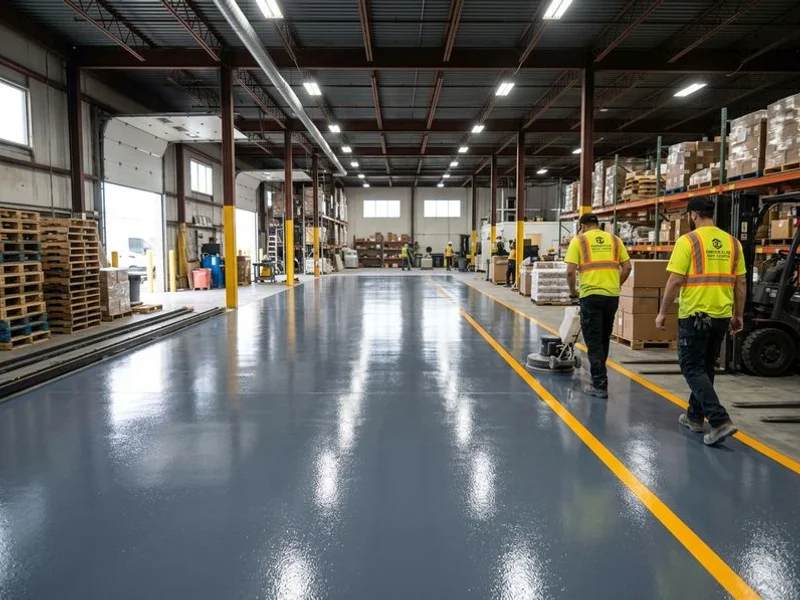
- Warehouse Epoxy Flooring - forklift-rated, 80-100 mil total build
- Parking Garage & Hangar Epoxy - ASTM C672 rated, polyurea membrane
How Much Does Commercial Epoxy Cost?
Commercial epoxy ranges from $3 per sq ft for open warehouse systems to $20 for pharmaceutical cleanrooms. Restaurant and kitchen floors run $8-$14 per sq ft, healthcare floors $9-$16, and retail showrooms $5-$9.
Benefits of Commercial Epoxy Flooring
Commercial-grade epoxy performs under constant wear in offices, schools, clinics, and stores. The floors we install combine durability, hygiene, and safety compliance in one long-term surface that meets both performance and building code standards.
Long-Term Durability and Lifespan
Our commercial floors stand up to impact, heavy foot traffic, and equipment without cracking or peeling. With 100% solids epoxy over a slab diamond-ground to CSP 3, the coating bonds mechanically and outlasts tile or vinyl by a wide margin.
Industrial-grade epoxy also resists abrasion from forklifts, carts, and tools. In mixed-use buildings, we design each zone for its own wear, so reception, corridors, and storage rooms each keep their finish.
Epoxy’s compressive strength often tops 10,000 psi, far beyond ordinary floor coatings. That means fewer repairs and less downtime, which matters for businesses that run all week or on tight maintenance schedules.
Low Maintenance and Easy Cleaning
Commercial epoxy is designed to need very little upkeep. The seamless, non-porous surface resists oil, chemical, and cleaner stains, so daily care is just sweeping and mopping, with no wax or polish.
In schools and healthcare buildings, easy maintenance means fewer disruptions. The smooth finish lets auto-scrubbers work properly, cutting janitorial time and cost.
Over time, owners save money. Because the floor doesn’t absorb liquids or hold dirt, it keeps its appearance for years, even in busy retail and restaurant settings.
Improved Safety and Compliance
Safety compliance is built into every commercial floor. Our systems meet ASTM D2047 slip resistance and Ontario Building Code requirements for public spaces, lowering liability and accident risk.
We offer textured finishes for wet and high-movement areas using the same slip-rated standards found in hospitals and production plants. They hold their grip while still cleaning easily with standard sanitation routines.
Every project includes documented checks for adhesion, gloss, and coefficient of friction. Our WSIB-cleared crews and $2M liability coverage keep the job compliant with provincial safety rules from prep to handover.
Hygienic and Allergen-Resistant Surfaces
Seamless epoxy gives bacteria, mould, and dust no joints or grout lines to settle in. That suits clinics, labs, and food prep areas that must meet strict standards under Ontario’s Food Premises Regulation and CFIA guidance.
We use low-VOC epoxy formulations suitable for LEED tenant fit-outs, which keeps odours and emissions low during and after installation. Moisture-control primers and vapour barriers also prevent microbial growth from humidity trapped under the coating.
The result is a cleaner indoor environment with better air quality. With nowhere for allergens and dust to collect, the floor supports a healthier workplace.
Professional Installation Process
Every commercial installation follows a methodical sequence designed for consistent results, minimal downtime, and code compliance. Retail floors, clinics, and school corridors all get the same technical attention to adhesion, finish, and slip resistance.
Site Evaluation and Multi-Zone Assessment
Each project starts with a full site evaluation covering slab condition, layout, occupancy classification, and how each area is used. We measure, check humidity, assess any existing coatings or damage, and map the requirements for each zone, such as reception, back-of-house, washrooms, and server rooms, before writing a scope.
For sensitive facilities like clinics and schools, we plan off-hours and weekend installs to avoid disrupting operations. The evaluation also identifies which framework applies to each area, whether that’s the Ontario Building Code, CFIA, IPAC Canada, or TSSA, so each zone gets the right system instead of one spec for the whole building.
Surface Preparation Techniques
Durable floors start with proper surface preparation. Our crews profile the concrete by CSP 3 diamond grinding or shot blasting, opening the pores and removing contaminants to create the profile epoxy needs to bond.
All surfaces are vacuumed and cleaned until dust-free before any coating goes on. In occupied buildings, we use low-dust machines and sealed HEPA vacuums so nothing drifts into neighbouring spaces. Crews follow strict safety procedures and use equipment that meets current Ontario Building Code requirements for public spaces.
| Preparation Step | Purpose | Equipment Used |
|---|---|---|
| Diamond Grinding | Achieve proper surface profile (CSP 3) | Planetary grinder |
| Crack Cleaning | Remove debris and weak edges | Angle grinder and wire brush |
| Vacuuming | Eliminate dust particles | HEPA vacuum system |
Crack Repair and Moisture Barriers
Before coating, we fix every visible flaw with crack repair and patching. Depending on how much movement we expect, cracks get epoxy filler or flexible joint sealant. Large gaps and spalls are resin-patched and sanded flush, so adhesion is even across the floor.
Moisture control is critical. High vapour emissions cause bubbling and delamination, the most common failure in commercial epoxy installed without checking the slab. We measure in-slab RH and apply a moisture barrier primer when readings are too high. That’s common in older retail plazas and office buildings along Dundas Street and Hurontario, where slabs often test above the limit.
Epoxy Application and Curing
With prep complete, the epoxy application begins. We use 100% solids epoxy systems that meet ASTM D2047 slip-resistance criteria for public spaces. Each coat is rolled or squeegeed on and checked for consistent thickness and finish.
Depending on the spec, we add colour flake, quartz broadcast, or a urethane topcoat for wear resistance and design flexibility. Temperature and humidity are monitored during cure so the floor hardens and develops gloss properly. Most systems take 16-24 hours before light foot traffic.
For LEED-certified tenant improvements, we use low-VOC systems and control air quality during the work. Our WSIB-cleared technicians keep to a tight schedule so each floor is delivered on time and meets its performance, safety, and appearance targets.
Comparing Flooring Solutions for Businesses
We compare flooring systems on performance, code compliance, and long-term durability. Each option has its own installation needs, lifecycle cost, and wear resistance.
Epoxy Flooring vs Polished Concrete
Epoxy creates a seamless, non-porous surface that resists chemicals, stains, and moisture. Polished concrete, made by grinding and densifying the slab, gives an exposed-aggregate finish with natural shine. Both appeal to facility managers who want easy-to-clean, low-maintenance floors.
For high-traffic spaces like hospital corridors, retail floors, and school gyms, our commercial epoxy flooring uses industrial-grade materials formulated for mechanical wear. Polished concrete is durable but needs periodic resealing to keep its gloss and chemical resistance.
| Feature | Epoxy Flooring | Polished Concrete |
|---|---|---|
| Surface Type | Continuous coating | Exposed aggregate |
| Maintenance | Minimal, easy to clean | Needs resealing |
| Chemical Resistance | Excellent | Moderate |
| Lifespan | 15-25 years | 10-20 years |
| Compliance | ASTM D2047 slip-rated | Depends on finish |
Advantages Over Painted Concrete
Painted concrete usually fails under regular mechanical or chemical exposure. An epoxy floor coating forms a much thicker protective layer, built for forklifts, carts, and the sanitizers used in manufacturing and food facilities.
Our systems cure without strong odours or high VOCs, which makes them ideal for LEED tenant fit-outs and occupied spaces. The seamless surface also limits dust and bacterial growth, which painted concrete can’t do in clinics and labs.
Paint shows wear within a year or two. A properly installed polymer floor keeps its gloss and integrity for more than a decade with basic care, and its slip-resistant texture meets Ontario Building Code public-access standards, confirmed by ASTM D2047 testing.
Selecting the Right System for Your Facility
The right system depends on loads, chemical exposure, regulations, and your operating schedule. Many facilities in Mississauga run around the clock, especially near the airport and along Highway 401, which makes our off-hours and weekend installation approach essential.
We break projects into multi-zone specifications, with reception, washrooms, server rooms, and kitchens each meeting their own traction or hygiene standard. Textured finishes add safety in wet areas, and high-gloss finishes improve lighting in production and retail spaces.
Our WSIB-cleared crews and $2M liability coverage meet Ontario workplace safety and insurance requirements. We help you choose a system for each zone that balances appearance, maintenance, and lifespan.
Customisation and Design Options
We match each floor to the client’s operational, visual, and safety goals by controlling the material formulation, surface texture, and layout details.
Colour, Texture, and Finish Selections
Our commercial epoxy palette includes solid colours, metallic blends, and flake systems. Retail, office, and school clients often choose neutral tones, while branded areas may call for bold accents or metallics that look like polished stone. Epoxy floor coating finishes come in matte, satin, and high-gloss, each affecting reflectivity and cleaning frequency.
Texture varies by zone. CSP 3 diamond grinding gives a consistent profile and bond, so reception areas, washrooms, and back-of-house spaces in the same building all get coordinated finishes suited to their use.
Logos, Safety Lines, and Branding
Logos, wayfinding symbols, and safety lines add both function and identity. We apply traffic markings and guide routes directly onto cured epoxy for a lasting bond, and we can embed logos and markings under a clear topcoat so they don’t wear or peel.
We use high-contrast colours that meet Ontario visibility standards. Branded elements can carry corporate colours or mark operational zones such as production, visitor, or server areas, keeping the facility compliant and professional.
Anti-Slip and Specialised Coatings
To meet Ontario Building Code requirements for public spaces, we apply slip-resistant finishes tested to ASTM D2047. Fine aggregate or micronized grip agents add traction without making the surface too rough, keeping entry vestibules and washrooms safe when wet.
We use 100% solids epoxy and low-VOC formulations suitable for LEED-certified tenant fit-outs, installed during off-hours or weekends to limit downtime. For clinics, server rooms, and ESD-sensitive electronics areas, our anti-static and chemical-resistant systems protect equipment and stand up to routine cleaning.
Industries and Applications
Our floors serve industrial, commercial, and institutional facilities across the city, built to commercial standards and in line with the Ontario Building Code and LEED low-emission requirements.
Warehouses and Industrial Facilities
In warehouses, factories, and logistics hubs, performance and safety come first. Our industrial epoxy flooring handles forklifts, pallet jacks, and heavy machinery without wearing through or delaminating. Every system starts with CSP 3 diamond grinding or shot blasting and uses 100% solids epoxy with compressive strength often above 10,000 psi.
The seamless finish resists oils, solvents, and chemical spills common in manufacturing. We regularly install ASTM D2047-compliant slip-resistant finishes in busy aisles and loading areas. Facility managers in Meadowvale Business Park and the Airport Corporate Centre value our dust-controlled prep, which keeps adjacent areas working during the install.
Retail, Commercial, and Office Spaces
Epoxy delivers long-term value in showrooms, offices, and retail chains where appearance and performance both matter. Our commercial epoxy flooring gives a clean, uniform finish that fits contemporary design and resists heavy foot traffic.
In multi-zone spaces, we specify different finishes within one coordinated project, which cuts future maintenance and keeps tenants running. For LEED tenant fit-outs, our low-VOC coatings support better indoor air quality and LEED EQ credit documentation.
Property managers in the City Centre office towers and along the new Hurontario corridor developments rely on our flexible scheduling to complete work overnight or on weekends without tenant downtime. Compared with tile or vinyl, commercial epoxy offers higher compressive strength and easier cleaning, which matters in offices, clinics, and schools.
Specialised Environments and Safety Requirements
We also floor medical clinics, schools, and food service areas, where regulations decide how the surface must perform. Slip resistance, hygiene, and containment come first in these settings.
Where electronics or lab chemicals are present, we add static-dissipative or chemical-resistant coatings. Meeting the Ontario Building Code’s public-access slip resistance requirement protects patients and visitors. Clinics and schools often get integral cove bases to stop bacteria from building up at wall junctions, as IPAC Canada guidance requires.
Every project carries WSIB clearance and $2M liability coverage. Experienced installation combined with local compliance knowledge keeps facilities safe, attractive, and ready for inspection.
Related Questions Property Managers Ask
What compliance documentation do I need after commercial epoxy flooring is installed?
It depends on the facility. Commercial kitchens need a material data sheet showing the system is seamless, non-porous, and cleanable, plus confirmation of coving at floor-to-wall junctions. Healthcare facilities following IPAC Canada guidance need installation records confirming at least 4-inch coving and a QAC-resistant topcoat. LEED fit-outs need product VOC documentation for EQ credits. Public areas under the Ontario Building Code need coefficient of friction results showing ASTM D2047 compliance. We provide all of these as a standard package at completion.
Can a restaurant reopen the same day epoxy flooring is installed?
Not the same day, but often the next morning if it’s scheduled well. A typical kitchen job runs from Thursday night through Friday, with the floor cured and ready for weekend service. The polyaspartic topcoat over the base system reaches light foot traffic in 16-24 hours. We plan kitchen work around your week: Thursday night prep and grinding, Friday overnight coating, Saturday morning inspection and opening. That’s why the first step is always a site visit to review your layout and hours.
What is the minimum thickness for a commercial epoxy floor that must support forklifts and pallet jacks?
Floors with forklift and pallet jack traffic need at least 60-80 mils total dry film thickness for adequate impact resistance. That usually means three coats: moisture-tolerant primer, 100% solids epoxy base, and a urethane or polyaspartic topcoat. Narrow-aisle forklifts and heavy racking with concentrated point loads may need extra quartz broadcast to reach 80-100 mils. At those thicknesses, 100% solids epoxy exceeds 10,000 psi compressive strength, well above what standard material handling equipment demands in local distribution and manufacturing facilities.
Does an industrial facility need a permit to install epoxy flooring?
Usually not. An epoxy coating is a surface treatment rather than a structural change, so it doesn’t typically need a building permit from the City of Mississauga Building Division. Permits or approvals may be needed if the work adds floor drains, penetrates fire-rated assemblies, changes a building’s use, or alters secondary containment covered by TSSA or provincial regulations. We flag anything that touches regulated building systems during the assessment and coordinate with your building management before work starts.
What is the difference between ESD dissipative and ESD conductive epoxy, and which does an electronics or data centre facility need?
ESD dissipative epoxy (10^6-10^9 ohm surface resistance) bleeds static to ground slowly and safely. It’s the right spec for most electronics manufacturing, PCB assembly, and data centres. ESD conductive epoxy (under 10^6 ohm) discharges faster and is required where static could ignite explosive or pyrotechnic materials. For electronics and data centre work, including the tech and aerospace facilities around the airport, dissipative systems meeting ANSI/ESD S20.20 are standard. We test every ESD floor with a calibrated surface resistance meter and provide ANSI/ESD S20.20 documentation at handover.
Commercial Epoxy Pricing
Pricing varies by facility type and compliance specification.
Why GTA Customers Choose Toronto Elite Epoxy Flooring - Mississauga for Commercial Epoxy
Off-Hours & Section-by-Section Scheduling
Most businesses can't close for three days of floor work. We schedule overnight, weekend-only, and section-by-section phases around your hours: reception Friday night, back-of-house Saturday, washrooms Sunday, fully open Monday.
Multi-Zone Specification in One Project
Reception, washrooms, server rooms, kitchens, and back-of-house each need a different system. We specify slip-rated finishes for wet areas, low-VOC for occupied offices, and chemical-resistant coatings for storage, all as one coordinated project.
Ontario Building Code Slip Compliance
The Ontario Building Code requires slip-resistant floors in public-access areas. We install ASTM D2047-compliant systems and hand over coefficient of friction documentation on every commercial project.
LEED-Eligible Low-VOC Systems
Our 100% solids, low-VOC systems support LEED EQ credit documentation for tenant fit-outs. Applied off-hours and returned to service the next morning with no lingering odour.
How Commercial Epoxy Works
Multi-Zone Assessment
Facility layout review, occupancy classification, and regulatory requirement mapping (Food Premises Regulation, CFIA, IPAC Canada, Ontario Building Code). Zone-specific coating requirements and off-hours installation windows identified before quoting.
CSP 3 Grinding & Substrate Repair
Diamond grinding to CSP 3, HEPA-filtered dust collection, crack and joint repair with epoxy mortar, moisture testing with moisture-barrier primer applied to any slab above RH threshold.
Zone-by-Zone Epoxy Application
100% solid epoxy base coat with zone-specific topcoats - ASTM D2047 slip-rated for public access, chemical-resistant for back-of-house, low-VOC for occupied spaces. Safety lines and demarcation applied where specified.
Compliance Docs & Return to Operations
Adhesion and coefficient of friction testing, compliance records matched to facility type, phased return-to-operations so the facility stays functional throughout.
Ready for a Free On-Site Assessment?
Same-day quotes across the GTA. WSIB-certified, $2M liability on every project.
What Customers Say About Our Commercial Epoxy
"Multi-zone office fit-out near Square One. Reception, server room, and washrooms, all in one long weekend. They used a different system for each zone, which nobody else had even suggested, and it still looks like one design. We opened Monday morning without losing an hour."
"Our Erin Mills dental clinic needed 4-inch integral coving and a seamless floor for our infection control audit. They removed the old tile, ground the slab, installed the coved epoxy, and gave us all the documentation. The auditor signed off with no follow-up questions."
"Our restaurant floor on Lakeshore had cracked grout and got flagged by the health inspector. They installed a seamless coved system Thursday night through Friday and we were open for weekend service. The inspector noted the new floor on the follow-up visit."
Commercial Epoxy FAQs
What commercial epoxy floors do you install in Mississauga?
Commercial kitchen and restaurant floors, retail and showroom systems, coved healthcare floors, ISO-rated pharmaceutical cleanroom systems, novolac lab floors, ESD conductive and dissipative floors, secondary containment, and general warehouse and office epoxy. Our crews work across the city, from Square One offices to plants in Meadowvale and Malton.
How much does commercial epoxy flooring cost in Mississauga?
From $3 per sq ft for open warehouse epoxy to $20 for pharmaceutical cleanrooms. Restaurant and kitchen floors run $8-$14, healthcare $9-$16, retail $5-$9, and general office or multi-zone fit-outs $5-$12. Every commercial quote becomes a fixed-price contract after an on-site assessment within one business week.
Who inspects restaurant and kitchen floors in Mississauga?
Peel Public Health inspects food premises in Mississauga under Ontario's Food Premises Regulation. Floors need to be smooth, non-absorbent, and easy to clean, with no cracked tile, open grout, or gaps at the walls. We install seamless systems with integral coving and provide material and installation documentation you can show an inspector.
Can you install without closing our business?
Yes. Most commercial projects run overnight, on weekends, or in phases so the rest of the facility stays open. We use low-VOC or zero-VOC chemistry in occupied buildings so air quality isn't a problem the next morning.
How long does a commercial epoxy floor last?
Typically 7-15 years depending on traffic, chemicals, and cleaning. Kitchens under daily hot washdowns usually need a recoat after 7-10 years. Retail and office floors last 10-15 years. Novolac and urethane cement systems in healthcare and cleanrooms can last 10-20 years with proper maintenance.
What slip resistance standard applies to commercial floors in Ontario?
The Ontario Building Code requires slip-resistant surfaces in public walking areas. ASTM D2047 is the test used to confirm a coefficient of friction of at least 0.5. We provide test results with every commercial project, which facility managers often need for insurance and code records.
Epoxy flooring, metallic coatings & polyaspartic
across the Greater Toronto Area
Same crew, same materials, same written warranty on every job. Browse by service and city — or call us direct.
Don't see your city? View our full service area →
Related Services
Commercial Kitchen Epoxy Flooring in Mississauga, ON
Commercial kitchen epoxy in Mississauga: seamless, CFIA-compatible floors with 4-6 inch coving, quartz anti-slip broadcast, and zero-VOC chemistry for restaurants and food service. $5-$11 per sq ft installed for standard systems. Most kitchens finish in 2 overnight shifts with no lost service, and health inspection documentation is included.
Retail Showroom Epoxy Flooring in Mississauga, ON
Retail showroom epoxy in Mississauga: high-gloss floors with custom RAL colour matching, optional logo inlays, and an aliphatic polyaspartic topcoat that resists scuffing and UV yellowing under heavy foot traffic. $4-$9 per sq ft installed for standard systems, with most showrooms done in 2-3 overnight shifts and no lost business days.
Institutional & Medical Epoxy Flooring in Mississauga, ON
Institutional and medical epoxy flooring in Mississauga: seamless antimicrobial systems with 4-6 inch coving and zero-VOC chemistry for hospitals, clinics, schools, and long-term care. $6-$12 per sq ft installed for standard systems, with section-by-section scheduling so the facility stays open. WSIB cleared, $2M liability, IPAC Canada documentation.
Warehouse Epoxy Flooring in Mississauga, ON
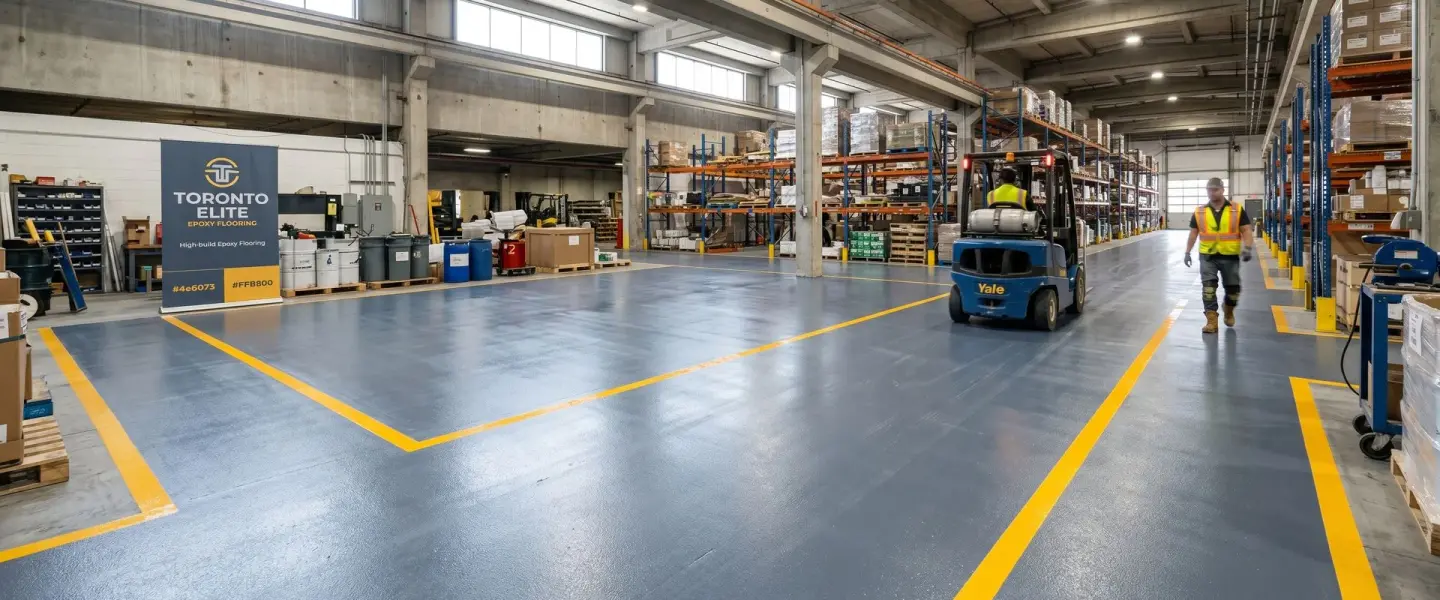
Warehouse epoxy flooring in Mississauga: forklift-rated 100% solids systems with shot-blast prep, chemical-resistant topcoat, and embedded line marking for distribution centres and logistics hubs. $3-$7 per sq ft installed, with large floors done in off-hours weekend windows. WSIB-cleared crews, $2M liability, full compliance documentation.
ESD Conductive Epoxy Flooring in Mississauga, ON
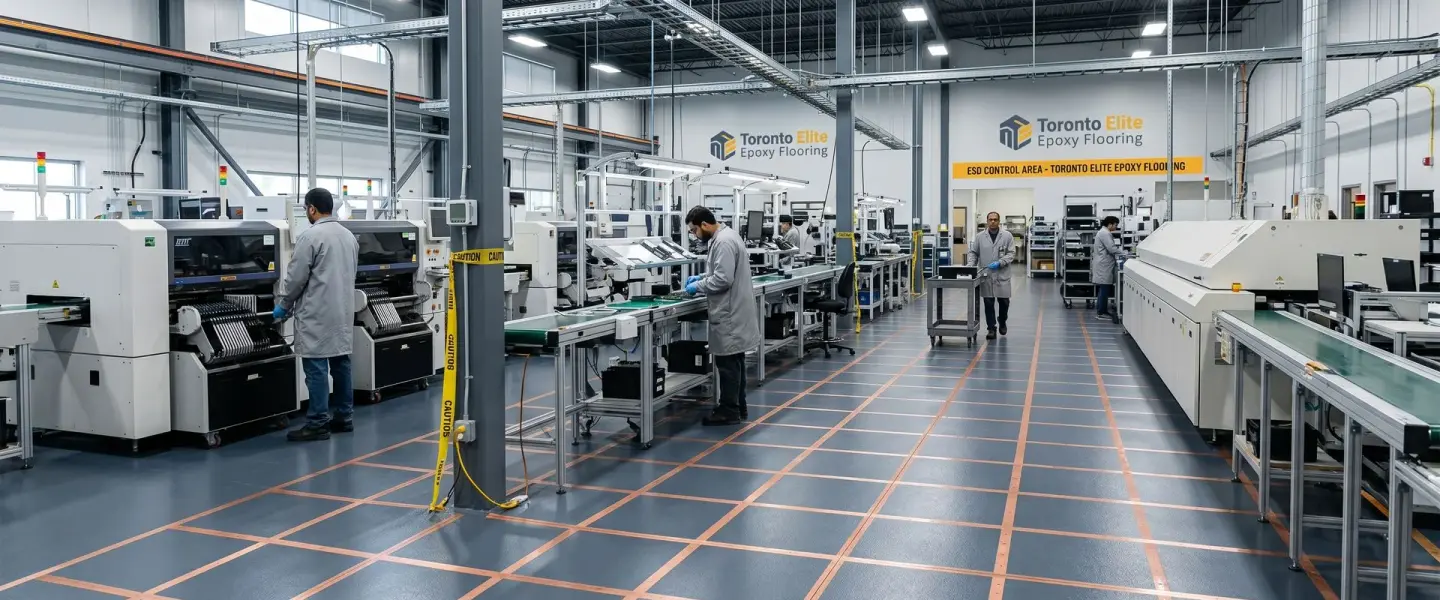
ESD conductive epoxy in Mississauga, built to ANSI/ESD S20.20 with a copper grounding grid and verified by megohmmeter to NFPA 99 and ESD Association STM7.1. $7-$14 per sq ft installed for standard systems, with resistance testing and a full compliance report included. Built for electronics, aerospace, data centres, and cleanrooms.
Ready to Book Commercial Epoxy?
Same-day free on-site assessment. WSIB-certified, $2M liability on every project.