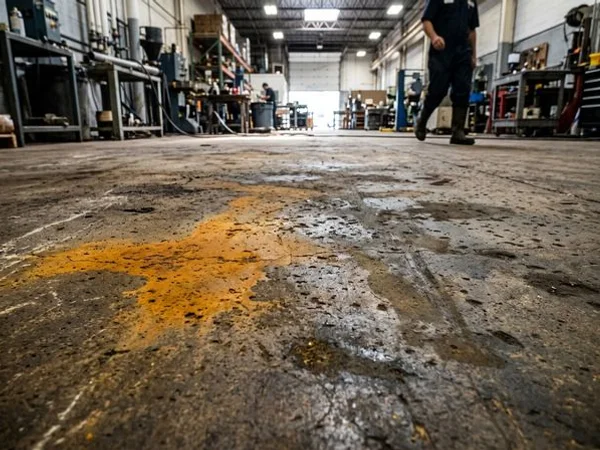
Secondary Containment Coatings in Mississauga - TSSA Berms, Chemical Storage, and Spill Containment
Toronto Elite Epoxy Flooring - Mississauga installs novolac epoxy, vinyl ester, and polyurea containment coatings for fuel tank berms, chemical storage rooms, transformer and electrical equipment pads, drum storage, and hazardous material spill containment. Every project is designed around the 110% containment volume required for above-ground fuel storage under Ontario Regulation 217/01 (Liquid Fuels) and TSSA guidance, with chemical resistance confirmed for the exact fuel, chemical, or fluid being stored.
Containment coatings fail in different ways than floors. A floor coating only has to resist splashes. A containment berm, by definition, sits full of liquid after a spill. Standard epoxy on a slab that emits moisture vapour lets go under hydrostatic backpressure when the berm fills, so the spill attacks the coating from above while moisture pushes it off from below. Vinyl ester systems, used in chemical plant containment under NACE SP0892 and ASTM C722, resist concentrated sulphuric, hydrochloric, and nitric acid, solvents, and hydrocarbons under full immersion where novolac would eventually fail. The Ontario Building Code also requires impermeable floors where dangerous goods are stored, and a failed containment surface can leave the owner facing remediation costs of $50,000-$500,000 per contaminated site.
Mississauga's Southdown Industrial Area and Clarkson corridor host heavy industry, chemical plants, and fuel storage, and logistics yards across the city run their own tanks and generators. Most containment projects run 100-2,000 sq ft and take 1-3 days. Pricing runs $10 to $18 per sq ft depending on chemistry, system, and documentation.
Secondary Containment Coatings in Mississauga
Toronto Elite Epoxy Flooring - Mississauga installs TSSA-compliant novolac epoxy, vinyl ester, and polyurea containment coatings for fuel storage berms, chemical storage rooms, transformer pads, and industrial spill containment. Our immersion-rated systems meet Ontario liquid fuels requirements, TSSA guidance, and the CCME Environmental Code of Practice, with full documentation on every project.
What Are Secondary Containment Coatings?
Secondary containment coatings are immersion-rated epoxy or vinyl ester systems applied to the floors and walls of berms, spill pads, and chemical storage areas. They keep petroleum and hazardous chemicals from contaminating the concrete and soil when there’s a spill. Unlike floor coatings designed only for splashes, they must stay impermeable under static immersion, meaning the full load of a berm after a tank fails.
What Does a Secondary Containment System Include?
- ASTM F2170 moisture verification before application
- CSP 3-5 diamond-ground or blast-cleaned surface preparation
- Moisture-tolerant primer penetrant coat
- Immersion-rated vinyl ester or novolac epoxy base coat
- Oil and chemical separator berm edge detailing
- Wall-to-floor junction sealing
- TSSA and CCME compliance documentation
How Much Do Secondary Containment Coatings Cost?
Containment coatings run $10-$18 per sq ft installed, depending on chemical resistance, the system selected, and documentation required. Most projects run 100-2,000 sq ft.
Key Benefits of Secondary Containment Epoxy Systems
Our containment systems are designed for industrial reliability, environmental compliance, and chemical durability. They protect concrete, reduce environmental liability, and satisfy regulators across Ontario’s industrial sectors.
Environmental and Regulatory Compliance
Our containment coatings are engineered to meet provincial and federal standards, including Ontario’s liquid fuels regulation and Technical Standards and Safety Authority (TSSA) guidance, which govern spill control and storage containment at fuel and chemical handling sites. In Mississauga, the Ontario Building Code also requires impermeable floors wherever dangerous goods or hazardous chemicals are stored.
Every design includes 110% spill volume verification and oil or chemical separator berm detailing, consistent with the CCME Environmental Code of Practice. Following the NACE SP0892 lining standard keeps prep and application quality high enough to stand up to regulatory audits and environmental reporting.
To help operators show due diligence, we document installation details including slab moisture readings, coating thickness, and cure times. That supports TSSA inspection readiness and ISO 14001 environmental recordkeeping.
Chemical and Impact Resistance
Our containment systems resist the strong acids, caustics, and hydrocarbons that eat concrete during a spill. Formulated to ASTM C722 chemical-resistant mortar criteria, they reduce concrete permeability and hold their bond through thermal cycling and vibration.
In concentrated acid and solvent zones, vinyl ester coatings perform much better than novolac under full immersion. Their dense polymer network gives sustained resistance to sulphuric, hydrochloric, and nitric acid and halogenated solvents in tank farms, mixing pits, and transfer areas where a berm can fill completely. That’s the reality in many of the chemical and heavy industrial plants in the Southdown Industrial Area.
Impact resistance matters too. Our commercial-grade materials absorb equipment shock without cracking the substrate, protecting pump pads and neutralization basins from wear that would eventually compromise containment.
Longevity Under Continuous Chemical Exposure
Our multi-layer systems combine a primer, an immersion-rated mid-coat, and a wear-resistant topcoat, so they can carry forklift and chemical cart traffic with less downtime for reapplication. Bond strength between the liner and CSP 3-5 prepared concrete exceeds 300 psi pull-off, maintaining integrity under continuous chemical exposure.
A properly installed vinyl ester containment system lasts 10-20 years depending on chemical contact, UV exposure, and inspection. We recommend checking berm edges and junctions every year. A well-maintained containment coating also protects your position under the Ontario Environmental Protection Act, since a failure that contaminates soil can bring remediation costs above $500,000 per site.
Critical Installation Steps and Surface Preparation
Every containment system depends on careful assessment, precise prep, and controlled installation. Because coatings can be pushed off from below when the berm fills, containment demands a higher prep standard than ordinary floors.
Containment Volume Assessment and System Specification
Every project starts with an on-site assessment of the substrate, containment layout, stored substances, and regulatory exposure. Moisture readings, chemical compatibility checks, and volume calculations shape the design so the system meets provincial fuel regulations and TSSA requirements for containment capacity and documentation.
We confirm 110% containment capacity by calculating wall height, footprint, and internal slope against the largest vessel. Coating thickness and primer type are specified to NACE SP0892, and you get a written scope covering resin selection, base coat thickness, and cure schedule before work starts.
Concrete Repair and Chemical-Resistant Joint Treatment
Proper concrete repair is the foundation for immersion-rated adhesion. We check compressive strength and remove failed coatings and hollow areas before filling voids. Structural cracks and cold joints get flexible sealants or epoxy injection rated under ASTM C722, the same standard that governs the containment coating.
In containment zones, we add oil and chemical separator berm details to manage spills and stop them spreading into neighbouring floor areas. All repairs are finished flush for even film thickness. Older berms in the Southdown and Clarkson industrial areas usually need this repair phase before any recoat.
Diamond Grinding and Surface Profiling (CSP 3-5)
We grind to CSP 3-5 for containment, higher than the CSP 3 used on ordinary floors. Containment coatings face hydrostatic pressure from below that regular floors never do, and a deeper profile means a stronger mechanical bond and better containment under immersion.
Our crew uses HEPA-filtered, dust-controlled grinders that meet site safety and cleanliness standards. After grinding, ASTM F2170 in-situ moisture testing confirms vapour emission is below 3 lb/1,000 sq ft/24 hr. High vapour emission is the most common cause of containment coating failure, because moisture pressure from below lifts the coating when the berm fills.
Epoxy Flooring Options for Containment Solutions
Containment floors have to match the chemistry to the resin. Specifying novolac where vinyl ester is needed produces a system that passes its first inspection and fails during its first serious spill.
Industrial-Grade Novolac and Vinyl Ester Systems
Our industrial containment systems are built to Ontario’s liquid fuels requirements and TSSA secondary containment guidance, using ASTM C722 chemical-resistant mortars and dense industrial resins that resist fuels, acids, and alkalis under full immersion.
Novolac epoxy is the right choice for petroleum containment: fuel berms, transformer dielectric fluid pads, and waste oil sumps. Vinyl ester is required when the stored substance is a concentrated acid, strong caustic, or aggressive solvent, because its chemistry provides sustained immersion resistance where novolac would eventually soften. Chemical manufacturers with mixed storage may need both systems in the same footprint, depending on which areas face which substances.
| Feature | Specification |
|---|---|
| Chemical Resistance Standard | ASTM C722 Compliant |
| Regulatory Compliance | Ontario liquid fuels regulation, TSSA, CCME, OBC |
| Spill Capacity | 110% Verified |
| Lining Standard | NACE SP0892 |
| Liability Coverage | WSIB-Certified, $2M |
Polyurea Spray Systems for Rapid Return to Service
When downtime is the main constraint, polyurea spray containment gets you back in service fast. It reaches mechanical service in 2-4 hours and full containment service in 24 hours, much faster than the 5-7 days epoxy needs for full immersion cure.
Polyurea also bridges cracks well where joints or the substrate are still moving. Its 300-400% elongation lets it accommodate movement without lifting at cracks. That’s valuable on older concrete containment structures where complete crack repair before coating isn’t always practical.
Decorative Safety Markings and Zone Demarcation
Containment performance comes first, but clear markings help with operations and maintenance planning. Using safety colour coding, we mark spill zones, drainage routes, and equipment boundaries.
Safety lines and colour-coded zones are set into the final coating layer, identifying walkways, drain paths, and equipment staging without compromising chemical resistance. Colours follow Ontario occupational safety coding for industrial environments.
Application Areas Across Industrial Sectors
We apply containment coatings wherever petroleum, chemical, or hazardous material storage creates regulatory and environmental exposure.
Industrial Facilities and Manufacturing Plants
We install containment systems in plants that handle chemicals, fuels, and wastewater, providing continuous protection with 110% spill volume verification and resistance to acids, caustics, and petroleum under immersion. Automotive, aerospace, food processing, pharmaceutical, and electronics manufacturers all need containment for chemical storage and transfer areas, and Mississauga has all of them.
We design oil and chemical separator berm details into the layout to keep zones separate and prevent cross-contamination. A proper containment lining extends a structure’s service life by 10-15 years compared with bare concrete, which starts absorbing contamination from the first spill.
Fuel Storage Berms and Transformer Pads
TSSA-regulated fuel berms are the most common containment application in industrial and commercial settings, including the fleet fuelling yards common around Pearson and along Highway 401. Above-ground tank berms must have an impermeable coating that meets the 110% volume requirement. We provide the specification, installation, and documentation package needed for TSSA inspection.
Transformer pads holding dielectric fluid need a petroleum-resistant coating with UV stability outdoors and enough flexibility for freeze-thaw. Novolac epoxy with an elastomeric topcoat or a polyurea system is appropriate, depending on thermal cycling and how quickly the pad must return to service.
Commercial and Institutional Environments
Hospitals, research centres, universities, and utilities need containment for chemical storage rooms, generator fuel tanks, and lab chemical storage. These spaces combine regulatory requirements with appearance standards, so our coatings stay cleanable and semi-gloss while resisting chemicals.
Every project includes thickness verification, WSIB-cleared installation records, and full compliance documentation. For organizations under combined food, pharmaceutical, or environmental rules, we structure one documentation package to satisfy multiple regulatory frameworks.
Related Questions Facility Managers Ask
What is the most common failure mode in secondary containment coatings and how is it prevented?
Hydrostatic backpressure delamination, where the coating lifts from below when the berm fills because vapour pressure in the slab is stronger than the bond. It’s the most preventable failure and the most often overlooked. Preventing it takes three things: ASTM F2170 testing to confirm vapour emission is within tolerance, a moisture-tolerant primer that bonds with residual moisture present, and a CSP 3-5 profile for maximum mechanical bond. Facilities whose coatings let go after a spill almost always skipped or under-did at least one of these steps.
Why does a TSSA inspection sometimes fail a containment system that looks intact?
Inspectors assess more than appearance. They check that the chemistry suits the stored substance, that the berm holds 110% of the largest tank, that wall-to-floor junctions are sealed without gaps, and that installation records confirm proper application. A flawless-looking coating of the wrong chemistry, such as standard floor epoxy instead of immersion-rated novolac, will fail even with no visible defects.
Can an active industrial facility install secondary containment coatings without shutting down the contained area?
It depends on the size and whether the stored substance can be moved temporarily. Small fuel berms under about 500 sq ft can usually be drained, cleaned, and recoated in 48-72 hours while the tanks are emptied. Larger chemical rooms may need section-by-section phasing. We plan warm-up, drying, and installation around your operations and provide a written phase plan before starting, and the compliance documentation reflects any phased sequence.
What documentation does an industrial facility need to demonstrate secondary containment compliance to inspectors?
At minimum: the product data sheet confirming the system is rated for the stored substance under immersion, the installation record showing surface profile, moisture results, thickness per coat, and cure times. For TSSA-regulated fuel storage, add the system specification and the 110% volume calculation. For Environmental Protection Act oversight, add records showing the containment surface has been maintained in line with provincial requirements and the CCME Code of Practice. Toronto Elite Epoxy Flooring - Mississauga provides all of these as standard at handover.
What is the typical remediation cost exposure if a containment coating fails and allows soil contamination?
Soil contamination in Ontario falls under the Environmental Protection Act and Record of Site Condition rules. Costs depend on how far contamination spreads, what the substance is, and whether the site triggers a mandatory RSC. For petroleum from a failed fuel berm, remediation typically ranges from $50,000 for a small contained spill to more than $500,000 if contamination reaches groundwater. That’s why $10-$18 per sq ft for a properly specified containment coating is risk management, not just maintenance.
Secondary Containment Pricing
Chemical resistance specification and compliance documentation package affect final price.
Why GTA Customers Choose Toronto Elite Epoxy Flooring - Mississauga for Secondary Containment
Vinyl Ester Where Novolac Isn't Enough
Novolac handles petroleum and mild chemicals well. For concentrated acids, solvents, and aggressive chemicals under full immersion, we specify vinyl ester to NACE SP0892.
Hydrostatic Backpressure Design
Floor epoxy lets go when a berm fills because pressure from below beats the bond. Our crew uses moisture-tolerant primers and immersion-rated systems built for a real spill.
110% Volume Verification in Writing
We calculate wall height, floor area, and internal geometry against your largest vessel and include the written verification in your compliance package.
TSSA & Compliance Docs Included
Every project includes the documentation needed for TSSA inspection and Environmental Protection Act audit readiness. The paperwork is standard, not an add-on.
How Secondary Containment Works
Containment Volume & Chemical Assessment
We review stored substance profile, container volumes, drainage layout, and applicable regulations (Ontario liquid fuels regulation, TSSA, CCME, OBC) before specifying between novolac, vinyl ester, or polyurea systems.
CSP 3-5 Prep & Moisture Testing
Diamond grinding or shot blasting to CSP 3-5 profile, ASTM F2170 moisture vapour testing below 3 lb/1,000 sq ft/24 hr, and crack treatment with ASTM C722 chemical-resistant mortar before any primer.
Immersion-Rated System Application
Moisture-tolerant primer penetrant, novolac or vinyl ester base coat, oil and chemical separator berm edge detailing, wall-to-floor junction sealing, and UV-resistant topcoat.
Volume Verification & Compliance Documentation
110% containment capacity confirmation by geometry calculation, TSSA and CCME compliance documentation, and chemical resistance data sheets provided at handover.
Ready for a Free On-Site Assessment?
Same-day quotes across the GTA. WSIB-certified, $2M liability on every project.
What Customers Say About Our Secondary Containment
"We store concentrated sulphuric acid and caustic at our Southdown plant, and the previous epoxy failed under immersion after 18 months. They specified vinyl ester instead of novolac, confirmed the 110% calculation, and documented everything for our environmental file. It's held through two simulated spill tests."
"TSSA flagged the coating on our fuel berms at our logistics yard near the airport. They replaced it with a compliant novolac system, confirmed the 110% volume, and gave us the full documentation package. The inspector cleared us on re-inspection, and our fuelling never stopped during the two-day job."
"Transformer pad and oil containment at our Clarkson facility. We needed resistance to both dielectric fluid and the maintenance solvents. They knew the compatibility issues right away, and the berm-to-floor detailing has held through 14 months, including one real spill the containment caught."
Secondary Containment FAQs
How much do secondary containment coatings cost in Mississauga?
$10-$18 per sq ft installed, depending on the chemical resistance needed, the system (novolac or vinyl ester), and the documentation package. Most projects run 100-2,000 sq ft and take 1-3 days. TSSA and CCME documentation is included, and the price is fixed in writing after a site assessment.
Which coating do I need for my containment berm?
It depends on what's stored. Fuels, dielectric fluid, and glycol: immersion-rated novolac epoxy. Concentrated sulphuric, hydrochloric, or nitric acid, strong caustics, and aggressive solvents: vinyl ester rated under ASTM C722. Standard floor epoxy isn't rated for static immersion at all.
Why did TSSA fail a coating that looks fine?
Inspectors check more than appearance. They look at whether the chemistry suits the stored substance, whether the berm holds 110% of the largest tank, whether wall-to-floor junctions are sealed, and whether installation records exist. A perfect-looking coating of the wrong chemistry will still fail.
Do outdoor berms need a different system?
Often, yes. Outdoor berms and transformer pads face freeze-thaw, road salt, and UV. We use more flexible epoxy or polyurea hybrid systems, often over 60 mils total, that stay bonded over micro-cracks and keep chlorides out of the concrete.
Can you coat our berm without shutting down fuelling?
Small berms under about 500 sq ft are usually drained, cleaned, and recoated in a 48-72 hour window while tanks are temporarily emptied. Larger chemical rooms are phased section by section. You get a written phase plan before work starts.
Epoxy flooring, metallic coatings & polyaspartic
across the Greater Toronto Area
Same crew, same materials, same written warranty on every job. Browse by service and city — or call us direct.
Don't see your city? View our full service area →
Related Services
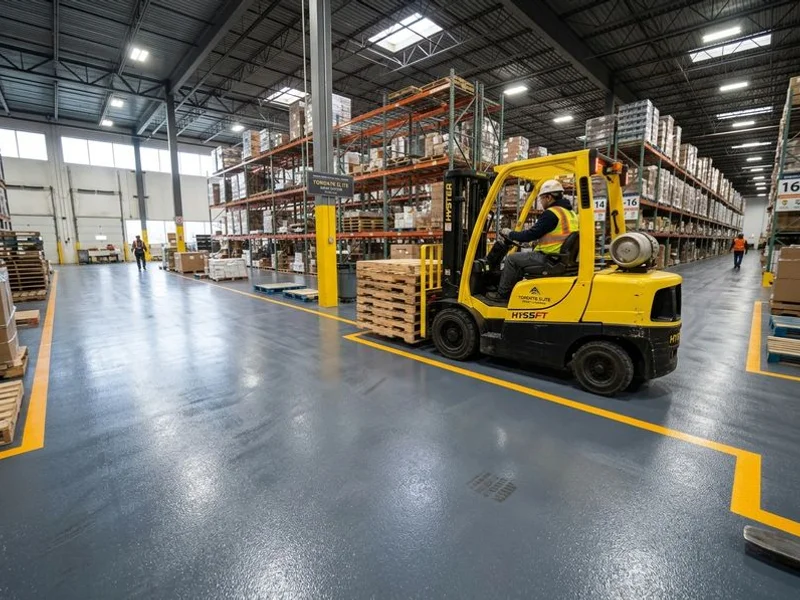
Industrial Epoxy Flooring in Mississauga, Ontario
Industrial epoxy flooring in Mississauga for manufacturing plants, warehouses, food processors, chemical storage, and automotive operations. 80-100 mil broadcast systems rated for Class 1-3 forklifts, 12,000+ lb point loads, and chemical spills. From $3 per sq ft for open warehouse epoxy to $18 for novolac chemical-resistant systems. WSIB cleared, $2M liability.
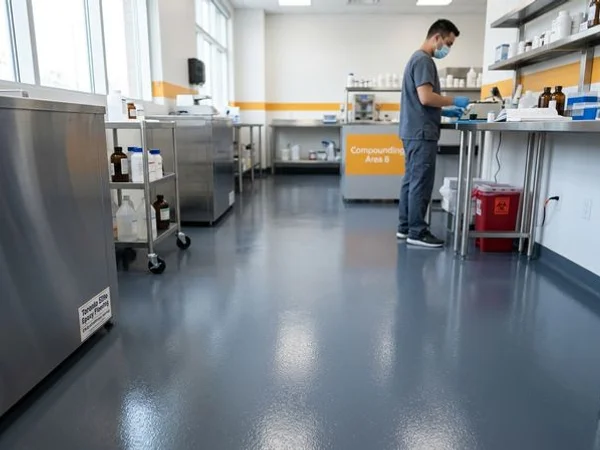
Laboratory Epoxy Flooring in Mississauga, Ontario
Laboratory epoxy flooring in Mississauga: novolac chemical-resistant systems for research labs, academic facilities, clinical labs, and industrial testing. Resists concentrated acids, bases, solvents, and lab-grade reagents. $10-$18 per sq ft installed. WSIB-cleared crews with $2M liability and full compliance documentation.
Wash Bay & Washdown Epoxy Flooring in Mississauga, Ontario
Wash bay epoxy flooring in Mississauga using washdown-rated polyurea and urethane cement for truck wash bays, fleet maintenance, food plant washdown, and industrial cleaning stations. Resists hot water, pressure washing, alkaline degreasers, and petroleum. $7-$12 per sq ft installed. WSIB cleared with $2M liability.
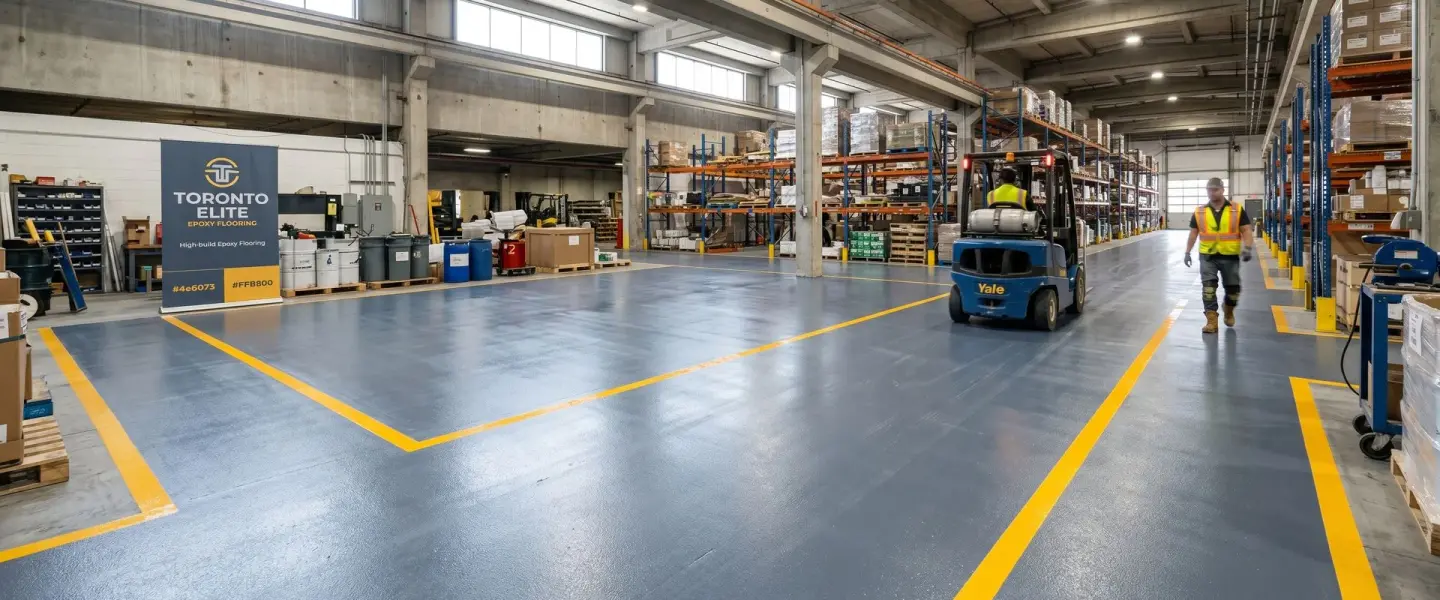
Warehouse Epoxy Flooring in Mississauga, ON
Warehouse epoxy flooring in Mississauga: forklift-rated 100% solids systems with shot-blast prep, chemical-resistant topcoat, and embedded line marking for distribution centres and logistics hubs. $3-$7 per sq ft installed, with large floors done in off-hours weekend windows. WSIB-cleared crews, $2M liability, full compliance documentation.
Commercial Epoxy Flooring in Mississauga, Ontario
Commercial epoxy flooring in Mississauga for retail, restaurants, offices, healthcare, labs, and institutional buildings. CFIA-compliant kitchen systems, coved medical floors, ESD flooring, and high-traffic retail epoxy. From $3 per sq ft for warehouse epoxy to $20 for pharmaceutical cleanrooms. WSIB cleared, $2M liability, compliance documentation on every project.
Ready to Book Secondary Containment?
Same-day free on-site assessment. WSIB-certified, $2M liability on every project.