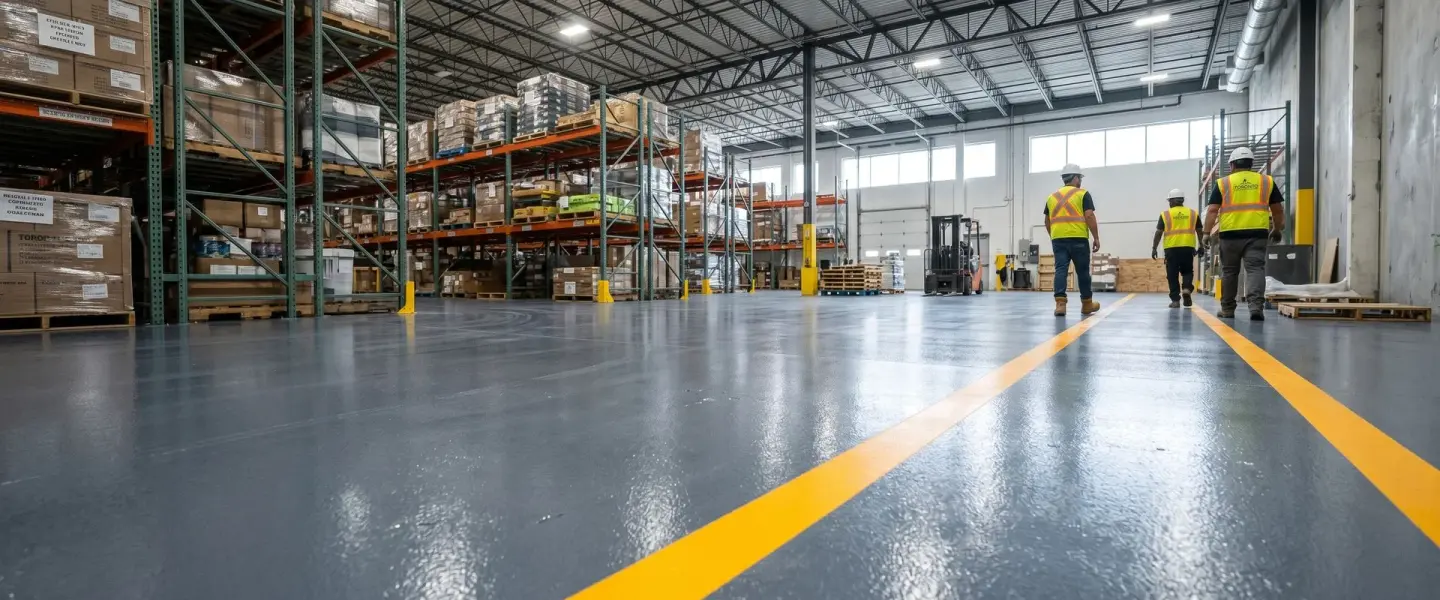
Commercial & Industrial Epoxy Flooring in Mississauga, ON - Heavy-Duty Floors for Plants and Distribution Centres
Toronto Elite Epoxy Flooring - Mississauga installs shot-blast-prepared, 100% solids broadcast epoxy systems for manufacturing plants, distribution centres, food processors, and dealerships. Every industrial floor comes with CFIA-compatible seamless chemistry, integrated aisle line marking, and coved base detailing built for forklift traffic, pallet jack loads, and concentrated chemical spills.
Industrial floors fail when the coating doesn't match the real loads and chemicals. A budget waterborne epoxy at 40-60% solids and 4-6 mils shrinks 30-50% as it cures, leaving a thin film that shears off under forklift wheels carrying 12,000+ lbs. Hydraulic fluid, degreasers, and fuel oil break down urethane topcoats rated only for light splash within months. Food and pharmaceutical plants face one more rule: floors must be seamless and non-absorbent, with no cracks, grout joints, or porous topcoat. That rules out painted concrete and vinyl tile.
Mississauga has one of the densest concentrations of logistics and manufacturing space in Canada, from Meadowvale Business Park to the Southdown Industrial Area and the Airport Corporate Centre. Typical floors run 2,000-50,000 sq ft and are installed over one to three night shifts, so production never stops. Standard systems run $3.50 to $8 per sq ft, while full coved novolac and urethane cement specifications run higher.
The Real Cost of a Commercial Floor Failure
A failed commercial floor is more than a cosmetic problem. In a food plant, a cracked or porous floor can fail an inspection. In a warehouse, crumbling concrete creates trip hazards and damages equipment. In a hospital, a floor that can’t be sanitized properly is a liability. And every repair means downtime your operation can’t afford.
Most failures we see in Mississauga trace back to one of three causes: the wrong system for the chemicals, poor surface prep, or a solvent-based product that looked fine on paper but couldn’t handle the loads. A properly specified 100% solids system, installed over shot-blasted concrete with the right topcoat, is built to outlast its warranty. As a full-service epoxy flooring contractor, we spec each system to the facility, from warehouse floor systems to chemical-resistant production zones.
What is Commercial & Industrial Epoxy?
Commercial and industrial floors take punishment residential systems never see: forklift point loads, chemical splash, thermal shock from autoclaves and washdowns, and nonstop foot traffic. They need a system matched to the actual chemicals and traffic, not one picked off a generic product sheet.
Our commercial work uses 100% solids, zero-VOC epoxy with full shot-blast prep, sanitary coving where the facility needs it, and chemical-resistant topcoats matched to the environment. Common builds include 100% solids epoxy with broadcast quartz for aggregate floors, novolac epoxy for chemical zones, and urethane cement where thermal shock is an issue.
Every install is scheduled around your operation, with overnight, weekend, or multi-shift sequencing so daytime production never stops. We carry WSIB clearance, $2M liability, and Canadian Inspection Agency certification for institutional and municipal work.
What’s Included in Every Commercial Epoxy Contract
Every commercial project includes:
- Detailed site survey and line-item RFQ
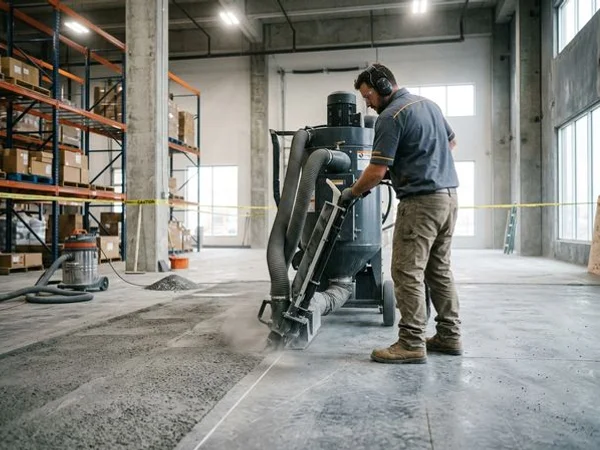
- Full shot-blast or diamond-grind surface preparation
- Substrate repair and crack stitching as needed
- 100% solids commercial-grade epoxy systems
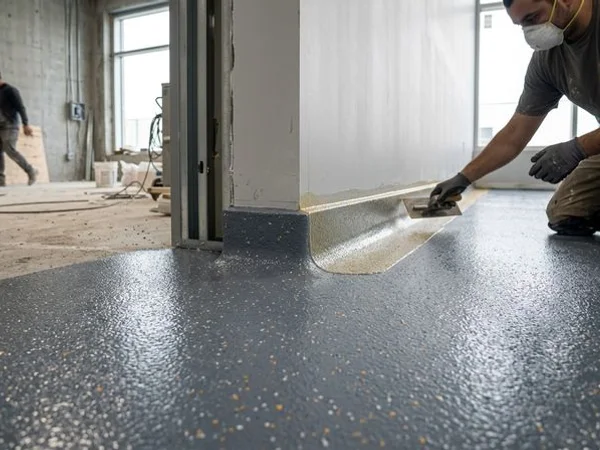
- Sanitary coving (4-6” up the wall) where required
- Chemical- and impact-resistant topcoats specified to the facility
- Line marking and safety striping
- Off-hours scheduling around your shifts
- Full compliance documentation (WSIB, insurance, CFIA where applicable)
100% Solids vs Solvent-Based Commercial Epoxy: Why It Matters
Solids content is the most misrepresented spec in commercial flooring quotes. A 100% solids epoxy has no carrier solvent, so every gram mixed becomes film. Solvent-based and waterborne products lose 20-40% of their volume as they cure. The film left behind is thinner, more porous, and less able to handle the point loads of the Class II and III forklifts used in distribution centres around Pearson. On a 50,000 sq ft slab, the difference between a 3 mm build and a 1.5 mm film adds up to years of service life.
There’s a health and safety side too. Solvent-based coatings release VOCs during application and cure. In occupied or partly occupied facilities, that raises air quality concerns and may require long ventilation periods before people can return. Zero-VOC, 100% solids systems go down, cure, and hand back without those restrictions, which is why they’re the baseline for institutional contracts in Ontario.
ASTM C1583 pull-off tests on 100% solids systems over properly shot-blasted concrete at CSP 3-4 consistently break in the concrete, not the bond, meaning the epoxy grips harder than the slab holds together. Solvent-based products on the same profile often fail at the bond line at lower readings. For a Malton parts warehouse running 6,000 lb electric forklifts, that’s the difference between a floor that lasts eight years and one that peels in eighteen months.
What Is Commercial Coving and Why Food Plants Need It
Commercial coving is a reinforced, rounded base that runs continuously from the floor 4-6 inches up the wall, replacing the square floor-wall joint. In food processing and packaging plants under CFIA oversight, that joint is a known hiding place for bacteria, chemical residue, and pests. A continuous coved system, with epoxy mortar built up the wall and the same topcoat as the floor, eliminates the joint and leaves a surface that can be sanitized properly.
Food and beverage processing is one of Mississauga’s fastest-growing sectors, with major new investments in production capacity. In these plants, coving is part of the facility design, not an extra. We use a 100% solids epoxy aggregate mortar, trowelled on and reinforced at the radius. The topcoat matches the floor: novolac for strong acid or caustic cleaning, or aliphatic polyurea where UV stability and colour retention matter under skylights. Both stand up to the quaternary ammonium and peracetic acid sanitizers used in licensed food plants.
Coving is also specified in pharmaceutical production areas, hospital soiled utility rooms, and commercial kitchens. Any floor that’s mopped, pressure-washed, or hosed daily benefits because water no longer pools at the wall. It adds roughly $2-4 per linear foot to a commercial quote, which is modest compared with the reduced risk for a facility facing CFIA inspections.
How Off-Hours Installs Cut Facility Downtime
A full commercial system needs at least two coats with a cure window between them. At typical facility temperatures of 15-22°C, a 100% solids system can be recoated after 8-12 hours and takes foot and light wheel traffic after 24 hours. Rapid-cure polyaspartic topcoats cut return to traffic to 4-6 hours after the final coat. That means a two-coat system with a polyaspartic finish can be applied overnight and handed back for the morning shift.
For large buildings in the Airport Corporate Centre, Meadowvale Business Park, and the Highway 410 corridor, we sequence the work by zone. Zone 1 is prepped, coated, and returned before Zone 2 starts, so the facility never fully shuts down. Zone boundaries follow your racking, dock doors, and shift schedule. A 30,000 sq ft warehouse is usually finished in three or four overnight windows without losing a single day shift.
Off-hours work usually adds 10-15% to labour, but that’s almost always less than one day of downtime for a busy distribution or manufacturing site. Many institutional contracts, such as municipal yards, hospital service wings, and school board warehouses, require off-hours installs as part of the facility management agreement. Our WSIB clearance and $2M liability insurance cover the documentation those contracts require.
Chemical and Impact Resistance Ratings for Industrial Floors
Commercial epoxies don’t all have the same chemical resistance. Standard 100% solids bisphenol-A epoxy handles what most light manufacturing and warehouse floors see: petroleum oils, hydraulic fluid, mild alkalis, and dilute cleaners. Battery charging rooms are different. Sulphuric acid splash from lead-acid forklift batteries is a documented exposure, and standard epoxy isn’t enough. The right spec is novolac epoxy, a phenol-formaldehyde resin with tighter cross-linking that resists concentrated acids, aromatic solvents, and temperatures up to about 120°C.
ASTM C267 is the standard test for chemical resistance of monolithic surfacings, and we use it to confirm the topcoat suits your chemicals. For chemical blending facilities and heavy plants in the Southdown and Clarkson industrial areas, we ask for the safety data sheet for every chemical used on the floor and check each one against ASTM C267 immersion data for the candidate topcoat. That gives you a specification you can defend to an insurer or facility manager.
Impact resistance is measured with the ASTM D2794 Gardner test. Systems with broadcast quartz score much higher than plain epoxy films because the aggregate spreads point loads over a larger area. In Malton’s aerospace supply and manufacturing plants, where steel-wheeled carts and dropped parts are routine, a 3-4 mm quartz broadcast floor at 80-100 mesh gives the impact resistance needed without giving up chemical resistance. Broadcast also adds an R11-R13 slip rating, which lowers slip-and-fall exposure.
Epoxy vs Polyurethane Cement for Industrial Floors
Polyurethane cement is a hybrid of cementitious aggregate in a polyurethane binder. It handles two things standard epoxy can’t: constant moisture vapour from below and repeated thermal shock from hot washdowns or steam cleaning above 60°C. In a poultry or meat plant washing down with 82°C water twice a day, standard epoxy would delaminate within months because it expands differently from the concrete. Urethane cement expands much more like concrete and bonds to damp slabs at 75% RH, where epoxy would at least need a moisture-tolerant primer.
The trade-offs are cost and workability. Urethane cement typically runs $14-22 per sq ft installed depending on build and coving, compared with $8-14 for a comparable 100% solids epoxy spec. It also has a short working time and needs experienced trowel hands. For dry warehouses, showrooms, and light manufacturing floors, 100% solids epoxy gives better value and equal durability.
The decision is straightforward. Hot wet processes, commercial cooking, or a slab with documented moisture problems call for urethane cement. A dry environment with mild to moderate chemicals and budget pressure calls for 100% solids epoxy over a shot-blasted CSP 3-4 profile. We install both and recommend based on the site survey, not on which product carries a better margin.
What Commercial Epoxy Flooring Costs and What Drives the Quote
Full-spec commercial epoxy typically runs about $6-$18 per sq ft installed, and the range reflects truly different specifications rather than markup. The low end is a single-coat 100% solids system on a clean, lightly used slab, such as a storage room or small warehouse unit with a flat, uncontaminated floor. The high end is a multi-coat novolac or urethane cement system with full shot-blast prep, crack stitching, coving, broadcast aggregate, chemical-resistant topcoat, and line marking in a food or pharmaceutical plant.
Five factors drive most of the price: slab condition, system chemistry, coving, timing, and square footage. Slab condition varies most. Oil contamination, an old failed coating, or heavy cracking all add labour and materials before the epoxy even starts. That’s common in older buildings being retrofitted for new tenants, which is happening across the city given how little vacant industrial space there is. Shot blasting a clean slab to CSP 3-4 runs about $1.50-$2.50 per sq ft. A contaminated slab needing several passes, degreasing, and crack repair can add another $1.50-$3.00.
Off-hours scheduling adds 10-15%, and coving adds $2-4 per linear foot. For a 15,000 sq ft food plant with 400 linear feet of coving, two-shift off-hours work, and a novolac topcoat, a realistic all-in budget is $12-$16 per sq ft, or $180,000-$240,000. A straightforward 8,000 sq ft warehouse with a clean slab, daytime access, and standard broadcast quartz comes in closer to $7-$9 per sq ft, or $56,000-$72,000. Every quote from Toronto Elite Epoxy Flooring - Mississauga is itemized by material, prep, coving, labour, and scheduling, and becomes a fixed-price contract.
Related Questions Facility Managers Ask
How long does commercial epoxy last in a warehouse environment?
A properly specified 100% solids system over a shot-blasted CSP 3-4 profile typically lasts 10-20 years before the topcoat needs refreshing. The bond to the slab doesn’t degrade. What wears is the topcoat, from forklift and foot traffic. A topcoat refresh around year 10-12 costs about 30-40% of the original install and adds another decade.
Can commercial epoxy be installed in winter?
Yes, as long as conditions are managed. Epoxy needs the slab above 10°C and at least 3°C above the dew point to cure properly. Most active commercial buildings are heated, so winter installs are routine. Unheated buildings and new construction shells need temporary heat to bring the slab up to temperature before work starts.
What surface preparation standard is required for commercial epoxy in Ontario?
Industry practice in Ontario calls for CSP 3-5 on the ICRI scale. Shot blasting reliably reaches that range on existing slabs and is preferred over acid etching, which can’t consistently reach CSP 3 on dense power-trowelled floors and leaves residue that can interfere with curing.
Do you handle the permit and insurance documentation for institutional contracts?
Yes. Commercial and institutional contracts typically require WSIB clearance, a certificate of insurance naming the owner as additional insured, and CFIA system documentation for food plants. All of it comes as part of the contract package. WSIB clearance certificates are pulled directly from the WSIB Ontario portal and included in every handover.
How do I know if my facility needs novolac epoxy or standard 100% solids epoxy?
It depends on the chemicals and temperatures on your floor. If you use concentrated acids (below pH 3), aromatic solvents, or strong caustics that contact the floor, or if floor temperatures regularly exceed 80°C, you need novolac. For most dry manufacturing, warehousing, and distribution floors where exposure is limited to petroleum products, mild cleaners, and water, standard 100% solids bisphenol-A epoxy is appropriate and more cost-effective.
Our Commercial Epoxy Results in Toronto
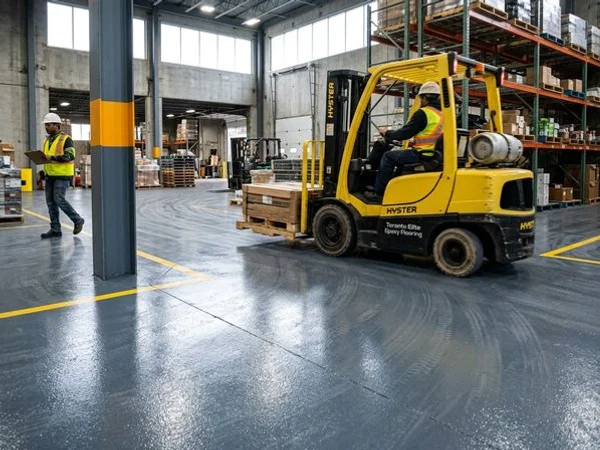
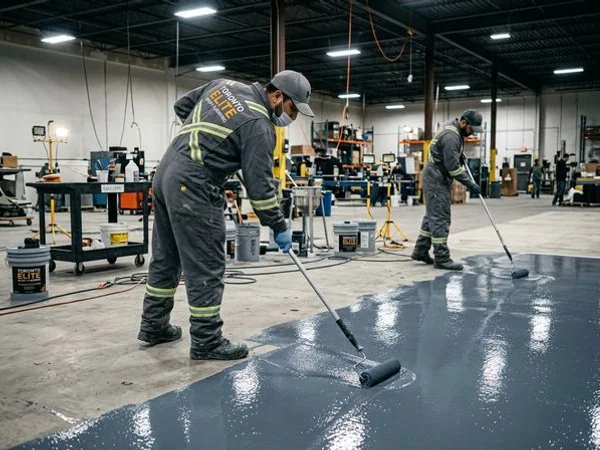
Commercial Epoxy Pricing
Industrial scope varies widely. We provide a line-item quote after a site visit.
Why GTA Customers Choose Toronto Elite Epoxy Flooring - Mississauga for Commercial Epoxy
Off-Hours Installs
Night and weekend scheduling for 24/7 sites near Pearson and Highway 401, so you never lose a daytime shift.
100% Solid, Zero-VOC
Commercial-grade systems with no solvent-based budget shortcuts.
WSIB + $2M Liability
Full compliance for institutional, municipal, and large commercial contracts.
In-House Shot-Blast Crew
Our crew brings full prep equipment on-site. No subcontracted prep.
How Commercial Epoxy Works
Site Survey & RFQ
We visit, scope traffic, chemistry, and coving needs, and return a detailed line-item RFQ.
Shot-Blast Prep
Full shot-blast surface profile for mechanical bonding to industrial slabs.
Coving + Base + Topcoat
Sanitary coving where required, then 100% solid base and chemical-resistant topcoat.
Off-Hours Handover
Scheduled around your shift pattern. Floor ready for daytime traffic the next morning.
Ready for a Free On-Site Assessment?
Same-day quotes across the GTA. WSIB-certified, $2M liability on every project.
What Customers Say About Our Commercial Epoxy
"They coated our auto parts distribution centre near Dixie and Derry off-hours. Shot-blast, 100% solids base, novolac topcoat. Three years of heavy forklift traffic and zero delamination."
"We needed full WSIB and $2M liability documentation for our food plant contract in Meadowvale. They delivered all of it plus coving run six inches up the wall, and we passed our first inspection clean."
"Our Southdown plant has solvent splash every day on a 12,000 sq ft floor. They shot-blasted to CSP 4 and installed a novolac high-build system. Two years in and not a single soft spot or lifted edge."
Commercial Epoxy FAQs
How much does commercial and industrial epoxy cost in Mississauga?
A standard 100% solids broadcast system on a clean warehouse slab runs $3.50-$8 per sq ft. Full specifications with heavy prep, crack stitching, coving, novolac or urethane cement topcoats, and line marking for food or pharmaceutical plants typically run $8-$18. Every project gets a line-item, fixed-price contract after a site survey.
Can you coat our distribution centre without shutting down?
Yes. Most logistics buildings near the airport and along the 401 run around the clock, so we work in zones over nights and weekends. One zone is shot-blasted, coated, and handed back before the next is closed off. A 30,000 sq ft floor is typically done in three or four overnight windows.
What floor do you recommend for a food processing plant?
For wet areas with hot washdowns, urethane cement with an integral cove base, because it handles thermal shock and bonds to damp concrete. For dry packaging and storage areas, 100% solids epoxy with a chemical-resistant topcoat is usually enough. We spec each zone separately.
Our Southdown plant uses strong acids. Will standard epoxy hold up?
Probably not. Concentrated acids, aromatic solvents, and hot caustics need novolac epoxy, which has a much tighter cross-link structure. We review your safety data sheets and match the topcoat to ASTM C267 resistance data before specifying anything.
Do you provide insurance and compliance documents?
Yes. WSIB clearance, a certificate of insurance naming the owner as additional insured, $2M liability, and CFIA system documentation for food facilities are all part of the contract package.
Epoxy flooring, metallic coatings & polyaspartic
across the Greater Toronto Area
Same crew, same materials, same written warranty on every job. Browse by service and city — or call us direct.
Don't see your city? View our full service area →
Related Services
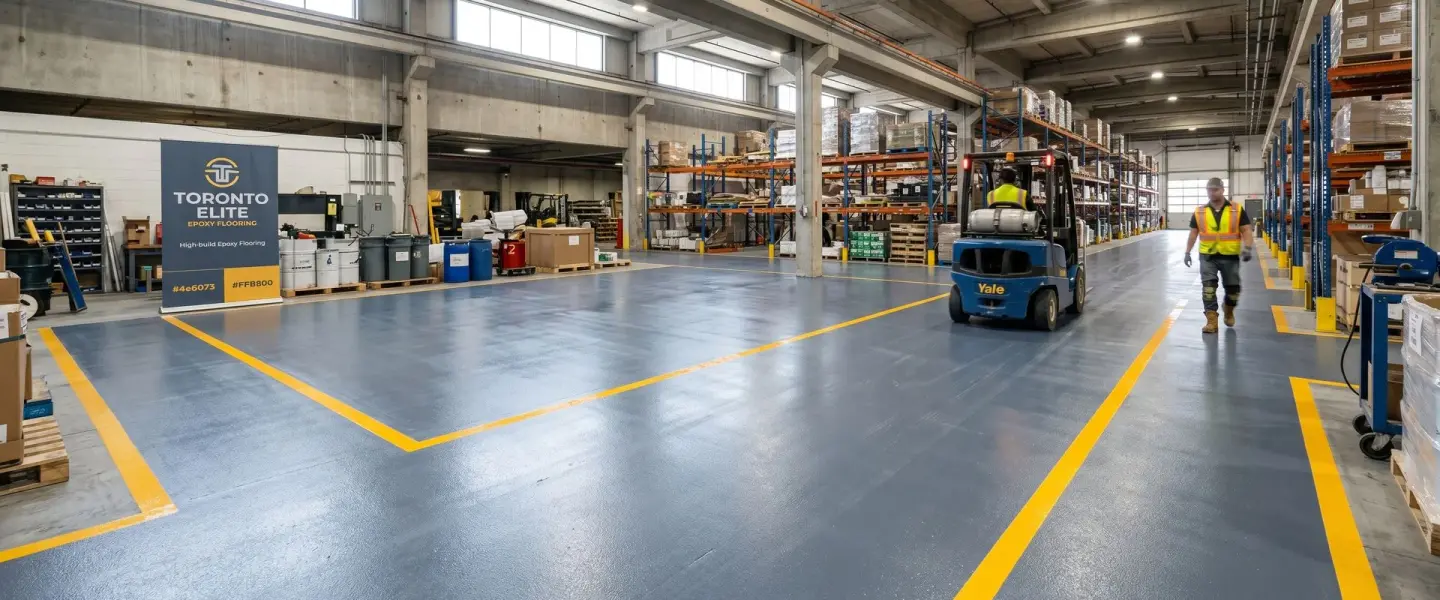
Warehouse Epoxy Flooring in Mississauga, ON
Warehouse epoxy flooring in Mississauga: forklift-rated 100% solids systems with shot-blast prep, chemical-resistant topcoat, and embedded line marking for distribution centres and logistics hubs. $3-$7 per sq ft installed, with large floors done in off-hours weekend windows. WSIB-cleared crews, $2M liability, full compliance documentation.
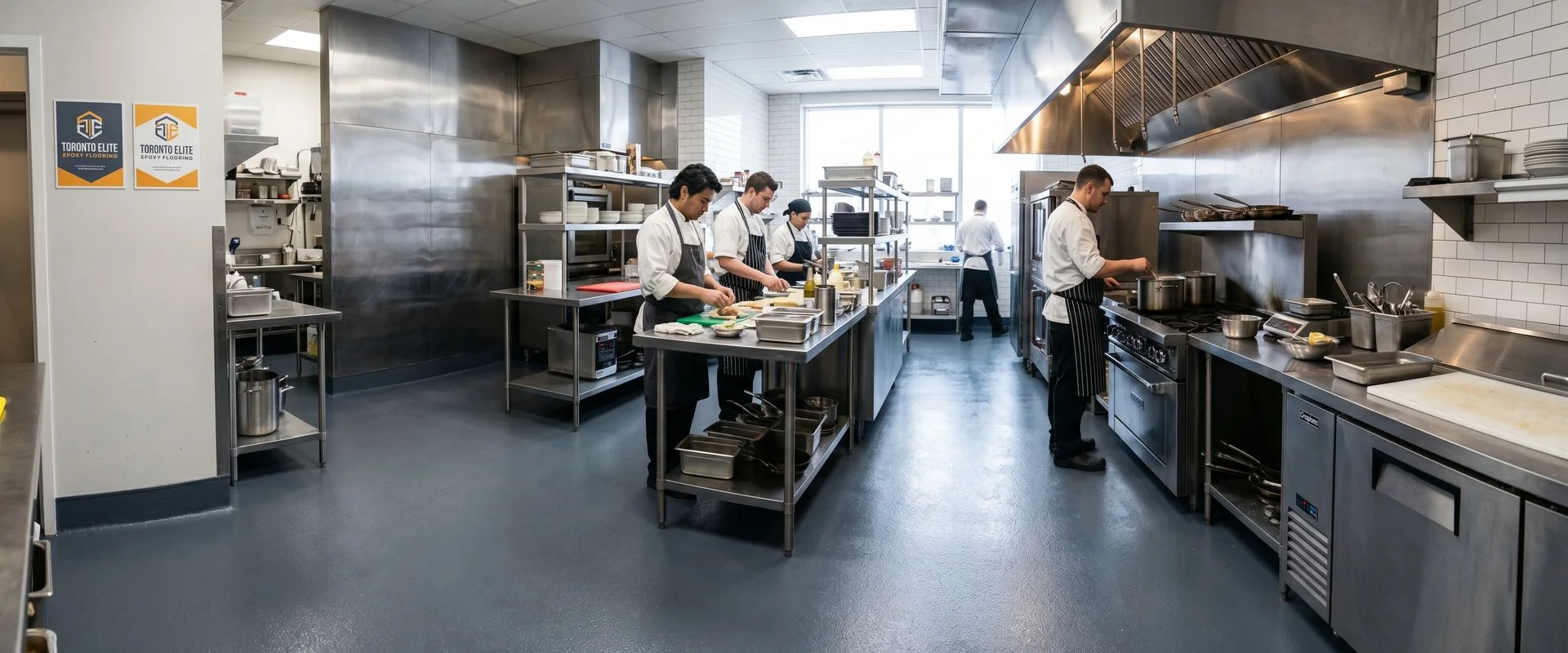
Commercial Kitchen Epoxy Flooring in Mississauga, ON
Commercial kitchen epoxy in Mississauga: seamless, CFIA-compatible floors with 4-6 inch coving, quartz anti-slip broadcast, and zero-VOC chemistry for restaurants and food service. $5-$11 per sq ft installed for standard systems. Most kitchens finish in 2 overnight shifts with no lost service, and health inspection documentation is included.
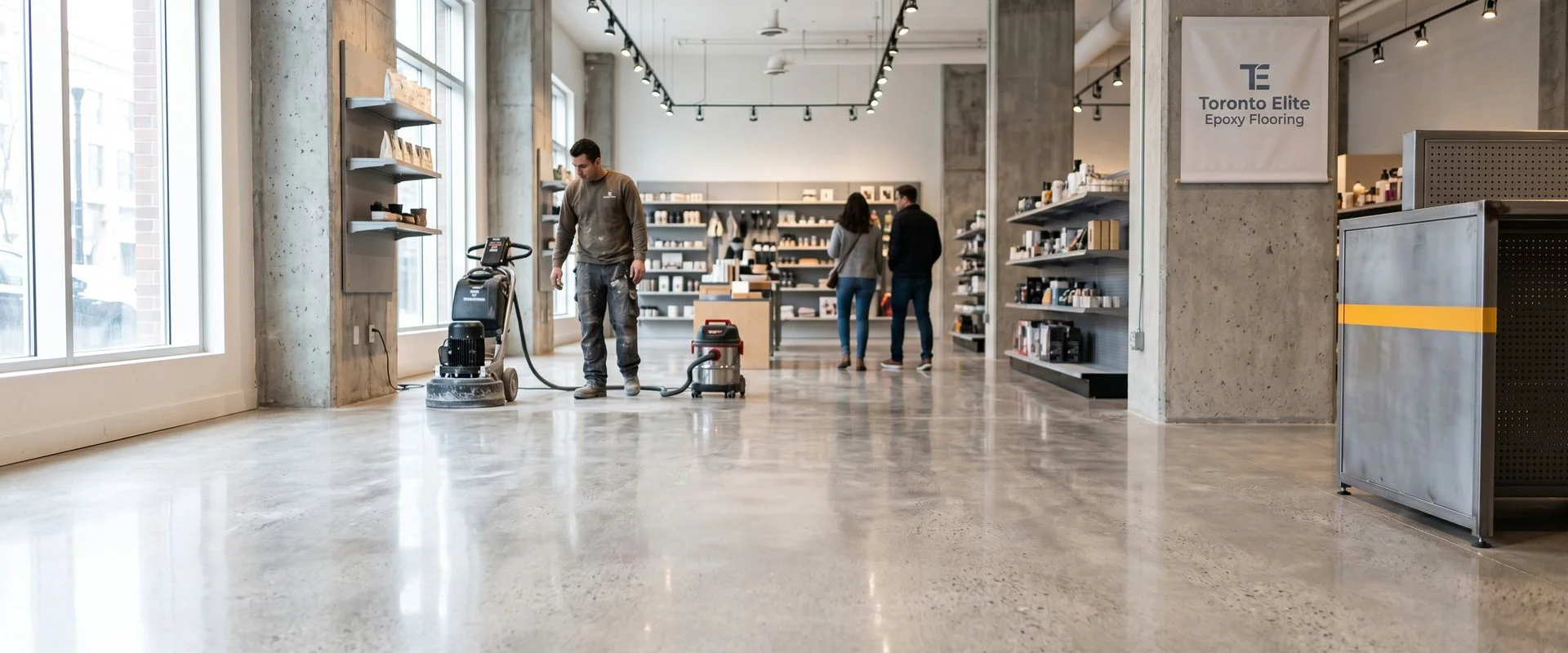
Concrete Polishing in Mississauga, ON
Concrete polishing in Mississauga using multi-pass diamond grinding up to 1,500 grit and a lithium silicate densifier. The result is a hard, light-reflecting, dust-proof floor with no wax or topcoat to reapply. $3-$8 per sq ft installed, and most commercial floors finish in 2-3 days. Popular for retail, office, and warehouse space.
Ready to Book Commercial Epoxy?
Same-day free on-site assessment. WSIB-certified, $2M liability on every project.