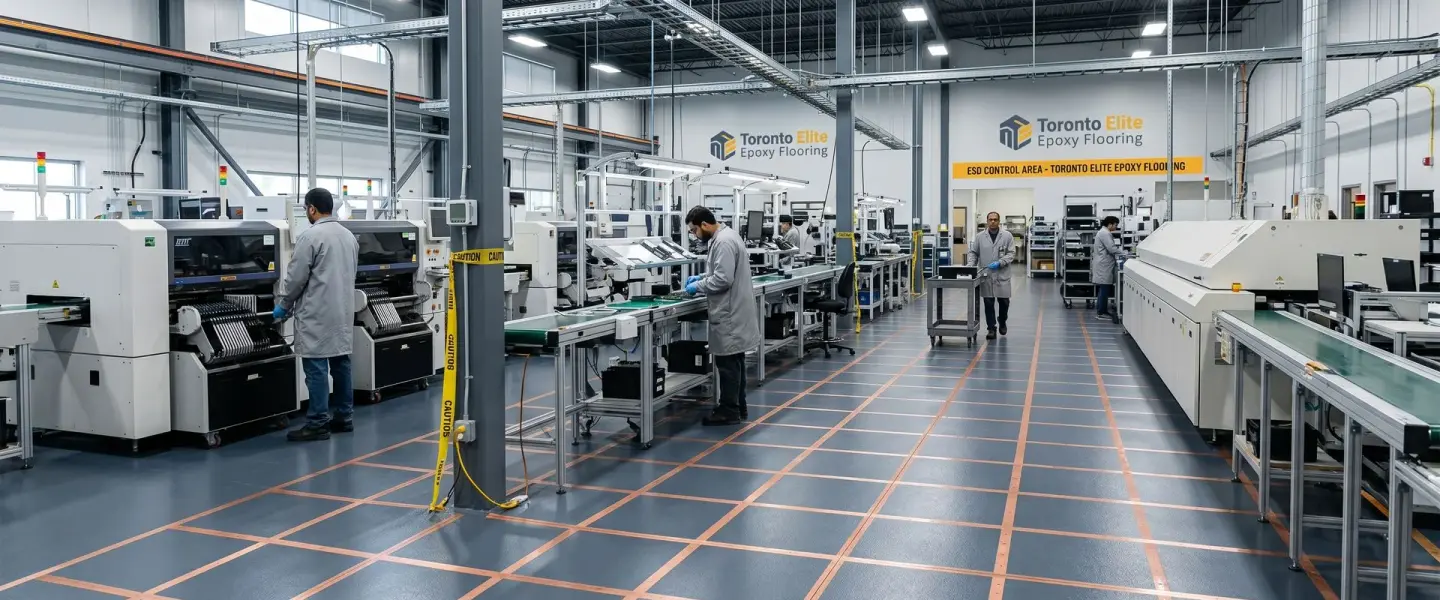
ESD Conductive Epoxy Flooring in Mississauga, ON - Tested, Certified Static Control
Toronto Elite Epoxy Flooring - Mississauga installs anti-static and conductive epoxy systems for electronics manufacturers, aerospace and defence suppliers, data centres, PCB assembly lines, and cleanrooms. Every ESD floor includes a copper grounding grid, carefully applied conductive epoxy, and post-install megohmmeter testing to NFPA 99 and ESD Association STM7.1, with full written compliance documentation.
Ordinary flooring lets static build to voltages that destroy microelectronics long before anyone feels a shock. A technician walking on vinyl tile can build up 12,000-35,000 volts. A discharge as small as 10 volts, far below the roughly 3,000 V a person can feel, can damage MOSFET gate oxides and void component warranties. ANSI/ESD S20.20 calls for floor resistance between 1x10^6 and 1x10^9 ohms, verified under ANSI/ESD STM7.1. Passing a third-party audit takes calibrated conductive chemistry, a precisely installed copper grid, and documented resistance mapping.
The Gateway and Airport Corporate Centre area is home to aerospace, defence, and high-tech manufacturers, and the city's life sciences sector keeps adding cleanroom space. Most ESD projects run 500-5,000 sq ft and take 2-4 days. Standard systems run $7 to $14 per sq ft, and cleanroom-grade or high-grid-density systems cost more. All chemistry is zero-VOC for installation in occupied buildings.
What is ESD Conductive Epoxy?
ESD conductive epoxy is a specialized floor system that controls static discharge. That matters anywhere a single static event can destroy electronic parts, ignite flammable vapour, or interfere with medical equipment.
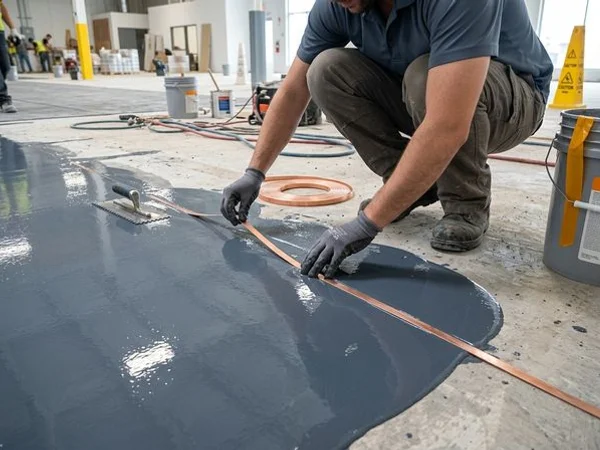
The system uses copper grounding strips laid in a pattern across the slab, covered by a conductive epoxy base with carbon fibre or carbon black additives, and finished with a static-dissipative topcoat. The whole floor is bonded to building ground and tested with a megohmmeter to confirm the resistance falls in the range your facility needs, typically 10^4-10^9 ohms depending on whether you need conductive or dissipative behaviour.
We install to NFPA 99 for healthcare and ESD Association guidelines, and we provide full compliance documentation including resistance test results. As a full-service epoxy flooring contractor, we install ESD systems alongside our institutional and medical epoxy work for hospitals, labs, and electronics facilities.
What’s Included
- Static-control spec review with your facilities team
- Diamond-grind substrate prep
- Copper grounding strip grid laid to drawing
- Conductive 100% solids epoxy base coat with carbon additives
- Static-dissipative topcoat
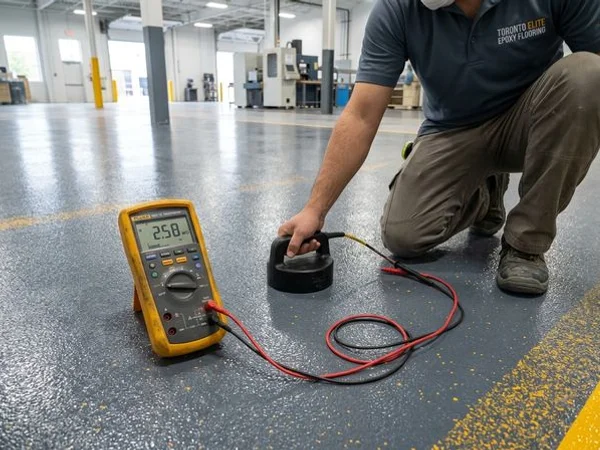
- Megohmmeter resistance testing at multiple points
- Documented compliance certificate
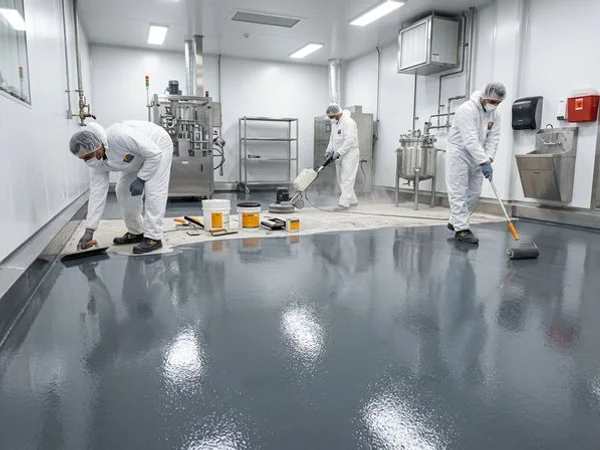
- Cleanroom-compatible install sequencing where required
What ESD Conductive Flooring Is and Which Facilities Need It
Static becomes a serious facility risk as soon as sensitive electronics, flammable solvents, or life-safety equipment are part of daily work. A discharge lasting nanoseconds at a few hundred volts can permanently damage a surface-mount part on a circuit board, cause a hidden defect that only shows up in the field, or ignite vapour in a pharmaceutical mixing room. ESD floors remove that risk by giving static a controlled, continuous path to ground before it builds to damaging levels.
There are two categories of ESD flooring, and they serve different needs. Conductive flooring targets 10^4-10^6 ohms and is used where active grounding is the main goal, such as electronics production lines, soldering areas, and aerospace component benches. Dissipative flooring targets 10^6-10^9 ohms, providing controlled bleed without the lower resistance that could create a shock risk if a worker touches a live circuit. Hospital operating rooms under NFPA 99 fall in the dissipative range. A spec review with your facilities or EHS team decides which applies before any copper is ordered.
In Mississauga, ESD floors are most often specified by aerospace and defence suppliers in Malton and the Gateway area around Pearson, electronics and technology manufacturers along the Highway 401 and 410 corridors, pharmaceutical and life sciences producers operating under Health Canada GMP, and hospital procedure suites. Data centre projects replacing failed or reconfigured raised-floor tile make up a growing share of requests too.
How the Copper Grounding Grid Works
The copper grid is the foundation of any working ESD floor. Without a reliable path to building ground, even the best conductive epoxy acts like a capacitor instead of a conductor. The grid is made of copper foil strips, usually 2 inches wide, laid across the prepared slab at the spacing in the system design, commonly 24-48 inches on centre depending on floor area and resistance target. Each strip ends at a bonding lug tied to the building’s electrical ground, which must meet ESA requirements under the Ontario Electrical Safety Code.
Before the copper goes down, the concrete is diamond-ground to CSP 3-4 under ICRI guidelines to remove contaminants, laitance, and any old coating that would break the conductive path. Cost-cutting contractors often skip or rush this step, and it’s the main reason ESD floors fail their resistance tests. The strips are then set in conductive adhesive, lapped at corners, and covered with a first coat of 100% solids conductive epoxy containing carbon black or carbon fibre to hit the target resistance. Further build coats and the dissipative topcoat keep the resistance chain intact from the surface, through the base, to the grid and building ground.
Topcoat choice matters beyond conductivity. In pharmaceutical cleanrooms under ISO 14644, the topcoat has to be seamless, chemical-resistant, low-outgassing, and compatible with the facility’s validated cleaners, usually quats or hydrogen peroxide disinfectants. With major pharmaceutical expansions underway in Mississauga, more of our ESD work now sits in this category. An aliphatic polyurethane or polyurea topcoat is often specified for its UV stability and chemical resistance, with conductive additives blended in to keep surface resistance at 10^6-10^9 ohms where people and equipment actually touch the floor.
Resistance Testing, Certification, and What the Numbers Mean
Megohmmeter testing is the only objective way to confirm an ESD floor meets spec. A digital megohmmeter applies 10 or 100 volts between electrodes placed on the floor and measures resistance. ASTM F150 is the standard method for point-to-point and point-to-ground resistance. We test at multiple points across the finished floor, usually every 100-200 sq ft in a grid, and every reading must fall inside the target range before the floor is accepted.
For a conductive system (10^4-10^6 ohms), the readings confirm charge drains actively to ground. For a dissipative system (10^6-10^9 ohms), they confirm controlled bleed without a shock path. Readings above the upper limit point to a bonding failure in the grid, a topcoat formulation problem, or slab moisture driving resistance up. Readings below the lower limit are rare but mean excessive conductivity that could allow current flow. We record every test location, reading, instrument, temperature and humidity (both affect resistance), and test voltage.
The compliance certificate we hand over ties those readings to your address, floor area, system spec, and the applicable standards: NFPA 99 for healthcare, ESD Association S7.1 for flooring materials, and ASTM F150 for the test method. For pharmaceutical facilities, it becomes part of the facility qualification package. For electronics and aerospace manufacturers around Derry Road and Airport Road, it satisfies audit requirements from OEM customers who need ESD verification from their suppliers.
Material Selection for Industrial and Cleanroom Environments
ESD systems don’t all use the same chemistry, and the wrong choice for your facility causes problems that show up months or years later. The base coat is almost always 100% solids epoxy, because it has the density and adhesion to encapsulate the copper grid and give consistent readings. It contains conductive filler, typically carbon black at concentrations matched to the target resistivity, with carbon fibre in premium systems where tensile strength also matters.
Four topcoat chemistries come up regularly. A standard conductive epoxy topcoat works well in dry electronics assembly with moderate chemical exposure and only foot and ESD-safe cart traffic. Aliphatic polyurethane adds UV stability and chemical resistance where cleaning chemicals are used, as in pharmaceutical facilities. Aliphatic polyurea cures faster, two to four hours to light foot traffic compared with eight to twelve for polyurethane, which matters in phased installs where downtime is expensive. Novolac epoxy topcoats are the choice where solvents are present, as in aerospace and chemical processing, resisting ketones, aromatics, and concentrated acids that would break down standard epoxy in weeks.
Slab moisture is a regular challenge, particularly in ground-level and below-grade slabs in older industrial buildings whose perimeter drainage wasn’t designed for modern moisture management. We see it often in the older building stock of Malton and the Dixie Road corridor. Calcium chloride testing to ASTM F1869 or in-situ RH probes to ASTM F2170 are required before any ESD system goes down. Slabs reading above 5 lbs per 1,000 sq ft per 24 hours, or above 75% RH, need a moisture-mitigating primer or vapour barrier first. It typically adds $1.50-$3.00 per sq ft, but it’s the only way to prevent osmotic blistering that would destroy both adhesion and the conductive path within one to three years.
Related Questions Facility Managers Ask
How much does ESD epoxy flooring cost per square foot?
Complete ESD systems typically run $12-$22 per sq ft installed. The low end applies to large open electronics or aerospace floors with straightforward concrete. The high end reflects cleanroom-grade topcoats, phased installs to keep production running, or moisture barrier work on older slabs.
How long does ESD epoxy take to cure before megohmmeter testing can happen?
Most 100% solids conductive base coats are ready to test after 24-48 hours at 18-22°C. The dissipative topcoat needs at least another 24 hours before testing, because some formulations shift their resistance during the final cure. In winter installs in unheated buildings, temporary heat keeps the slab above 10°C through the cure.
Can ESD epoxy be installed over an existing epoxy or vinyl floor?
Almost never. The conductive path runs from the surface through the base coat to the grid and building ground, and any non-conductive layer in between breaks it. Standard prep is shot blasting or diamond grinding to bare concrete at CSP 3 or higher. The only exception is a verified conductive primer over an existing coating that’s fully bonded with no delamination.
What is the maintenance routine for an ESD floor in a pharmaceutical facility?
Clean with ESD-safe, non-insulating products. Standard waxes and non-conductive strippers leave an insulating film that pushes resistance above the acceptable range. Facilities operating under Health Canada GMP should validate their cleaning procedure against the floor spec and retest resistance every year, or after any major change to the cleaning protocol.
Does the ESA in Ontario regulate the grounding connection for ESD floors?
Yes. The copper grid ties into building ground, which is part of the electrical system regulated by the Electrical Safety Authority under the Ontario Electrical Safety Code. The bonding lug, conductor, and connection to the grounding electrode system must meet ESA requirements. When a licensed electrician makes the ground connection, that’s coordinated as a separate scope. We provide the grid termination points and confirm the ground path is accessible before the base coat goes down.
Toronto Elite Epoxy Flooring - Mississauga serves electronics manufacturers, aerospace suppliers, pharmaceutical producers, and healthcare facilities with the technical depth to specify, install, and certify ESD systems that pass on the first test and keep their conductivity for the life of the floor.
Our ESD Epoxy Results in Toronto
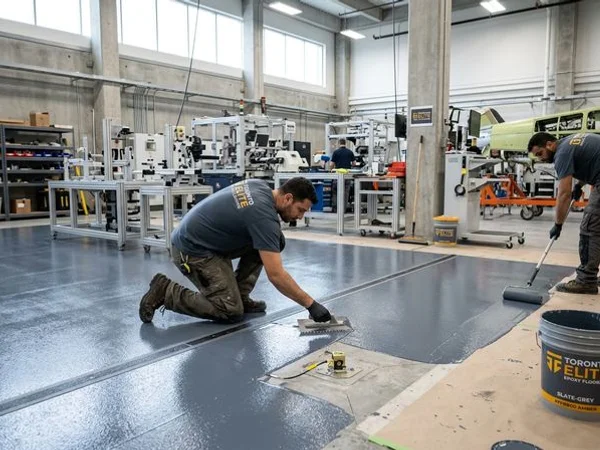
Why GTA Customers Choose Toronto Elite Epoxy Flooring - Mississauga for ESD Epoxy
NFPA 99 Compliant
Specified to NFPA 99 and ESD Association guidelines for hospital, electronics, and aerospace work.
Verified With Testing
Megohmmeter resistance testing across the finished floor, documented before handover.
Cleanroom Compatible
Continuous, low-particulate finish suited to cleanroom and pharmaceutical operations.
Full Documentation
Resistance test results, copper grid layout, and compliance certificates.
How ESD Epoxy Works
Static Spec Review
We confirm the target resistance range (10^4-10^9 ohms) for your facility.
Substrate Prep
Diamond grind and detailed prep - conductivity depends on proper bond.
Copper Grid + Conductive Base
Copper grounding strips laid in pattern, then conductive epoxy base over top.
Test + Certify
Megohmmeter testing across the floor and documentation for compliance.
Ready for a Free On-Site Assessment?
Same-day quotes across the GTA. WSIB-certified, $2M liability on every project.
What Customers Say About Our ESD Epoxy
"Cleanroom floor for our life sciences lab in Meadowvale. Seamless, ESD spec, and the resistance readings came back exactly on target."
"Electronics assembly area near Airport Road. Our ESD floor passed every certification test the first time, and the documentation was spot on for our customer audit."
"Aerospace component shop in Malton. Copper grid, conductive base, dissipative topcoat, and a full test report. On time and on budget."
ESD Epoxy FAQs
How much does ESD epoxy flooring cost in Mississauga?
Complete ESD systems typically run $12-$22 per sq ft installed once grid, testing, and documentation are included. Large, open electronics or aerospace floors with sound concrete land at the low end. Cleanroom-grade topcoats, phased installs, and moisture barriers on older slabs push toward the top. Every project gets a written, fixed-price RFQ after a site visit.
Do you work with aerospace and electronics manufacturers near the airport?
Yes. Facilities in the Gateway and Airport Corporate Centre area and in Malton's aerospace supply chain are some of our most common ESD clients. We provide the resistance documentation your OEM customers and auditors require.
What's the difference between conductive and dissipative?
Conductive floors (10^4-10^6 ohms) actively drain static to ground and suit electronics lines and solder stations. Dissipative floors (10^6-10^9 ohms) bleed static in a controlled way without creating a shock path and suit most electronics assembly, data centres, and hospital operating rooms. We confirm the right range in a spec review before ordering materials.
How do you prove the floor works?
We test with a calibrated megohmmeter at points every 100-200 sq ft under ASTM F150 and ESD Association methods, and record every reading with temperature, humidity, instrument, and test voltage. You get a compliance certificate tied to your facility and floor area.
Can you install in a running facility?
Yes. We work zone by zone, keep adjacent areas operating, and use HEPA air scrubbers in cleanroom and pharmaceutical spaces. All chemistry is zero-VOC.
Epoxy flooring, metallic coatings & polyaspartic
across the Greater Toronto Area
Same crew, same materials, same written warranty on every job. Browse by service and city — or call us direct.
Don't see your city? View our full service area →
Related Services
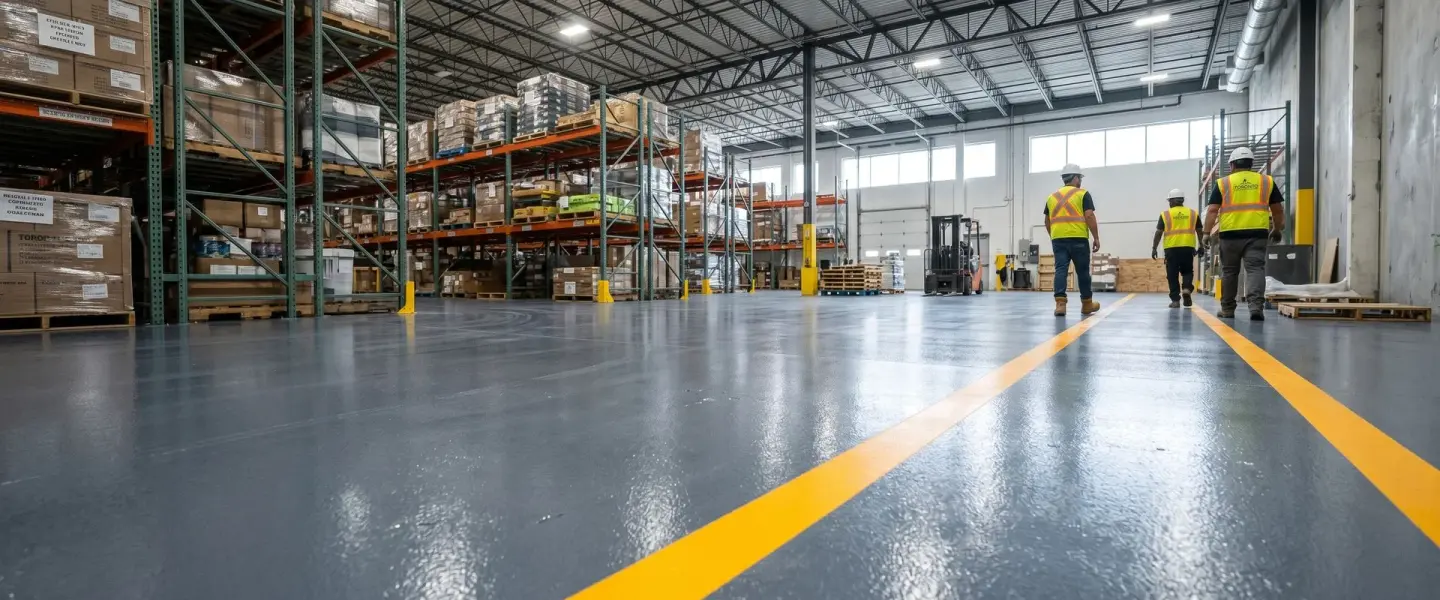
Commercial & Industrial Epoxy Flooring in Mississauga, ON
Commercial and industrial epoxy in Mississauga using 100% solids systems over shot-blasted CSP 3-4 concrete, for facilities running forklifts, food production, or 24-hour operations. $3.50-$8 per sq ft installed for standard systems, with off-hours scheduling that returns the floor before the next shift. WSIB cleared, $2M liability, full compliance documentation.
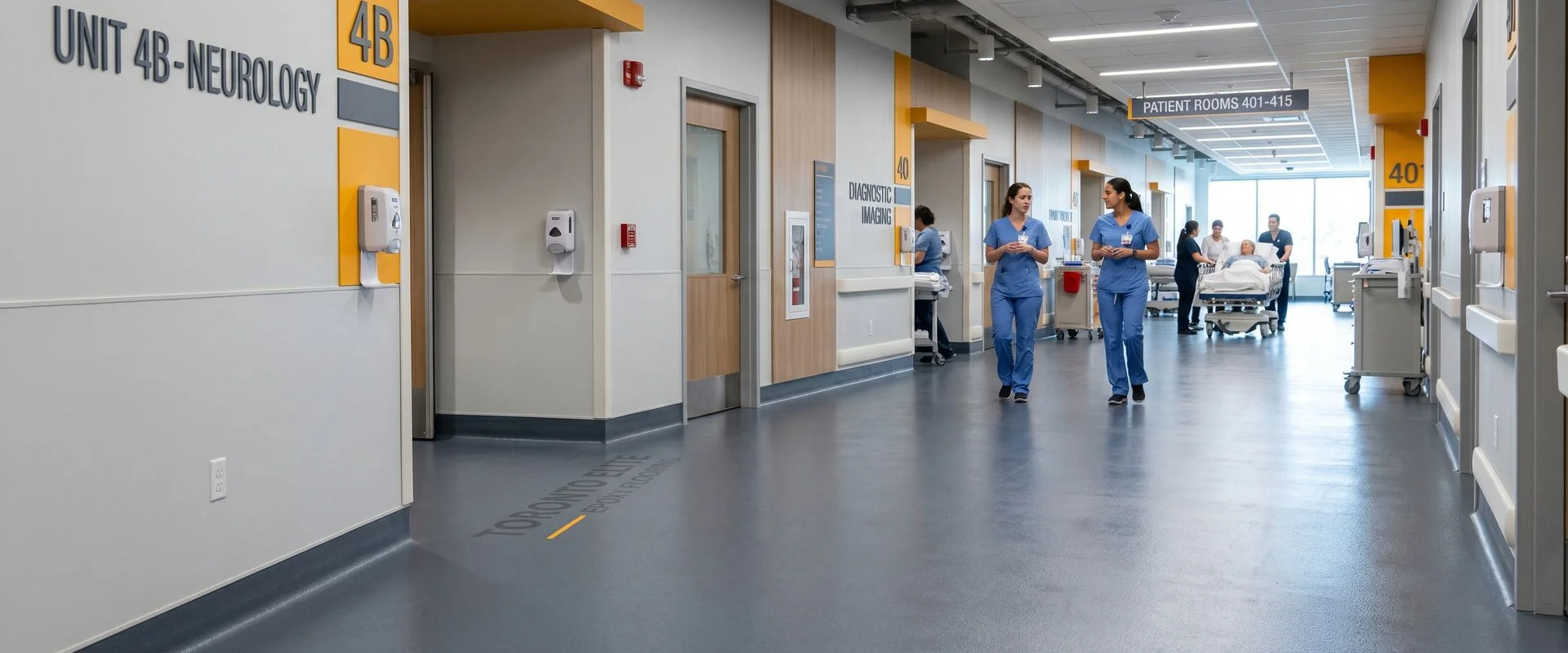
Institutional & Medical Epoxy Flooring in Mississauga, ON
Institutional and medical epoxy flooring in Mississauga: seamless antimicrobial systems with 4-6 inch coving and zero-VOC chemistry for hospitals, clinics, schools, and long-term care. $6-$12 per sq ft installed for standard systems, with section-by-section scheduling so the facility stays open. WSIB cleared, $2M liability, IPAC Canada documentation.
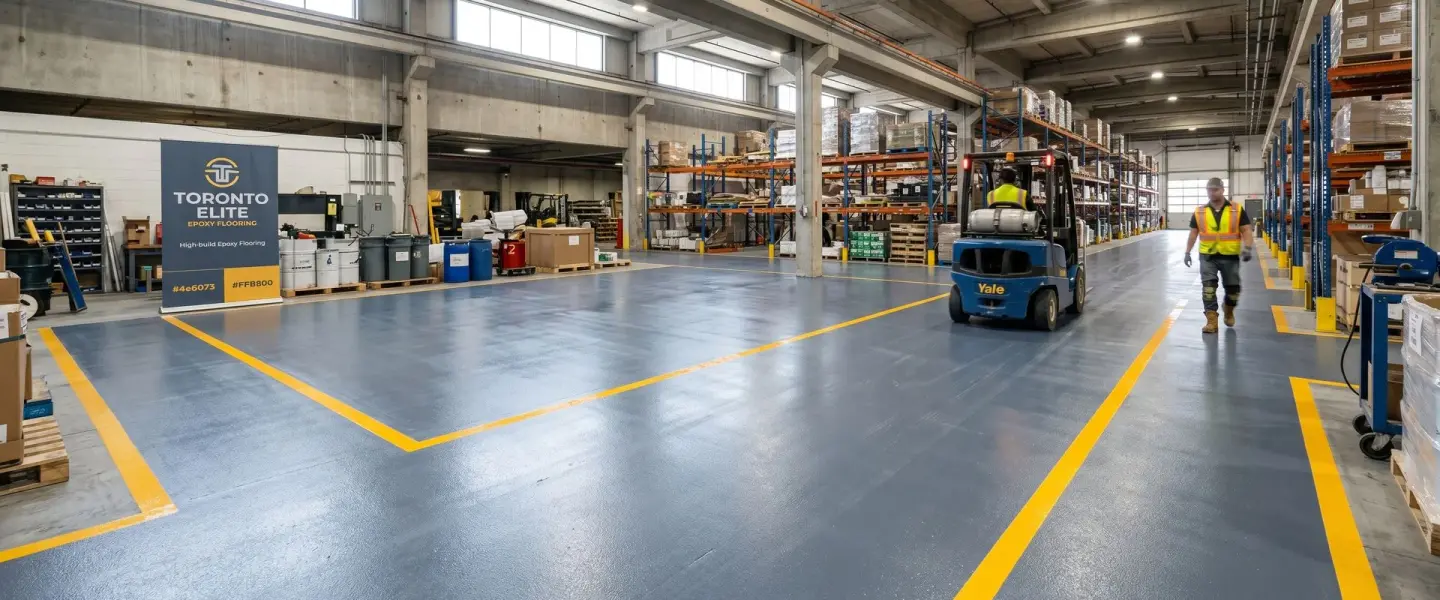
Warehouse Epoxy Flooring in Mississauga, ON
Warehouse epoxy flooring in Mississauga: forklift-rated 100% solids systems with shot-blast prep, chemical-resistant topcoat, and embedded line marking for distribution centres and logistics hubs. $3-$7 per sq ft installed, with large floors done in off-hours weekend windows. WSIB-cleared crews, $2M liability, full compliance documentation.
Ready to Book ESD Epoxy?
Same-day free on-site assessment. WSIB-certified, $2M liability on every project.