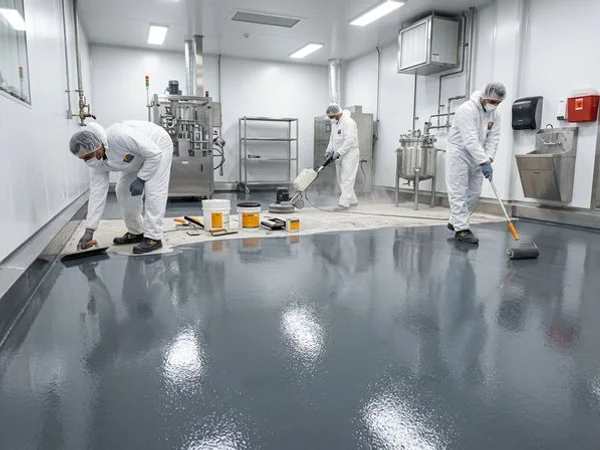
Pharmaceutical Cleanroom Epoxy in Mississauga - GMP, ISO-Rated, and ESD-Dissipative Floors for Life Sciences
Toronto Elite Epoxy Flooring - Mississauga installs ISO-classified cleanroom floors, novolac chemical-resistant base coats, and ESD-dissipative topcoats for GMP pharmaceutical plants, compounding pharmacies, API synthesis facilities, and Health Canada-licensed drug premises. Every cleanroom project uses zero-VOC, zero-particle chemistry, phased section-by-section scheduling to protect classification, and post-installation particle count verification to ISO 14644-1.
Pharmaceutical facilities work under Health Canada Good Manufacturing Practices and ISO 14644 cleanroom rules that standard epoxy can't meet. Floors in ISO 5-8 spaces must shed zero particles under foot traffic and equipment wheels. Broadcast flake systems are out, because individual chips generate particles that fail ISO count limits. Pharmaceutical-grade IPA, hypochlorite, peracetic acid, and hydrogen peroxide vapour also break down standard urethane topcoats within about 12 months of daily cleaning.
Life sciences is one of Mississauga's priority sectors, and the city has seen major pharmaceutical investments in recent years, including AstraZeneca's $820M expansion and Roche Canada's $130M investment. Cleanroom projects typically run 500-5,000 sq ft and are completed in phased overnight shifts to keep facility certification intact. Pricing runs $12 to $20 per sq ft depending on ISO class, ESD spec, chemical resistance, and documentation.
Pharmaceutical Cleanroom & GMP Epoxy Flooring in Mississauga
Toronto Elite Epoxy Flooring - Mississauga installs GMP-compliant seamless floors for Health Canada-licensed pharmaceutical manufacturing, compounding pharmacies, API synthesis labs, and ISO-classified cleanrooms. Our novolac epoxy base coats and ESD-dissipative topcoats meet ISO 14644-1 particle count requirements, GMP documentation standards, and the chemical demands of daily pharmaceutical-grade cleaning.
What Is Pharmaceutical Cleanroom Epoxy Flooring?
Cleanroom epoxy flooring is a seamless, zero-particle floor system designed to meet ISO 14644-1 classification requirements in pharmaceutical and life sciences facilities. Unlike broadcast flake or quartz systems, it uses smooth, impermeable novolac epoxy that doesn’t shed particles under foot traffic or equipment wheels.
What Does a GMP Cleanroom Floor System Include?
- CSP 3 diamond-ground surface preparation
- Novolac epoxy base coat resistant to IPA, peracetic acid, and H2O2
- ESD-dissipative topcoat in the 10^6-10^9 ohm range
- Integral sanitary wall coving (4-6 inches)
- Post-installation particle count verification (ISO 14644-1)
- Full GMP material traceability and installation records
How Much Does Pharmaceutical Cleanroom Flooring Cost?
Pharmaceutical cleanroom flooring runs $12-$20 per sq ft installed, depending on ISO class, ESD spec, chemical resistance, and documentation. Most projects run 500-5,000 sq ft.
Cleanroom and Pharmaceutical Facility Requirements
Our pharmaceutical floor systems comply with Health Canada and international contamination control requirements, meeting ISO-classified surface standards and GMP guidelines for pharmaceutical production and sterile compounding.
ISO 14644-1 Classification: ISO 5 through ISO 8
We design flooring for ISO 14644-1 cleanrooms from ISO 5 to ISO 8. These spaces need smooth, seamless, non-shedding surfaces that hold up to particle monitoring and sterilization cycles without degrading.
Novolac epoxy has a higher cross-link density than standard bisphenol-A, giving it better tolerance to hydrogen peroxide vapour, peracetic acid, and 10,000 ppm sodium hypochlorite. Every surface is mechanically prepared to CSP 3 by diamond grinding for adhesion and long-term chemical durability.
ASTM F2170 in-situ moisture testing comes before application, and all coatings meet zero-VOC criteria for occupied spaces. After installation, we verify particle counts against ISO thresholds through air and surface testing. Mississauga’s growing life sciences cluster, with new and expanded pharmaceutical plants in Meadowvale and around the airport, is where much of our cleanroom work happens, and Health Canada audits there are routine.
Health Canada Drug Premises Inspection and GMP Compliance
Our cleanroom floors are built for Health Canada drug premises inspection criteria and Good Manufacturing Practices (GMP) under Division 2, covering compounding pharmacies, sterile packaging areas, and API synthesis suites.
Cleanable, impermeable flooring is a basic GMP expectation. Our seamless systems eliminate cracks and crevices where bioburden could collect, and we use ESD-dissipative topcoats in the 10⁶-10⁹ ohm range where sensitive pharmaceutical instruments are in use.
Every install runs section by section overnight to avoid production interruptions, with HEPA filtration separating active work zones from neighbouring classified areas. Our crew is WSIB-cleared and carries $2 million liability insurance, both standard requirements for contractors working in licensed drug premises.
Specialized Epoxy and Resin Flooring Technologies
We use advanced epoxy and resin systems engineered for pharmaceutical cleanrooms, labs, and GMP manufacturing, each delivering measurable performance in hygiene, chemical resistance, and static control.
Novolac Epoxy Systems with High Crosslink Density
Our novolac epoxy systems have a higher cross-link density than standard bisphenol-A, which improves resistance to isopropyl alcohol (IPA), peracetic acid, hydrogen peroxide vapour, and sodium hypochlorite (10,000 ppm). That’s essential in ISO 5-8 cleanrooms and anywhere frequent sterilization is required.
The coatings go on after CSP 3 diamond grinding and ASTM F2170 moisture confirmation. The result is a seamless, zero-porosity surface with zero-VOC chemistry, safe for occupied pharmaceutical areas.
| Property | Performance | Relevance |
|---|---|---|
| Chemical Resistance | Excellent against IPA, H₂O₂, sodium hypochlorite | Meets GMP cleaning protocols |
| Crosslink Density | Higher than bisphenol-A epoxy | Improves long-term sterilant durability |
| VOC Content | Zero | Allows in-use installation in occupied cleanrooms |
Resin Flooring for Compounding Pharmacies and API Synthesis
For compounding pharmacies and API synthesis facilities, our resin floors combine seamless application with precise chemical performance. They’re monolithic and compatible with compounding isolators, laminar flow benches, and solvent handling areas.
These epoxy floors withstand aggressive reagents while staying smooth and easy to sanitize. Zero-particle chemistry keeps airborne particle counts in check during and after curing, and verified particle testing supports GMP documentation and Health Canada inspection readiness.
Unlike broadcast flake systems that can shed micro-particles, solid-colour novolac floors leave nowhere for debris to embed. Sterile compounding pharmacies near the city’s hospitals and API and process development labs are exactly the kind of facilities where this is the only compliant choice.
Critical Performance Features in Cleanroom Environments
Our cleanroom floors protect safety, cleanliness, and sensitive electronics. Every component, from prep to topcoat, supports ISO 14644-1 classification and GMP expectations.
Particle and Contamination Control
We use zero-particle chemistry and seamless installation to eliminate trapped contaminants in ISO 5-8 spaces. Every slab gets CSP 3 diamond grinding for mechanical adhesion and ASTM F2170 moisture testing to confirm readiness, preventing floor failure and microbial infiltration from vapour moving up through the slab.
Phased overnight scheduling keeps sterile areas operating. After cure, post-installation particle count verification documents compliance and supports Health Canada drug premises inspection requirements, confirming the surface meets ISO limits under static and dynamic conditions.
| Feature | Verification Method | Benefit |
|---|---|---|
| Zero-VOC epoxy chemistry | Air particulate audit | Safe for occupied installations |
| CSP 3 diamond grinding | Surface profile measurement | Optimal adhesion and uniformity |
| Particle count check | ISO 14644-1 sampling | Regulatory traceability |
Cleanrooms using novolac epoxy instead of standard bisphenol-A get higher cross-link density and better chemical resistance, with fewer organic leachables and less visible particle formation.
ESD-Dissipative Flooring for Static-Sensitive Areas
Pharmaceutical and biotech facilities with instrumentation, weighing cells, or automated filling lines need ESD-dissipative flooring. Our topcoats sit in the 10⁶-10⁹ ohm range, safely draining static without the over-conductivity that can disrupt sensitive electronics.
We build this into GMP production suites and API synthesis areas, preventing static-driven particle lift and ignition in solvent zones. ESD testing after installation confirms the surface meets ISO and IEC static control guidance.
Key ESD attributes:
- Ionic conductive pathways, with no carbon fibre or flake that sheds particles
- Zero-VOC formulation for application during active production
- Smooth, seamless finish that minimizes airborne lint attraction
- Uniform resistivity even as relative humidity changes
Chemical and Sterilant Resistance Standards
Our novolac epoxy systems deliver strong chemical resistance in compounding and sterile processing. The dense cross-link network resists isopropyl alcohol (IPA), 10,000 ppm sodium hypochlorite, hydrogen peroxide vapour, and peracetic acid used in disinfection cycles.
Unlike conventional coatings, it handles aggressive oxidizers without softening, discolouring, or micro-cracking, so each licensed facility keeps compliant hygiene between validations.
In select corridors or washdown areas, we specify polyaspartic topcoats where faster recoats or higher UV stability are needed. That flexibility supports phased section-by-section scheduling and keeps validated cleanroom states intact during flooring upgrades.
Installation Processes and Scheduling
We keep tight technical control over every stage to deliver compliant, low-particle, chemically resilient floors in operating pharmaceutical facilities, preserving uptime while meeting GMP and ISO 14644-1 requirements.
CSP 3 Diamond Grinding and Surface Preparation
We start by checking slab conditions with ASTM F2170 in-situ moisture testing to confirm humidity is below 75% RH before coating. Proper prep decides final bond strength and long-term performance.
Our installers perform CSP 3 diamond grinding for the right micro-texture. Many contractors stop at CSP 2, but our tighter spec prevents delamination in busy cleanroom areas under frequent thermal and chemical cycling.
After vacuuming, we inspect for laitance or contamination and record the surface profile readings. Only then do we apply zero-VOC primers and base coats. This careful verification minimizes outgassing and particle emission once the novolac cures.
Phased Installations for Active Facilities
Operating pharmaceutical plants can’t shut down. We use phased section-by-section scheduling with overnight installation to keep operations going. Each section is completed, cured, and particle-verified before we move to the next.
Work areas are isolated with temporary barriers, negative-air units, and HEPA filtration to protect ISO 5-8 spaces, which lets us apply zero-VOC chemistry while production or lab work continues nearby.
We typically complete one 1,000-1,500 sq ft section per night, depending on traffic and HVAC limits. Cleanroom supervisors get daily progress logs, and verification confirms each floor meets ISO particle count thresholds before handoff. GMP facilities running 24-hour production benefit most from this approach.
Post-Installation Compliance and Maintenance
We verify every surface parameter after installation to keep each cleanroom floor compliant with Health Canada and ISO 14644-1, with a focus on contamination control, zero-VOC conditions, and predictable maintenance.
Post-Install Particle Count and Broadcast Flake Risks
Our post-installation process includes particle count verification for ISO 5-8 compliance. Using calibrated airborne particle counters, we check counts at 0.3 µm, 0.5 µm, and 5 µm after full cure and compare them with ISO 14644-1 limits for your classification.
We avoid broadcast flake contamination by keeping loose decorative media out of pharmaceutical zones entirely. Micron-sized flakes can compromise sterility or cause audit nonconformances. Where texture is needed, we use controlled silica or aluminium oxide slip additives with validated particle capture.
Every project includes documentation confirming CSP 3 grinding and ASTM F2170 moisture testing, logged with the other quality records for inspection.
Zero-VOC and Environmental Considerations
Facilities in continuous GMP production can’t tolerate VOC emissions. Our zero-VOC systems go into occupied spaces without upsetting air handling or requiring evacuation, using novolac epoxy for better chemical tolerance than bisphenol-A.
Resistance covers hydrogen peroxide vapour, 10,000 ppm sodium hypochlorite, isopropyl alcohol (IPA), and peracetic acid, all documented in testing logs. Cured surfaces give off no measurable particles or volatiles during sterilization.
Overnight section-by-section scheduling maintains environmental control throughout. Each phase is sealed, cured, and verified before the next begins, keeping neighbouring areas safe and in line with cleanroom monitoring baselines.
Long-Term Flooring Maintenance for Regulated Sites
We train your facility team to maintain the floor with validated cleaners compatible with novolac topcoats. Daily wet cleaning with neutral pH detergents extends surface life and preserves static dissipation in the 10⁶-10⁹ ohm range.
Every six months, floors should get a surface resistance test and visual inspection for micro-cracks or coating fatigue. We provide maintenance checklists that make GMP documentation and internal audits easier. In regulated pharmaceutical spaces, novolac epoxy topcoats typically need recoating every 8-10 years depending on traffic and sterilant frequency, and our WSIB-cleared crew handles touch-ups or full recoats with minimal downtime.
Related Questions Pharmaceutical Facility Managers Ask
How does pharmaceutical cleanroom epoxy differ from standard commercial epoxy?
Standard commercial epoxy uses bisphenol-A chemistry and often includes flake or quartz for texture, and neither belongs in an ISO-classified cleanroom. Bisphenol-A degrades within 12 months under daily IPA and hypochlorite cleaning, and broadcast media sheds particles that fail ISO 14644-1 counts. Cleanroom epoxy uses smooth novolac chemistry with higher cross-link density, no aggregate, and zero-VOC formulation that can go into occupied cleanrooms without affecting classification.
What GMP documentation does the flooring installation produce?
Every cleanroom project delivers ASTM F2170 moisture logs with probe depths and RH readings, CSP surface profile measurements taken before primer, SDS and product traceability records for every coating component, phase logs with dates, section areas, and cure times, and post-installation ISO 14644-1 particle count results. Together they satisfy Health Canada recordkeeping expectations and support the cleanroom validation reports Quality Assurance teams prepare.
How large a section can be installed per overnight shift?
Usually 1,000-1,500 sq ft per night, depending on the HVAC schedule, cure temperature, and system. A 3,000 sq ft GMP floor typically takes two or three overnight phases. With zero-VOC chemistry, production can return to a section within 24 hours of the topcoat without air quality concerns.
Do compounding pharmacies need cleanroom-grade flooring?
Yes, if they perform sterile compounding under NAPRA standards. The compounding area needs a smooth, impermeable, non-shedding floor, and both vinyl composite tile and decorative flake epoxy fail that test. Pharmacies flagged for porous or cracked flooring during an inspection are some of our most common referrals. Toronto Elite Epoxy Flooring - Mississauga replaces those floors with a seamless novolac system, which removes the cause of the finding permanently.
What is the recoat timeline for a pharmaceutical cleanroom floor under heavy sterilant use?
With daily IPA, peracetic acid, and hydrogen peroxide vapour cycles, the novolac base is rated for 10-20 years. The topcoat, which takes the direct chemical exposure, usually needs recoating at 7-10 years depending on sterilant strength and frequency. Recoats follow the same phased overnight process as the original install, with particle count checks after each section, and the base coat stays in place.
Pharma Cleanroom Epoxy Pricing
ISO classification tier and ESD specification affect final price.
Why GTA Customers Choose Toronto Elite Epoxy Flooring - Mississauga for Pharma Cleanroom Epoxy
Novolac, Not Bisphenol-A
We specify higher cross-link novolac epoxy for pharmaceutical spaces. It resists IPA, peracetic acid, and hydrogen peroxide where standard epoxy degrades within 12 months.
Zero Broadcast Flake, Zero Particle Risk
Flake systems shed particles that fail ISO 14644-1 limits. Our smooth novolac systems produce no particle contamination under foot traffic or equipment wheels.
Post-Install Particle Count Included
Every project includes ISO 14644-1 particle count testing after cure, so you know the floor meets your classification before handover.
Classification Stays Intact During Install
Our crew works section by section with negative-air isolation and HEPA filtration, keeping adjacent cleanrooms compliant with no full shutdown.
How Pharma Cleanroom Epoxy Works
ISO Classification Assessment
We review your cleanroom tier, GMP documentation requirements, ESD specification, and chemical exposure profile before selecting the coating system.
CSP 3 Prep & Moisture Testing
Diamond grinding to CSP 3 surface profile, ASTM F2170 in-situ moisture testing, and full slab condition documentation before any coating application.
Phased Overnight Application
Zero-VOC novolac epoxy base coat, ESD-dissipative topcoat, and integral coving applied in section-by-section overnight shifts with HEPA isolation.
Particle Count Verification & GMP Handover
Post-installation ISO 14644-1 particle count testing, full GMP material traceability records, and compliance documentation package before handover.
Ready for a Free On-Site Assessment?
Same-day quotes across the GTA. WSIB-certified, $2M liability on every project.
What Customers Say About Our Pharma Cleanroom Epoxy
"Our GMP manufacturing facility in Meadowvale needed flooring that would pass a Health Canada drug premises inspection. They installed a novolac system with an ESD-dissipative topcoat in overnight phases and delivered the full GMP package our Quality team needed. Particle counts came back within ISO 7. Zero production downtime."
"Our compounding pharmacy near Credit Valley was flagged for surface porosity. They replaced the tile with a seamless novolac floor and gave us the traceability records Health Canada asked for. Two years of daily IPA and hypochlorite cleaning and it still looks perfect."
"Process development lab near the airport with strict peracetic acid and hydrogen peroxide vapour requirements. They knew exactly which novolac to specify, the ESD topcoat tests in the right range for our balances, and our validation team accepted the documentation without questions."
Pharma Cleanroom Epoxy FAQs
How much does pharmaceutical cleanroom flooring cost in Mississauga?
$12-$20 per sq ft installed, depending on ISO class, ESD spec, chemical resistance, and the GMP documentation package. Most projects run 500-5,000 sq ft and take 3-7 phased overnight shifts. Every project is confirmed in a fixed-price contract after an assessment.
Which epoxy system goes in a pharmaceutical cleanroom?
A novolac epoxy base coat for resistance to IPA, peracetic acid, and hydrogen peroxide sterilants, with a smooth, zero-particle topcoat. ESD-dissipative chemistry is added where static control is needed. Broadcast flake systems aren't allowed because they shed particles.
Can you install without disrupting our classified areas?
Yes. We isolate each section with temporary barriers, negative-air units, and HEPA filtration, and work overnight one section at a time. Zero-VOC chemistry means no air quality issues for nearby operations, and each section is particle-count verified before we move on.
Will the floor meet Health Canada GMP expectations?
We install with full GMP documentation: material traceability, installation records, ASTM F2170 moisture logs, CSP surface profile data, and post-installation particle counts. Your Quality team receives everything needed for validation and inspection.
Can an ESD topcoat work without shedding particles?
Yes. Our dissipative topcoats reach 10^6-10^9 ohms using ionic conductive pathways instead of carbon fibre or flake, so there's no particle-shedding media. Resistance is verified after cure.
Epoxy flooring, metallic coatings & polyaspartic
across the Greater Toronto Area
Same crew, same materials, same written warranty on every job. Browse by service and city — or call us direct.
Don't see your city? View our full service area →
Related Services
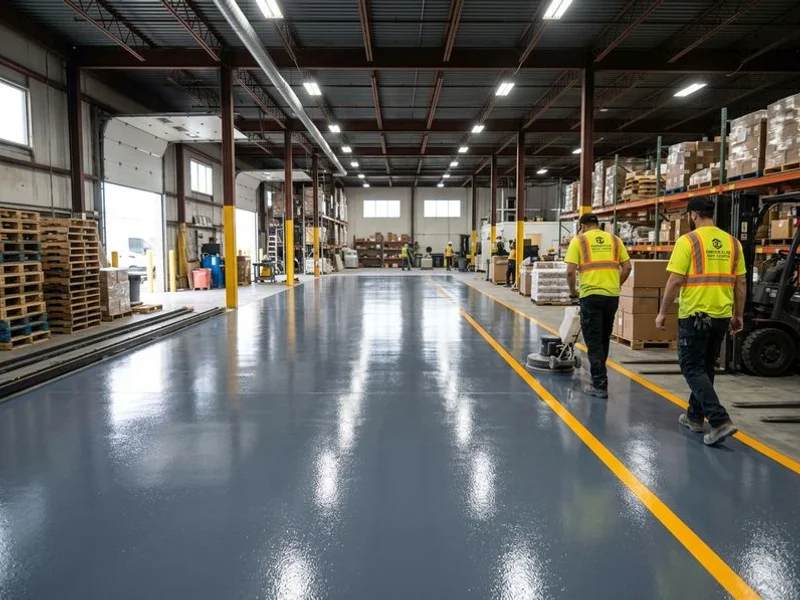
Commercial Epoxy Flooring in Mississauga, Ontario
Commercial epoxy flooring in Mississauga for retail, restaurants, offices, healthcare, labs, and institutional buildings. CFIA-compliant kitchen systems, coved medical floors, ESD flooring, and high-traffic retail epoxy. From $3 per sq ft for warehouse epoxy to $20 for pharmaceutical cleanrooms. WSIB cleared, $2M liability, compliance documentation on every project.
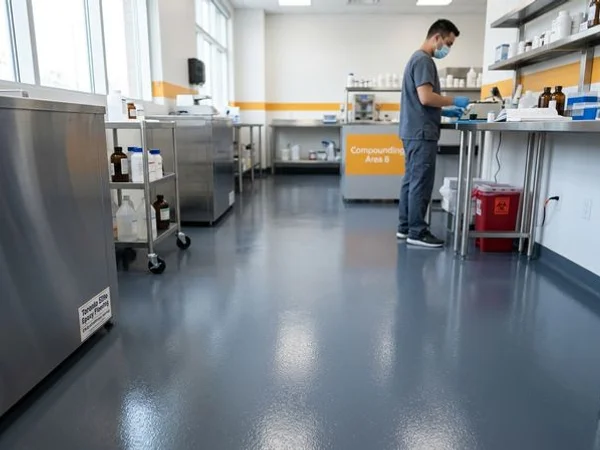
Laboratory Epoxy Flooring in Mississauga, Ontario
Laboratory epoxy flooring in Mississauga: novolac chemical-resistant systems for research labs, academic facilities, clinical labs, and industrial testing. Resists concentrated acids, bases, solvents, and lab-grade reagents. $10-$18 per sq ft installed. WSIB-cleared crews with $2M liability and full compliance documentation.
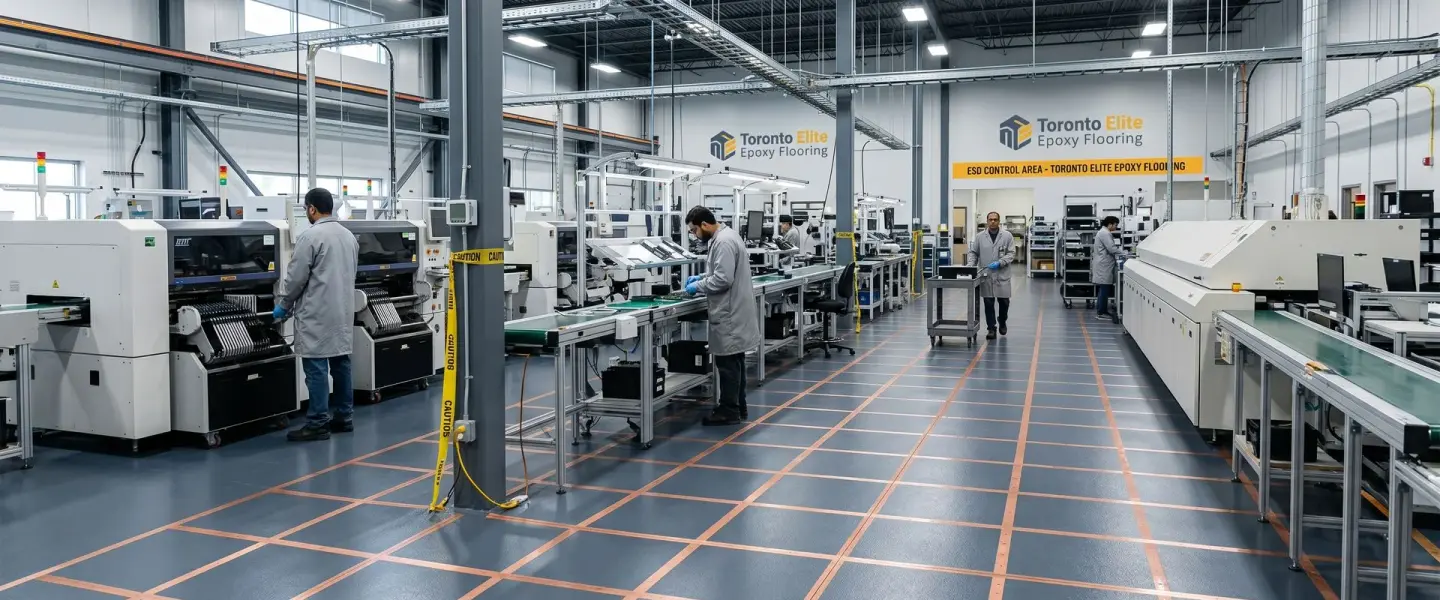
ESD Conductive Epoxy Flooring in Mississauga, ON
ESD conductive epoxy in Mississauga, built to ANSI/ESD S20.20 with a copper grounding grid and verified by megohmmeter to NFPA 99 and ESD Association STM7.1. $7-$14 per sq ft installed for standard systems, with resistance testing and a full compliance report included. Built for electronics, aerospace, data centres, and cleanrooms.
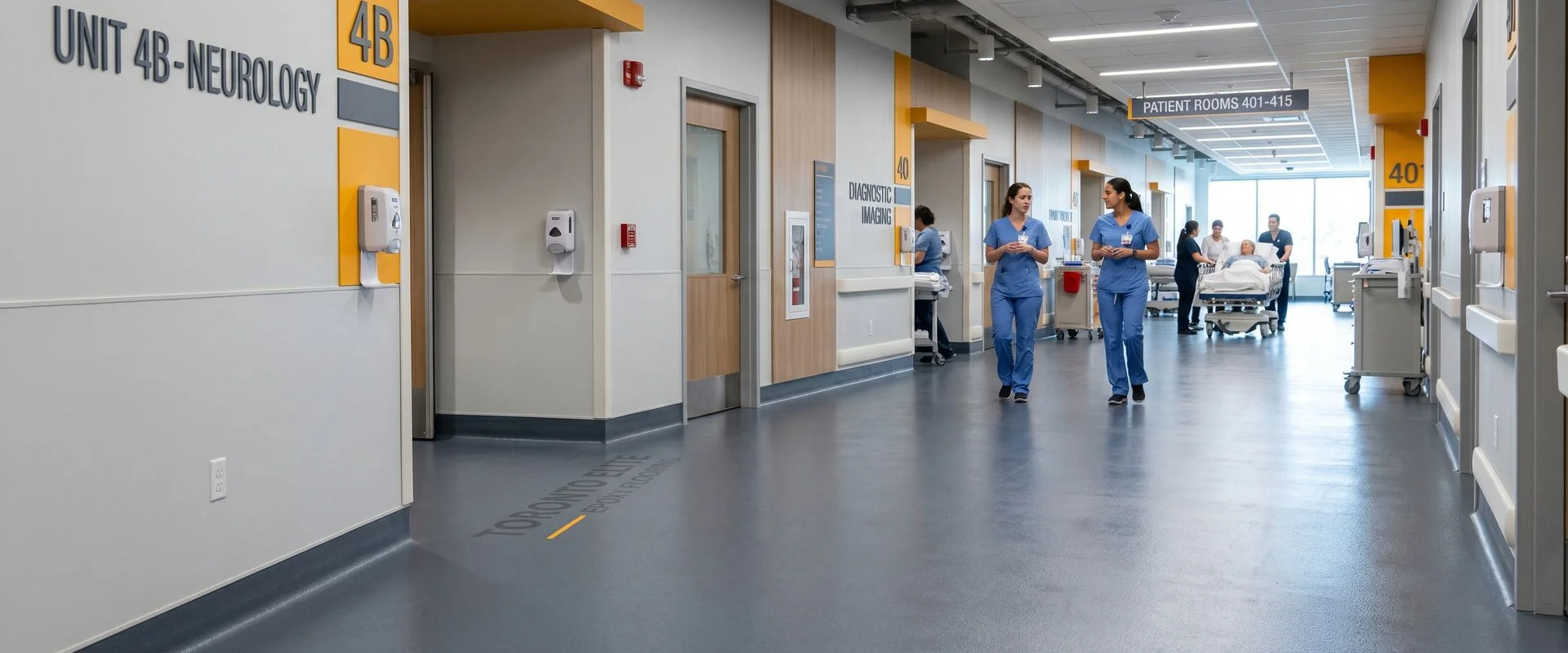
Institutional & Medical Epoxy Flooring in Mississauga, ON
Institutional and medical epoxy flooring in Mississauga: seamless antimicrobial systems with 4-6 inch coving and zero-VOC chemistry for hospitals, clinics, schools, and long-term care. $6-$12 per sq ft installed for standard systems, with section-by-section scheduling so the facility stays open. WSIB cleared, $2M liability, IPAC Canada documentation.
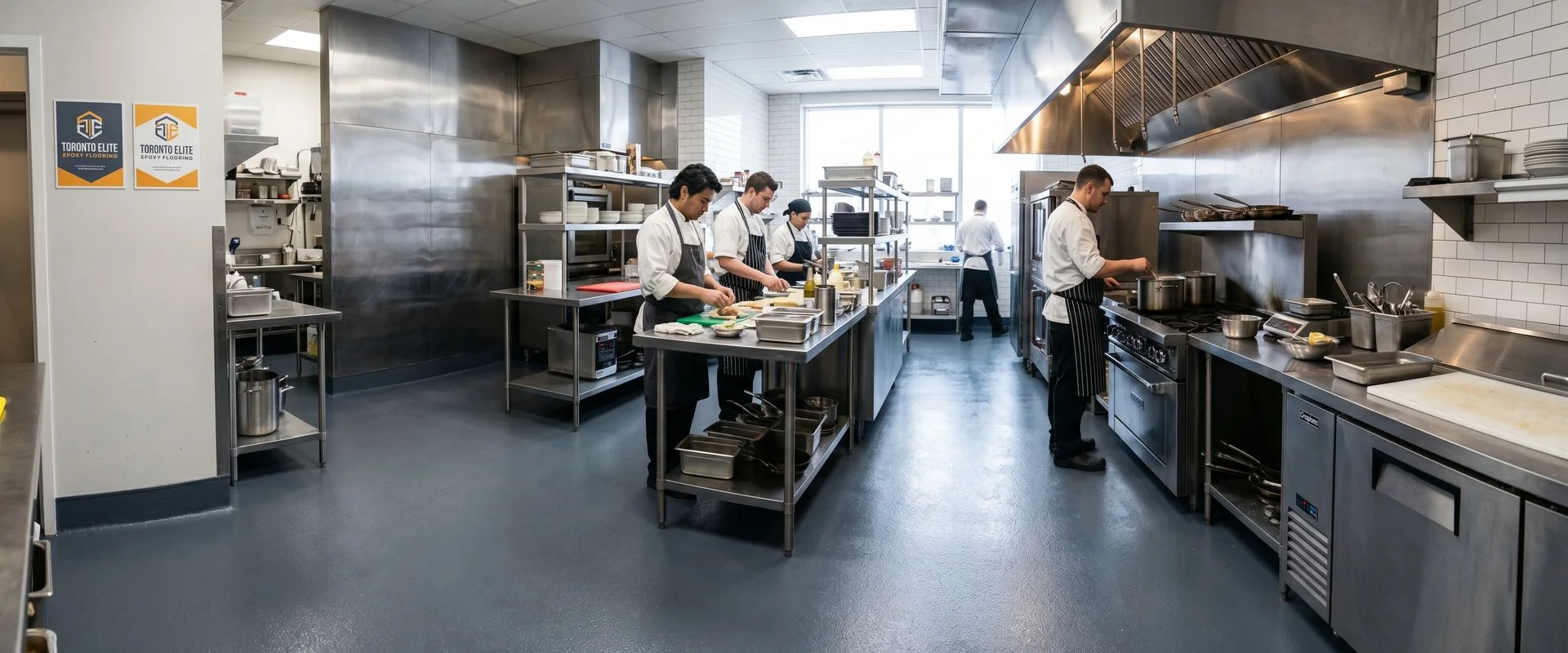
Commercial Kitchen Epoxy Flooring in Mississauga, ON
Commercial kitchen epoxy in Mississauga: seamless, CFIA-compatible floors with 4-6 inch coving, quartz anti-slip broadcast, and zero-VOC chemistry for restaurants and food service. $5-$11 per sq ft installed for standard systems. Most kitchens finish in 2 overnight shifts with no lost service, and health inspection documentation is included.
Ready to Book Pharma Cleanroom Epoxy?
Same-day free on-site assessment. WSIB-certified, $2M liability on every project.