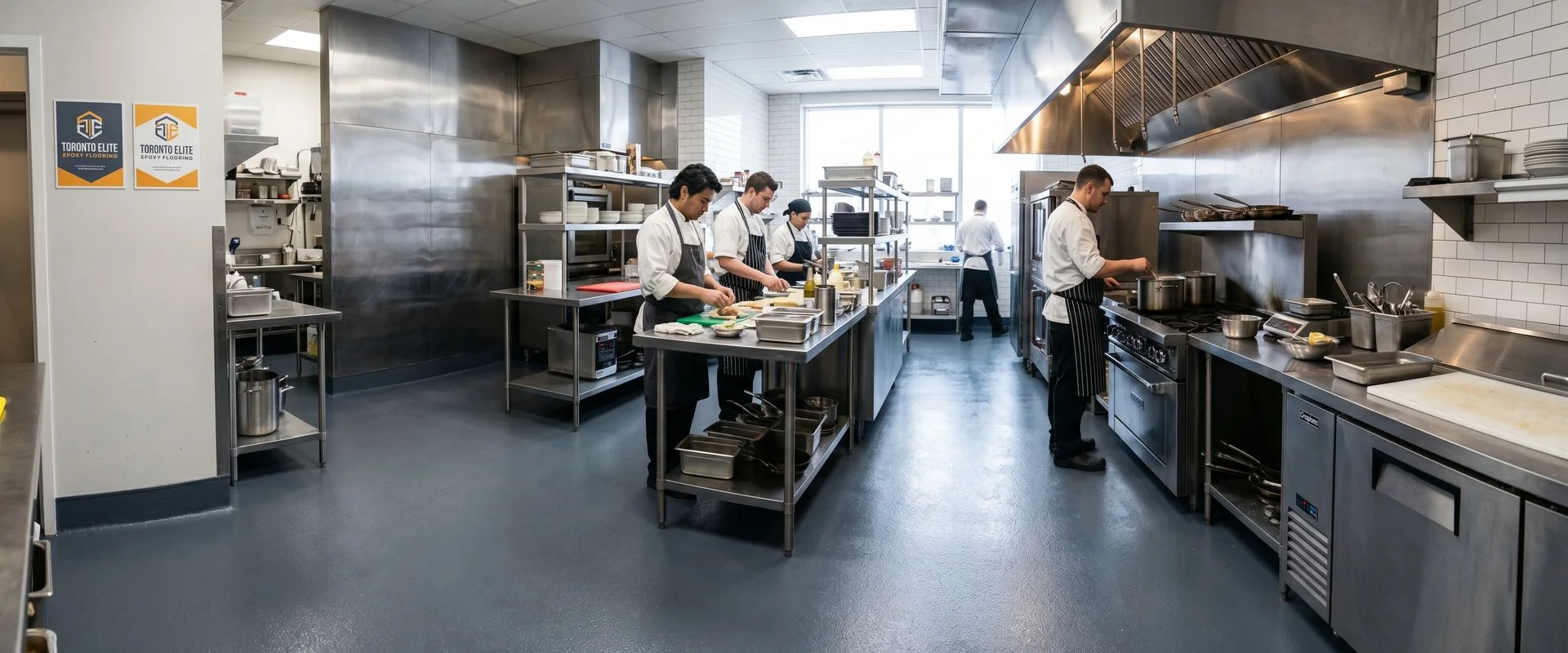
Commercial Kitchen Epoxy Flooring in Mississauga, ON - Seamless, Coved Floors That Pass Inspection
Toronto Elite Epoxy Flooring - Mississauga installs seamless quartz anti-slip systems, slope-to-drain layouts, and 4-6 inch coved bases for restaurants, institutional kitchens, commissaries, and food prep areas. Every kitchen floor uses zero-VOC chemistry suitable for occupied buildings, overnight scheduling to avoid lost service, and topcoats tested against hot water and daily degreaser cycles.
Commercial kitchens defeat ordinary flooring. Daily washdowns with 60-82°C water crack grout and lift vinyl tile adhesive within about 18 months. Quaternary ammonium sanitizers and hypochlorite degreasers turn standard urethane topcoats chalky and porous, so they soak up grease. Peel Public Health inspectors check food premises against Ontario's Food Premises Regulation, and cracked tile, open grout, and gaps where the floor meets the wall are common findings that lead to re-inspection.
Kitchen projects typically cover 200-3,000 sq ft and take 1-3 overnight shifts, depending on drains and cove height. Standard systems run $5 to $11 per sq ft, and full specifications with slope-to-drain work and heavy coving run $8-$15. We work in restaurants along Hurontario and Dundas, the historic village cores of Streetsville and Port Credit, and the food processors in Meadowvale and near the airport.
What is Commercial Kitchen Epoxy?
A commercial kitchen floor has to do four things at once: pass health inspection, stay grippy when wet, handle heat and grease, and survive daily washdowns with hot water and strong cleaners. Tile fails at the grout and sheet vinyl fails at the seams. A properly specified commercial epoxy handles all four.
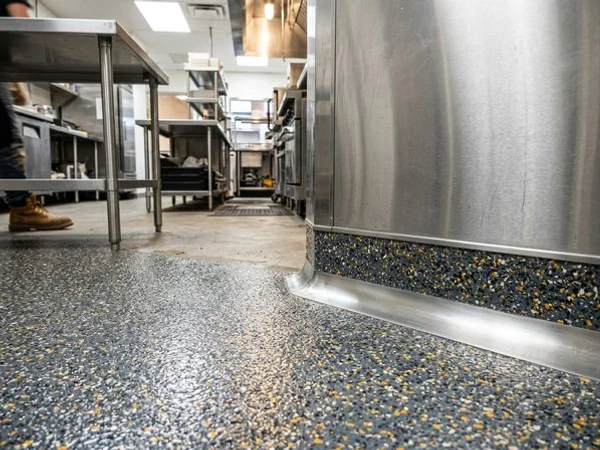
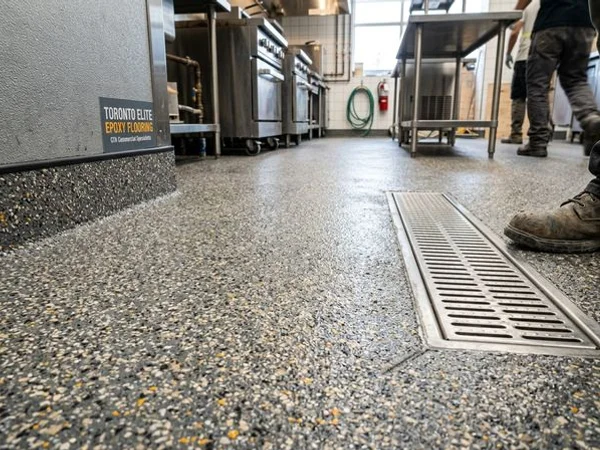
Our kitchen system runs continuous coving 4-6 inches up the wall, eliminating the floor-wall joint where bacteria normally collect. The floor is 100% solids, zero-VOC epoxy with quartz broadcast for slip resistance, sealed with a food-safe topcoat matched to your cleaning chemicals. Floor drains and trench drains are detailed into the system so water can’t get under the coating.
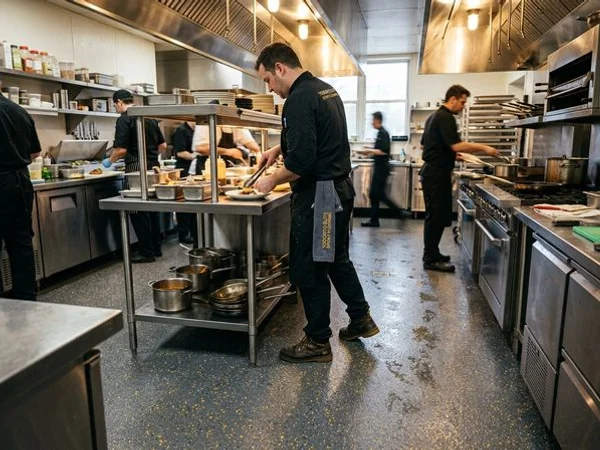
Every job is scheduled around your service hours, overnight or on weekends, so the kitchen reopens for the next shift. Fast-cure systems are available when downtime is critical. It’s the same standard we bring to every job as a full-service epoxy flooring contractor, and the kitchen system shares its coving and chemical-resistant build with our broader commercial and industrial coatings.
What’s Included
- Zero-VOC, food-safe materials throughout
- Continuous coving (4-6”) up the walls
- Shot-blast or diamond-grind surface prep
- 100% solids epoxy base coat
- Quartz broadcast for anti-slip texture
- Food-safe topcoat matched to your cleaning chemicals
- Detailed integration with floor and trench drains
- Off-hours installation around your service hours
- Inspection-ready handover documentation
Is Epoxy Flooring CFIA and Health-Code Compliant?
The Canadian Food Inspection Agency doesn’t certify specific coating products. It does require floors in food facilities to be smooth, non-absorbent, easy to clean, and free of cracks and open joints. A 100% solids epoxy over properly prepared concrete meets all of those requirements. Quarry tile grout and sheet vinyl seams don’t, because they fail the non-absorbent and easy-to-clean tests. In Mississauga, Peel Public Health inspectors apply Ontario Regulation 493/17 (Food Premises) to every restaurant, caterer, and food processor.
Restaurants that switch from grouted tile to seamless epoxy tend to clear re-inspections faster, partly because an inspector can see in one walk-through that there are no grout lines or open wall joints. Smaller operators face the same rules. A ghost kitchen in a Hurontario plaza and a catering kitchen in an industrial unit are held to the same Food Premises Regulation as a full-service dining room.
Federally registered food establishments, such as meat processors, packing plants, and cold storage, follow CFIA requirements for impervious, non-slip, easy-to-clean surfaces that drain without pooling in wet areas. With large new food and beverage manufacturing investments arriving in the city, more of our kitchen work now sits in that federally regulated category. Our system handles each point: coving removes the wall joints, the seamless topcoat is impervious, and every drain is detailed so water can’t pool at the edges. All materials are zero-VOC and food-safe once cured to the manufacturer’s schedule.
Anti-Slip and Continuous Coving for Commercial Kitchens
ASTM E2349 and the NFPA 101 Life Safety Code both address walking surfaces where wet contamination is expected, and commercial kitchens are the textbook case. The practical way to meet them is quartz broadcast. Dry 20-40 mesh quartz is broadcast into a wet base coat, the excess is swept off, and a food-safe topcoat goes over it. The result has a wet coefficient of friction above 0.6, the level commonly used in Ontario slip-and-fall assessments. It grips underfoot, but mops and squeegees still glide across it.
Continuous coving is the other must-have. Standard practice is a 6-inch cove up every wall and around every floor penetration, formed from epoxy mortar and finished with the same base and topcoat as the floor. It removes the biggest bacteria trap in a kitchen and fixes one of the most frequently cited problems in kitchens with old tile floors. Food processors that have spent years patching grout often find coving is what finally satisfies their inspector.
Installation order matters as much as material. For a mechanically bonded system carrying kitchen traffic, the surface should reach CSP 3-4 under ICRI Guideline 310.2R. We get there with shot blasting rather than acid etching, because etching leaves salts that weaken the bond over time. In industrial kitchens where forklifts come in from the loading dock, reaching the right profile is what achieves the 2,000 psi tensile bond that lets a floor last a decade instead of peeling in two years.
Epoxy vs Quarry Tile for Restaurant Kitchen Floors
Quarry tile was the default kitchen floor for decades because it’s durable, heat-resistant, and familiar to inspectors. But it has three weaknesses epoxy doesn’t. Grout cracks under heat and rolling loads, and cracked grout is nearly impossible to clean to a sanitary standard. The floor-wall joint collects grease and biofilm no matter how often you clean it. And retiling means days of closure, because tile is set in mortar, grouted, and then can’t take loads for 48-72 hours.
Epoxy avoids all three. There are no grout joints, no floor-wall joint, and no long cure before foot traffic. On cost, quarry tile for a 1,200 sq ft restaurant kitchen currently runs about $18,000-$36,000 installed, depending on tile and mortar bed work. An equivalent epoxy system, with shot-blast prep, 100% solids base, quartz broadcast, food-safe topcoat, and 6-inch coving, runs $9,600-$21,600. Epoxy also goes in over 1-3 overnight shifts, while tile needs 3-5 days of full closure.
Chemical resistance favours epoxy too. Quats, standard-dilution hypochlorite, and most food-service degreasers are fully compatible with a standard food-safe topcoat. Operations that use concentrated caustics, which is common in meat and poultry processing, should step up to a novolac or aliphatic polyurea topcoat, which handles pH levels and solvents that would etch or stain standard epoxy. The upgrade typically adds $1.50-$3.00 per sq ft and is worth it for any kitchen with an aggressive cleaning program.
Quarry tile keeps one advantage: resistance to direct, continuous steam. Hot condensate running straight onto the floor from a steam kettle drain, for example, can thermally crack a rigid epoxy over time. For those spots, a more flexible polyurea or polyaspartic topcoat handles the cycling better, and we specify it when the site survey finds that condition. A contractor who scopes your kitchen properly catches that detail before installation, not after.
Commercial Kitchen Epoxy Cost and Project Timelines
Kitchen quotes vary with floor area, slab condition, and how much downtime you can absorb. A ghost kitchen or small restaurant of 300-600 sq ft with a sound slab, minimal crack repair, and a single overnight window typically runs $4,500-$8,000 including coving. That covers diamond grinding to CSP 3, the broadcast base coat, quartz anti-slip aggregate, and a food-safe topcoat rated for constant wet cleaning. Larger institutional cafeterias in schools and hospitals, often 2,000-5,000 sq ft, are priced per square foot after an assessment and typically run $5-$9 depending on slab condition and drain and equipment work.
Downtime is what most kitchens want to minimize, and it’s the main reason we use fast-cure polyurea and polyaspartic systems. A standard 100% solids base coat needs 8-12 hours before topcoat at 20°C, which works over a weekend closure but is tight for one night. Polyaspartic reaches foot traffic in 4-6 hours, so a well-staged overnight install can have the floor walkable by 5 a.m. and fully back in use for the morning. We confirm the cure schedule with your kitchen manager before quoting, so the spec matches your real timeline.
Related Questions Restaurant Owners Ask
How much does commercial kitchen epoxy cost per square foot?
Most commercial kitchen systems run $8-$18 per sq ft installed, and the range depends mostly on coving footage and drain count rather than floor area. A simple rectangular kitchen with two floor drains lands at the low end. A kitchen with lots of equipment alcoves, several trench drains, and major concrete repair moves toward the top.
How many nights does a commercial kitchen epoxy install actually take?
A straightforward kitchen under 1,000 sq ft usually takes 2 overnight shifts: one for shot-blast prep and any concrete repair, and one for coving, base coat, broadcast, and topcoat. Kitchens of 1,000-2,500 sq ft usually need 3 nights. We set the schedule at the site survey around your service hours, so you don’t lose revenue days.
What happens if the epoxy fails or starts to peel?
Delamination on a properly prepared and installed system is rare. When it happens, it almost always comes from poor prep (below CSP 3), undisclosed slab moisture above 3 lbs per 1,000 sq ft per 24 hours, or chemicals beyond what the topcoat is rated for. We check all three at the site survey, and our 5-year warranty covers adhesion failure and delamination under normal commercial use.
Can commercial kitchen epoxy be installed in a commissary or shared kitchen in Mississauga?
Yes. Commissaries and shared kitchens fall under the same Food Premises Regulation as a dedicated restaurant, and the same coving and anti-slip quartz spec applies. Shared kitchens often have more complicated drain layouts and heavier rolling traffic, so we usually specify a thicker base coat of 60-80 mils instead of the 40-60 mils used in lighter kitchens.
Does a new commercial kitchen epoxy floor require any special maintenance to stay compliant?
The floor doesn’t need resealing or recoating under normal use. Routine care is mopping with a pH-neutral or mildly alkaline food-service cleaner, which most kitchens already use. The one thing that matters for long-term compliance is repairing mechanical damage quickly, such as a deep gouge from dropped equipment. A breached topcoat can harbour bacteria just like grout. Toronto Elite Epoxy Flooring - Mississauga can repair damaged areas quickly, usually overnight.
Our Kitchen Epoxy Results in Toronto
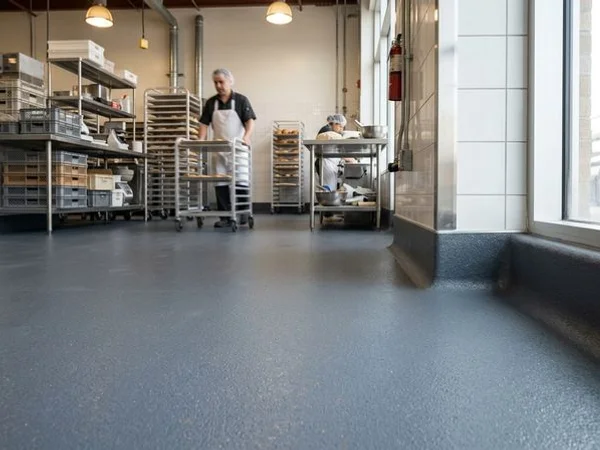
Kitchen Epoxy Pricing
Pricing depends on coving lineal footage, drain detailing, and chemistry.
Why GTA Customers Choose Toronto Elite Epoxy Flooring - Mississauga for Kitchen Epoxy
CFIA Compliant
Continuous coving, antimicrobial options, and zero-VOC materials matched to health-code standards.
Anti-Slip Standard
Quartz broadcast under the topcoat gives grip in wet areas without making the floor hard to clean.
Off-Hours Installs
Our crew works overnight or on weekends so your kitchen never loses a service day.
Drain Integration
Continuous detailing into floor drains and trench drains, with no failed perimeters.
How Kitchen Epoxy Works
Site Survey
We scope coving footage, drain locations, and chemistry of cleaners and food contact.
Off-Hours Shot-Blast Prep
Overnight prep so the kitchen reopens for service.
Cove + Base + Anti-Slip
Continuous coving 4-6 inches up the wall, 100% solid base, quartz-broadcast anti-slip.
Cure + Reopen
Fast-cure systems return your kitchen to service in 24 hours or less.
Ready for a Free On-Site Assessment?
Same-day quotes across the GTA. WSIB-certified, $2M liability on every project.
What Customers Say About Our Kitchen Epoxy
"We replaced our tile kitchen floor near Square One with coved epoxy. Cleaning time dropped, we passed inspection the first time, and we reopened the next morning."
"They did our catering prep kitchen in Meadowvale overnight. Shot-blast, 100% solids base, quartz topcoat. All the WSIB paperwork was in order and the floor passed inspection without a single note."
"Coated our Streetsville bakery over a weekend. Anti-slip, easy to mop, and done before we reopened Monday."
Kitchen Epoxy FAQs
How much does commercial kitchen epoxy cost in Mississauga?
Most commercial kitchen systems run $8-$18 per sq ft installed, driven mainly by coving footage and drain count. A 300-600 sq ft restaurant or ghost kitchen with a sound slab usually lands around $4,500-$8,000 including coving. Larger institutional kitchens are priced per square foot after a site visit and confirmed in a fixed-price contract.
Will the floor satisfy a Peel Public Health inspection?
Yes, when it's installed properly. Inspectors look for floors that are smooth, non-absorbent, easy to clean, and free of cracks and open joints. A seamless epoxy system with integral coving meets all of that, and we provide product and installation documentation you can show the inspector.
Our Streetsville restaurant is in an old building with an uneven slab. Can it still get epoxy?
Yes. Older village buildings often have irregular, aged slabs. We grind high spots, fill low areas with self-levelling or epoxy mortar, and build in slope to the drains where needed before the coating goes on. It may add a night to the schedule, which we'll plan around your closing days.
Can you install without closing the restaurant?
Yes. Most kitchens up to 1,500 sq ft are done in 1-3 overnight shifts, and fast-cure polyaspartic topcoats can have the floor walkable by early morning. We confirm the cure schedule with your kitchen manager before quoting.
What cleaning chemicals are safe on the floor?
Quaternary ammonium sanitizers, diluted bleach, and most food-service degreasers are fine with our standard topcoat. If you use concentrated caustics above pH 12 or undiluted solvent degreasers, we specify a novolac or aliphatic polyurea topcoat for extra resistance.
Epoxy flooring, metallic coatings & polyaspartic
across the Greater Toronto Area
Same crew, same materials, same written warranty on every job. Browse by service and city — or call us direct.
Don't see your city? View our full service area →
Related Services
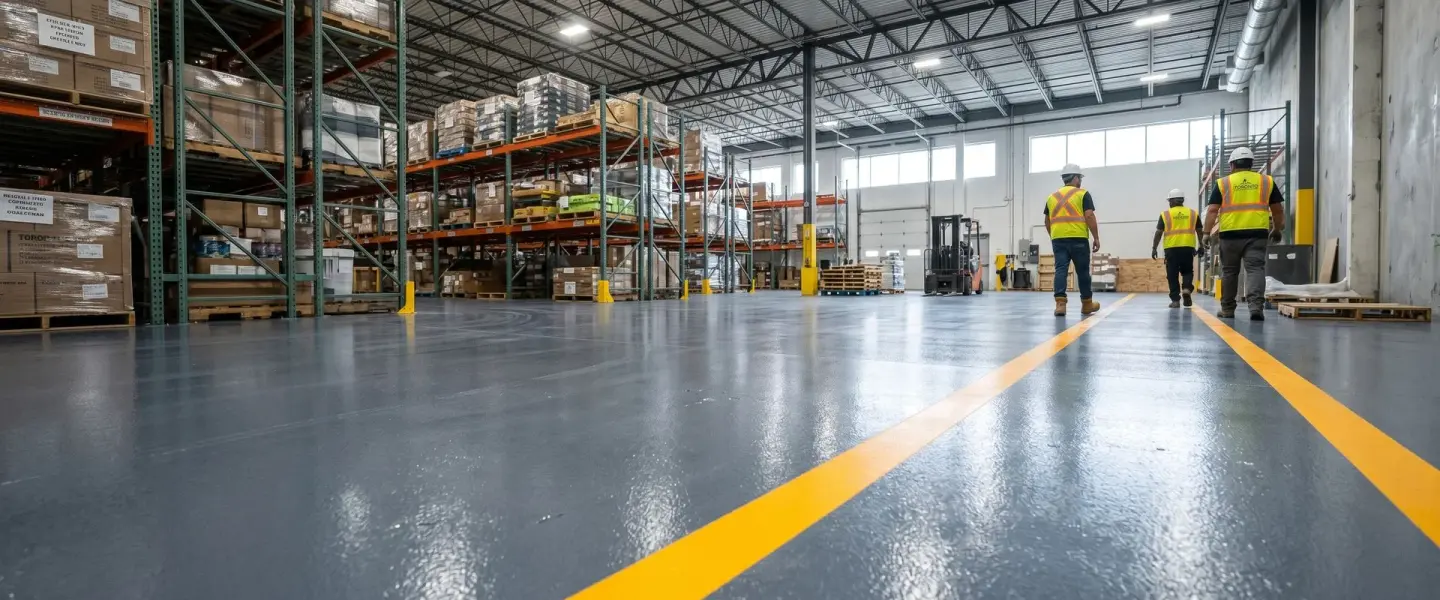
Commercial & Industrial Epoxy Flooring in Mississauga, ON
Commercial and industrial epoxy in Mississauga using 100% solids systems over shot-blasted CSP 3-4 concrete, for facilities running forklifts, food production, or 24-hour operations. $3.50-$8 per sq ft installed for standard systems, with off-hours scheduling that returns the floor before the next shift. WSIB cleared, $2M liability, full compliance documentation.
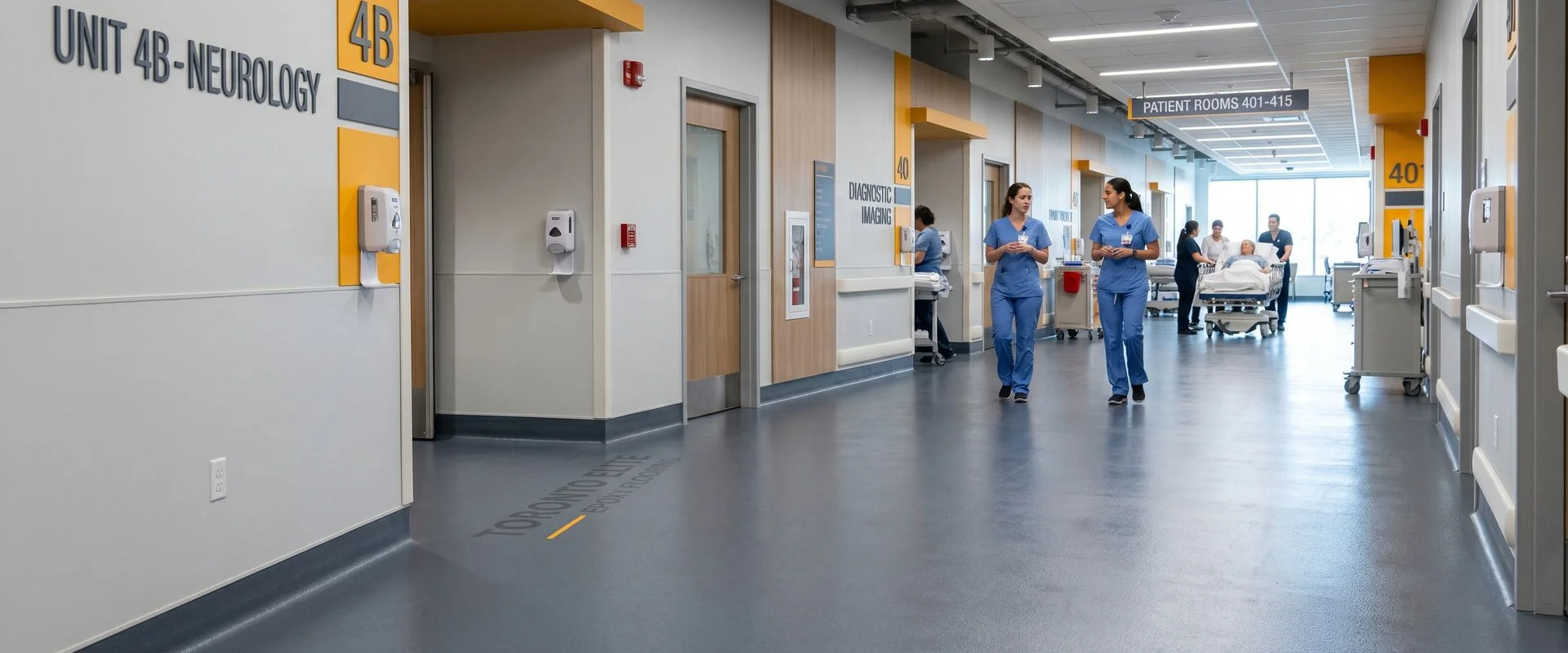
Institutional & Medical Epoxy Flooring in Mississauga, ON
Institutional and medical epoxy flooring in Mississauga: seamless antimicrobial systems with 4-6 inch coving and zero-VOC chemistry for hospitals, clinics, schools, and long-term care. $6-$12 per sq ft installed for standard systems, with section-by-section scheduling so the facility stays open. WSIB cleared, $2M liability, IPAC Canada documentation.

Retail Showroom Epoxy Flooring in Mississauga, ON
Retail showroom epoxy in Mississauga: high-gloss floors with custom RAL colour matching, optional logo inlays, and an aliphatic polyaspartic topcoat that resists scuffing and UV yellowing under heavy foot traffic. $4-$9 per sq ft installed for standard systems, with most showrooms done in 2-3 overnight shifts and no lost business days.
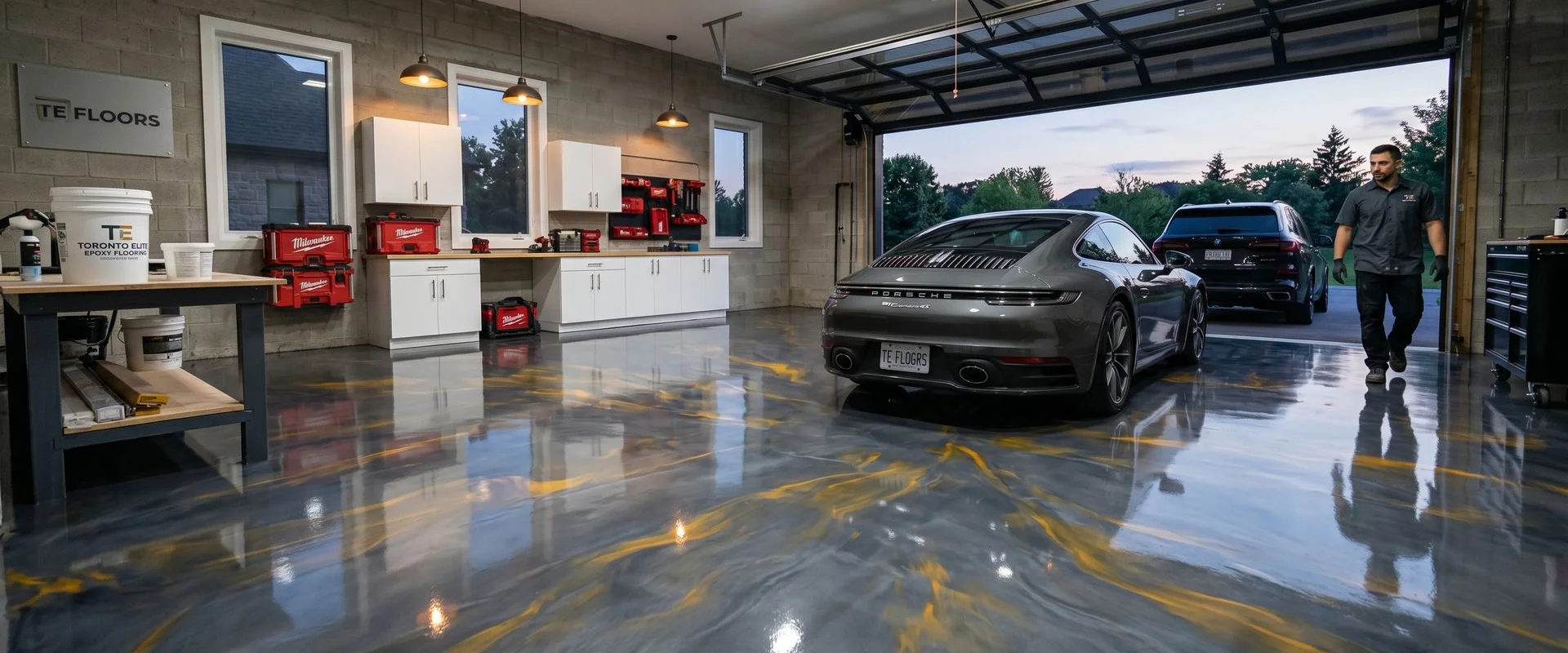
Ready to Book Kitchen Epoxy?
Same-day free on-site assessment. WSIB-certified, $2M liability on every project.